Quick Take
- Narration: Gerhard Weigelt reads with a calm, measured delivery appropriate to contemplative self-help material, though the performance is functional rather than memorable.
- Themes: Japanese philosophy of purpose, the gap between cultural prescription and authentic meaning, breaking the cycle of comparison
- Mood: Deliberate and structured, aiming for meditative but occasionally clinical
- Verdict: A comprehensive introduction to ikigai philosophy with practical therapeutic grounding, best suited to listeners approaching the concept for the first time.
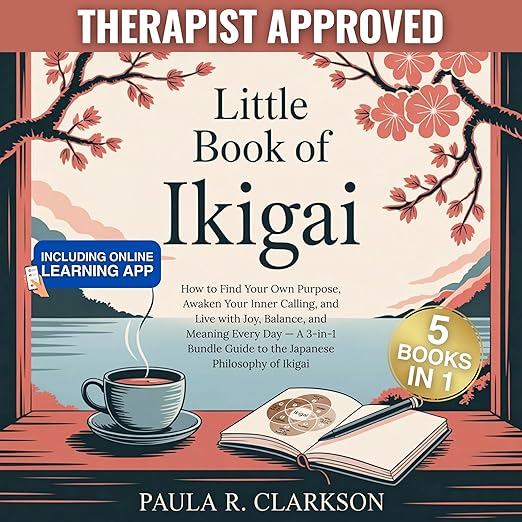
Ikigai, the Japanese concept of a reason to rise each morning, a convergence of what you love, what you are good at, what the world needs, and what you can be paid for, has become one of the more traveled ideas in the popular philosophy and wellness space over the past decade. This creates a specific challenge for any new book on the subject: the concept is familiar enough that a treatment needs to bring something beyond the basic framework to justify its existence. Paula R. Clarkson’s Little Book of Ikigai, structured as a five-part bundle guide and described as therapist-approved, approaches this challenge with more methodological seriousness than the self-help genre typically offers, which makes it worth examining on its own terms.
The book’s central argument is that understanding ikigai intellectually is not the same as living it, and that the gap between conceptual knowledge and embodied practice requires active work, not just inspiration. The five-part structure is designed to address that gap systematically, moving from foundations through obstacle-clearing, habit formation, and the challenge of sustaining meaning across life’s changes. This is a more clinical framework than most ikigai books offer, which will suit some listeners better than others.
Our Take on Little Book of Ikigai
The strongest aspect of this book is the acknowledgment that the obstacle to purpose is rarely a lack of information. Most people who feel that unexplainable emptiness the synopsis describes are not missing the concept; they are missing the tools to dismantle what is in the way. The book’s chapters on overcoming comparison, dismantling limiting beliefs, and the cognitive reframing techniques borrowed from therapeutic practice address this more directly than a purely philosophy-focused treatment would. The psychotherapist endorsement from Annaliese Arthur of the IAOTH adds a grounding that differentiates this from more loosely assembled wellness content.
The workbook elements, including journaling prompts and case studies of real people who found their ikigai within everyday constraints, are designed to make the audio experience active rather than passive. The companion PDF available in the Audible Library extends this dimension further, and for listeners who engage with that material, the audiobook functions as a guided course rather than a passive listen. This is a meaningful design choice that acknowledges how self-help material actually produces change, through application, not just exposure.
Why Listen to Little Book of Ikigai
Gerhard Weigelt’s narration is calm and measured, which suits the material’s contemplative intent. He does not inject theatrical energy into sections that call for reflection, which is the right instinct for this kind of content. The four-hour running time is appropriate for the subject: long enough to be substantive, short enough to be revisitable. Many listeners use audiobooks like this one in segments rather than from beginning to end, and the chapter structure supports that approach.
At just under four hours, this is also a more manageable investment for listeners who are genuinely uncertain whether an ikigai framework resonates with them. The shorter length means that even skeptical listeners can sample the approach without committing to a fifteen-hour philosophical treatise. The five-section structure means that any given part can be listened to independently if a particular obstacle or life stage is more pressing than others.
What to Watch For in Little Book of Ikigai
The book has a very small number of reviews at the time of this writing, which limits the external evidence of how it lands for different readers. The five-star average reflects genuine enthusiasm from those who have engaged with it, but the sample size means that the picture is incomplete. Listeners with prior exposure to ikigai literature may find the foundational sections familiar, though the therapeutic integration differentiates it from purely philosophy-based treatments.
The bundle framing, five comprehensive parts plus twenty expert takes plus bonus quizlet materials, reflects a content-marketing sensibility that can feel at odds with the philosophical simplicity ikigai itself recommends. This tension between the concept’s Japanese origins, which emphasize organic discovery over structured optimization, and the book’s deliberate methodology is worth noting. The book is self-aware about this to some degree, but the packaging leans harder into the productivity-culture idiom than the subject strictly requires.
Who Should Listen to Little Book of Ikigai
This is well-suited for listeners who are genuinely new to the ikigai concept and want a structured, therapeutically grounded introduction rather than a purely inspirational overview. The workbook elements and companion PDF make it particularly useful for listeners who learn through active engagement rather than passive listening. Skip it if you have already done significant reading or listening in this space and are looking for novel philosophical territory; the framework is well-executed but not groundbreaking. Come to it if you want something that takes the concept seriously enough to tell you how, not just what.
Frequently Asked Questions
Is the Little Book of Ikigai suitable for someone with no prior knowledge of Japanese philosophy?
Yes. The book is designed as an introduction and builds from the foundational concept outward. Easwaran’s framing for the Western reader analogy applies here: Clarkson has structured this for readers approaching ikigai fresh, with context provided before application is demanded.
How does the companion PDF enhance the audiobook experience?
The PDF includes the workbook elements referenced in the audio, including journaling prompts and self-assessment tools that are difficult to replicate in audio format alone. For listeners who want the full guided-course experience rather than a passive listen, accessing the PDF alongside the audiobook is recommended.
What makes this ikigai book different from others on the same topic?
The primary differentiator is the therapeutic grounding, with techniques borrowed from cognitive reframing, identity reconstruction, and burnout prevention, and the psychotherapist endorsement. Most ikigai books stay at the philosophical and inspirational level; this one engages more directly with the psychological obstacles that prevent people from living the concept.
Does Gerhard Weigelt’s narration work for reflective, contemplative content?
Yes. His measured, calm delivery suits the introspective nature of the material. Listeners looking for energetic motivational delivery will find his approach understated, but for content designed to prompt reflection rather than action, his pacing is appropriate.