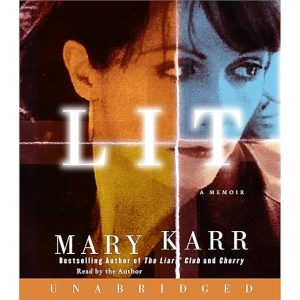
The summary for this audiobook opens with twelve publication names run together without a comma between any two of them, beginning at the New York Times Book Review and finishing at the Seattle Times, then adding the phrase NBCC Award Finalist as though it were another magazine. It reads like a spreadsheet column pasted into a sentence, and that is more or less what happened. Twelve hours and twenty-nine minutes of Mary Karr reading Mary Karr sit underneath that wall of names, waiting to be noticed.
Karr Occupies Both Credit Lines at Once
Karr occupies both credit lines on this record, author and narrator alike, and for a memoir specifically about learning to write, that matters more than it usually would. No performer was hired to stand between the sentence and the person who survived it. Whatever irony, hesitation or flatness lands on a given line was chosen by the woman who put the line there, about as close as an audio edition gets to primary source material. Harper dated the release January 26, 2010, with no note anywhere indicating the text was cut for the recording.
A Doubled Quotation Mark Nobody Cleaned Up
A number here does not work. The star average reads 4.4 while the vote counter beside it reads a single vote, and one whole-star grade cannot average to four point four under any rounding rule anybody uses. Five signed responses are visible below the badge, four more than the counter is willing to admit. Whatever population produced that decimal, the page is not showing it to you.
Four separate endorsements are stacked into the publicity paragraph, and the seams show. Michiko Kakutani is quoted saying the book "lassos you, hogties your emotions" and will not let you go. The Boston Globe supplies the line about personal stories that "transmute into the highest art." The New York Times Book Review calls it "a master class on the art of the memoir," and Susan Cheever closes with a verdict about being a woman in America. Two of those quotations end with a doubled quotation mark, the fingerprint of a paste that nobody cleaned up.
A Tim Hawkins Joke That Never Lands
One sentence in the summary does more work than the twelve outlet names combined, and it belongs to the publisher rather than a critic: the book is about "getting drunk and getting sober; becoming a mother by letting go of a mother; learning to write by learning to live." Three clauses, three reversals, each one built on the same trick of losing a thing in order to acquire it. That structure is the reason twelve and a half hours does not feel arbitrary.
Both of the responses that argue instead of cheering land on the same quality, and it is not the prose. EJ, filing four stars, points at "the deep introspection and honesty toward herself" and adds that it "can't have been easy to plumb the depths of her own past failings, put them to paper, and let them out for the entire world to see." Dr Naughton, in a single sentence from the United Kingdom, describes a book "honest in a way that lets you see yourself in the harsh light of someone else's failings and find forgiveness."
Nobody in this column struggles harder to be fair than the reviewer signing as bookscdsdvdsandcoolstuff, whose write-up begins "I don't know if I can review this book fairly" and then produces the most useful warning available: loved it and was disappointed by it, found it frustratingly difficult to read and riveting, one of those books "that exhausts you even as it fills you with energy." The write-up then starts a Tim Hawkins joke about a church pew and gets cut off before the punchline, an accident with its own accuracy.
The Only Response That Mentions a Discography
This is the third volume, and the series data says so in a slightly confusing way: the sequence is filed under the name of its own first book, with this title sitting at number three. The publisher paragraph names the two that come before it. EJ arrived having read both and measures this one against them. Carolyn arrived with nothing but a shared Texas childhood and reports the same result. No sentence here states a requirement either way.
BAZZA, writing from Germany, compresses all three memoirs into one sentence about growing up in East Texas "as a gawky kid, experiencing life's medicine cabinet as a teen surfer girl and getting married into the academic circle of maturity and success as a writer later in life," and reaches the book by way of Karr's lyrics for the KIN album with Rodney Crowell. It is the only response here that treats her as a writer with a discography, and the one that best predicts what the voice on the recording will sound like.
Small textual damage is everywhere once you start looking. Carolyn writes that Karr has taken it "to a whole `nuther level here," complete with a stray backtick. EJ compares it to "the two prior two books." The run of outlet names includes a Post-Dispatch attached to a city spelled Louise. None of it changes the recording, but all of it tells you how much attention this particular listing has received in the years since. That paragraph is doing publicity work from a decade and a half ago and has never been asked to do anything else.
In the End, Karr Does the Rest
Listeners who already know what a first-person addiction memoir asks of them will get the most out of the format here, because the format is the argument. A twelve-hour recording of someone narrating her own drinking, her own motherhood and her own conversion is a different object from the same words on paper, and the reviews keep circling the word honesty for a reason.
Readers looking for a comfortable weekend should look at those three clauses again and take them literally. This is a book that one enthusiastic five-star reviewer describes as exhausting, and it arrives without chapter-level relief. Anyone who needs a narrator to soften hard material will find the self-narration working against them, because no performer stands between the listener and the events, and none was ever meant to.
The badge above all of this is broken, the marketing paragraph is a paste-up, and the useful information is entirely in the review bodies and in that one publisher sentence about losing a mother in order to become one. What survives all of it is the arrangement: twelve hours and twenty-nine minutes, one voice, and no interpreter standing between the two. Karr does the rest.
Before You Listen
Can this audiobook be followed without the two earlier memoirs?
The series data places it third and the publisher paragraph names the two that precede it. One reviewer read both first and measures this volume against them. Another came to it cold and reports the same effect. No statement anywhere here says a prior volume is required, and both routes are represented underneath.
Does Mary Karr narrate the recording herself?
Yes. The same name fills the author field and the narrator field, which for a memoir about learning to write changes the object substantially. No actor was engaged, so the pacing, the dryness and the hesitations belong to the person the events happened to. Twelve hours and twenty-nine minutes in that single voice.
Why does the star average sit at 4.4 with a single vote recorded?
It cannot, arithmetically. A lone whole-star grade rounds to a whole number, never to four point four, so the counter and the badge contradict each other outright. Five written responses appear underneath, four more than the counter acknowledges. Read the individual grades and the bodies, and treat the headline average as decoration.
How demanding is this audiobook to sit with for twelve and a half hours?
Demanding, on the evidence of the people who liked it most. One five-star response calls it frustratingly difficult and riveting at once, and describes a book that exhausts you while filling you with energy. The subject matter covers alcoholism, a difficult mother and a conversion, with no comic relief engineered in.