Quick Take
- Narration: Precise and unhurried, with a measured authority appropriate to legal analysis delivered for a general audience.
- Themes: Constitutional interpretation, judicial philosophy, the politics of the Supreme Court
- Mood: Dense but accessible, the kind of listening that rewards attention without punishing non-specialists
- Verdict: A rigorous introduction to how the Supreme Court actually works, essential for anyone trying to make sense of contemporary judicial decisions.
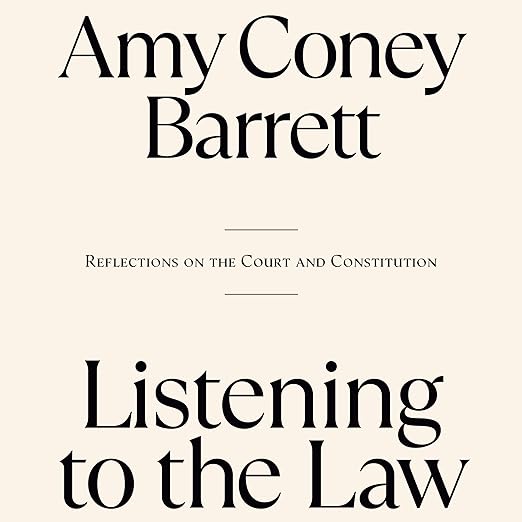
I picked up Listening to the Law while working through a stretch of reading about American constitutional history, specifically looking for something that could connect the abstract principles of judicial interpretation to the actual decisions coming out of the Court in a way that popular legal commentary rarely manages. What I found was considerably more sophisticated than I expected going in: a book that takes the fundamental question of how we should read legal texts seriously without pretending that the question has an obvious answer that only bad-faith actors would resist, and a narration that makes real complexity genuinely accessible without flattening it into comfortable simplification.
The book takes its title seriously in a way worth unpacking before beginning. It is about listening to law in the sense of attending carefully and without prior conclusion to what legal language actually says, what it has meant to different interpreters across historical contexts, and how the gap between original meaning and contemporary application gets negotiated by jurists who bring different interpretive commitments, different intellectual backgrounds, and different understandings of the judge’s institutional role to the same text. The Supreme Court is the central focus throughout, but the analysis extends consistently to the interpretive philosophies that shape how any legal text gets read, from the strongest versions of originalism through various forms of living constitutionalism to the more pragmatic positions that occupy the contested middle ground between those poles.
Originalism, Living Constitutionalism, and the Space Between
The debate between originalist and living constitutionalist approaches to constitutional interpretation is routinely presented in public discourse as a binary choice between two clearly defined camps that track neatly onto political alignments. This book is considerably more honest about the complexity of that debate, tracing how both major positions have evolved over time and how the most sophisticated current versions of each approach are far more responsive to the other’s criticisms than their simplified public characterizations suggest. Originalism, to take the more prominent example, is not a single coherent doctrine but a family of related positions with significant internal disagreements about what counts as the relevant original meaning, whether that meaning should be sought in the text itself or in the understood intentions of the drafters or ratifiers, and whose understanding of that meaning should govern contemporary interpretation.
The audiobook’s treatment of these debates is careful throughout to give each major position its strongest possible formulation before examining its weaknesses and limitations. That intellectual charity is essential for a book that aims to illuminate how serious jurists actually think rather than to advocate for a particular outcome, and the narration reflects this balanced approach in its measured and consistently even tone. The book does not pretend to resolve questions that professional legal scholars and sitting justices have been actively debating for decades. What it does instead is equip listeners with the conceptual vocabulary and the institutional context needed to follow those debates intelligently rather than simply accepting the characterizations offered by partisans on either side of the current political divide.
The Supreme Court’s Internal Logic
The sections dealing with how the Supreme Court actually operates as an institution, covering the conference processes, the role of law clerks in drafting opinions, the strategic dimensions of opinion assignment and coalition maintenance, and the complex relationship between majority opinions and the concurrences and dissents that accompany them, are among the most practically useful in the entire book. Understanding why a dissent sometimes matters more in the long run than the majority opinion it responds to, or why a concurrence that agrees with the outcome but for different reasons can shift the practical meaning of a holding for lower courts trying to apply it, requires institutional context that is simply not visible from reading the opinions themselves in isolation.
The narration handles the technical legal vocabulary with appropriate precision throughout, introducing specialized terms like standing, ripeness, certiorari, and the various tiers of constitutional scrutiny when they first appear and explaining them in context, then using them consistently thereafter in ways that allow listeners to accumulate the vocabulary they need to follow the developing analysis. This is the right pedagogical approach for an audiobook dealing with specialist material aimed at a general audience, and it prevents the text from either condescending to listeners with legal backgrounds or losing those without any background in a thicket of unexplained jargon.
What This Audiobook Prepares You For
The most valuable outcome of listening to this book is not a fixed set of conclusions about whether specific decisions were correctly decided but a more sophisticated framework for evaluating the legal arguments made in support of and in opposition to those decisions. After spending time with this material, the standard media coverage of major Supreme Court decisions feels noticeably thinner, not because the book provides better partisan answers but because it equips listeners with better analytical questions. Whether a given decision is correctly decided is often less important than understanding what interpretive choices the majority made, what alternatives were available and seriously argued, and what the decision implies about the Court’s institutional self-understanding. The book trains listeners to ask those questions systematically rather than simply reacting to outcomes, and the audio format makes that training genuinely engaging rather than merely dutiful. The habit of asking better questions rather than seeking partisan confirmation is, in the current environment, one of the most practical gifts that serious reading can provide, and this audiobook provides it with evident intelligence and care.
Frequently Asked Questions
Do I need a legal background to follow Listening to the Law?
No. The book is written for general readers and introduces legal concepts as they become relevant rather than assuming prior familiarity. Listeners with legal training will find familiar ground, but the analytical framework may still offer new perspectives on questions they have considered professionally.
Does the book take a political position on current Supreme Court controversies?
The book aims to be analytically balanced rather than politically partisan, presenting competing interpretive positions with genuine engagement. It gives readers tools for forming their own assessments rather than steering them toward predetermined conclusions.
How does the audiobook handle legal citations and case names?
Case names are handled naturally as part of the narrative and explained in context when introduced. The audiobook does not read footnotes or citation strings, keeping the listening experience fluid. Listeners who want to pursue specific cases can use the print edition.
Is this more useful as an introduction to constitutional law or as a guide to the contemporary Supreme Court?
Both. The book uses constitutional interpretation as its primary lens but grounds the theoretical discussion in the contemporary Court’s actual practices and decisions. It works as both an introduction to interpretive theory and a framework for understanding specific contemporary controversies.