Quick Take
- Narration: Greene is an exceptional science communicator and his self-narration is engaged and lucid, drawing on decades of public lectures and television.
- Themes: cosmological origins, the human story behind science, limits of current knowledge
- Mood: Intellectually warm, with an honest reckoning with what remains unknown
- Verdict: A beautifully constructed short audiobook that tells the human side of the Big Bang theory with Greene’s characteristic clarity and respect for the listener’s intelligence.
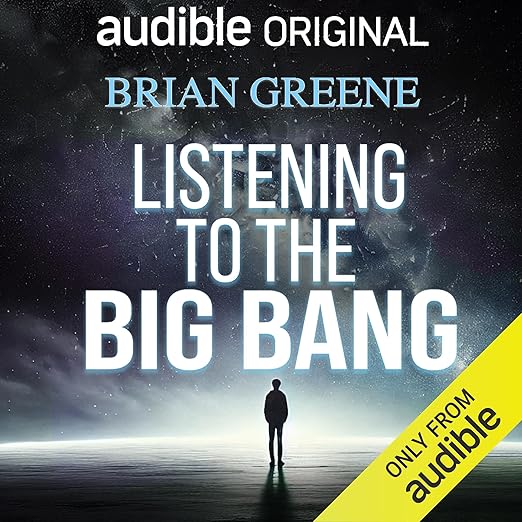
I have a particular fondness for short science audiobooks that do not waste their brevity on simplification. Two hours and forty-four minutes is not long enough to teach cosmology. It is long enough to tell a story about the people who built cosmology, and that is precisely what Brian Greene chooses to do with Listening to the Big Bang. This Audible Original feels like a companion piece to his longer works, The Fabric of the Cosmos and The Elegant Universe, but it finds a different gear: more narrative, more human-centered, and more willing to sit with the questions that remain open.
The cast of characters Greene assembles is the book’s first pleasure. A Russian dissident, a Jesuit priest, and an American mule skinner are not the figures you typically encounter in a physics history, but they are among the bold visionaries who contributed to the scientific story of how the universe began. Greene’s gift, consistent across his career, is for finding the human drama inside what looks from the outside like pure abstraction. The movement from ancient mythology to falsifiable mathematical models is not an impersonal progression of ideas. It is a story of individuals making leaps in contexts that made those leaps improbable or dangerous.
Our Take on Listening to the Big Bang
Greene narrating his own work is one of the better author-as-narrator experiences in popular science. He has spent decades explaining difficult ideas on public radio, television, and in lecture halls, and his prose carries that accumulated practice. The delivery is conversational without being loose, precise without being arid. One reviewer described it as carrying both integrity in analysis and acute presentation of the history of science, which captures the balance Greene consistently achieves. Another compared the listening experience to something with a Neil deGrasse Tyson quality, which is fair in the sense that both communicate genuine scientific excitement without condescension. Greene is the more philosophically careful of the two, which at this level of cosmological question matters.
Why Listen to Listening to the Big Bang
The final sections of the audiobook are where Greene earns its distinction from a standard popular science overview. After tracing the intellectual history of the Big Bang theory and its supporting evidence, he turns to the questions that the evidence cannot yet answer. Was the Big Bang a singular event or the latest in a series of bangs? What sparked it? Why is there something rather than nothing? These are not rhetorical gestures at profundity. Greene takes them seriously as genuine open scientific questions, and the honesty with which he holds the limits of current knowledge gives the ending a weight that more triumphalist science communication avoids. The title refers literally to the gravitational wave astronomy that may eventually give us direct acoustic evidence of creation, which is a beautiful framing for a book about how science continues past the point where we think it is finished.
What to Watch For in Listening to the Big Bang
At under three hours, this is brief. Listeners hoping for comprehensive treatment of cosmological physics will need to move to Greene’s longer works. The focus here is on story and argument rather than technical depth, which means some ideas are introduced in a form that might frustrate listeners who want the mathematics behind them. This is a feature for general audiences and a limitation for those with physics backgrounds who want more. The Audible Original format also means there is no print edition, which may matter for listeners who prefer to annotate or revisit dense passages in text form.
Who Should Listen to Listening to the Big Bang
Science communicators, curious general readers, and anyone who has enjoyed Greene’s previous work will find this a satisfying and beautifully made short audiobook. Listeners who have always been vaguely curious about cosmology but found longer physics books too demanding will find the narrative-first approach a genuinely accessible entry point. Physics readers looking for technical depth should move to The Fabric of the Cosmos or similar. And listeners who find the question of cosmic origins genuinely thrilling, rather than merely interesting, will find that Greene matches that emotional register precisely.
Frequently Asked Questions
Is Listening to the Big Bang related to Brian Greene’s earlier books like The Fabric of the Cosmos?
It shares thematic territory with Greene’s longer works but is a standalone audiobook rather than a companion or sequel. The shorter format means it approaches cosmological history through narrative and biography rather than through sustained technical explanation. Fans of his longer books will find it a satisfying complement, and new listeners can start here without prior Greene experience.
What does the title Listening to the Big Bang actually refer to?
It refers to gravitational wave astronomy, the scientific method by which researchers hope to detect the acoustic signature of the universe’s origins. Greene uses this as a framing device to argue that the Big Bang theory, while extensively supported by astronomical evidence, still requires new kinds of listening to answer its deepest remaining questions.
Is this audiobook appropriate for listeners with no science background?
Yes. Greene is one of the most skilled science communicators working today, and this audiobook is written for a general audience rather than specialists. The narrative-first structure keeps technical vocabulary to a minimum while preserving the conceptual substance of the ideas.
At under three hours, does this audiobook feel complete or like an excerpt?
Complete, in the sense that Greene structures it as a self-contained argument with a clear arc from mythology to mathematical cosmology to unresolved questions. It does not feel truncated. Some listeners may wish for more depth in specific areas, but the brevity feels intentional rather than insufficient.