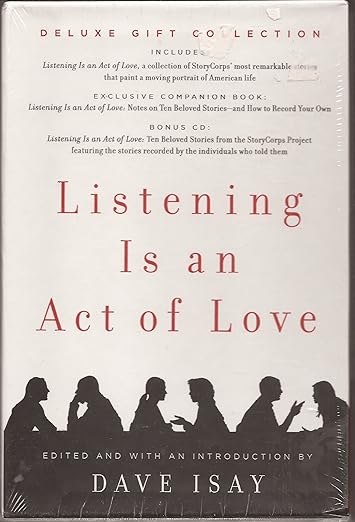
I came to Listening Is an Act of Love through a different route than most listeners probably do. I had known about the StoryCorps project, the recordings Dave Isay and his team have been collecting in recording booths across America since 2003, for years before I actually sat down to listen to a curated selection of the interviews. When I finally did, on a long afternoon when I had given myself permission to do nothing but listen, the experience was different from what I had anticipated. I had expected something warm but gentle. I got something that occasionally stopped me cold.
This is a celebration of American life in the most literal sense: ordinary people sitting down with someone they love and telling the truth about their experience. A grandmother and her granddaughter. Veterans. Parents. Teachers. Partners. People at the end of their lives and people at the beginning. The StoryCorps format creates the conditions for a specific kind of honesty that is very difficult to manufacture in any other context.
A Closer Look at Listening Is an Act of Love
Dave Isay has described the StoryCorps project as an attempt to honor the lives of everyday Americans by creating a space where those lives can be recorded and preserved. The title of this collection is also its thesis: the act of genuine listening, attentive, unhurried, without an agenda, is itself an expression of care. That premise sounds simple and is actually quite radical in a culture where most recorded speech is performative, curated, and produced for an audience rather than for a person.
The stories collected here run the full range of human experience. Grief is present throughout, but so is humor. So is resilience. One reviewer who works in customer service described the book as a corrective to the erosion of empathy that sustained public-facing work can produce, a reminder that every stranger you encounter carries a story of comparable depth and complexity to your own. Another described it as too hard to read in the sense that its emotional directness is almost physically demanding. Both responses are valid and both point to what makes this material significant.
What Makes Listening Is an Act of Love Worth Hearing
Isay narrating his own project brings something that no outside narrator could replicate. He knows these stories not as a reader encountering them for the first time but as someone who was present, or nearly so, when they were recorded. His voice carries that knowledge. There is a quality of witness in his reading that elevates the material beyond anthology, you sense that these stories mattered to him personally, which makes them matter more to the listener.
The audio format is the natural home for this material in a way that is not true of all audiobooks. StoryCorps exists because of audio recording. These are stories that were spoken into a microphone, stories that belong in the ear. Reading about them in print creates a slight barrier that does not exist when you hear them narrated. The thirteen-plus hours of runtime allows the collection to breathe, these are not compressed or hurried. Each story is given the time it needs.
Things to Know Before Starting Listening Is an Act of Love
The book benefits from being listened to in sections rather than consumed in a single sitting. The emotional accumulation of story after story of genuine human experience can become overwhelming if you push through without pausing. Several reviewers, including one who described the experience as making you laugh and cry and open your heart and mind, implicitly confirm this, the range of emotion is significant, and spacing out the listening serves the material better than marathon sessions.
It is also worth noting that the physical product described in the available metadata includes a companion CD and notes on how to record your own stories, which reflects the project's broader mission of preservation and participation. Whether those supplementary elements are part of your listening experience depends on the format you access. The audio itself stands entirely on its own.
Who Dave Isay Is Writing For
This collection is suited to anyone who values oral history, documentary audio, or literary nonfiction, and particularly to anyone who has become, over time, a faster and more distracted listener than they want to be. It is a corrective as much as a book. Book clubs, as one reviewer noted, will find it exceptionally generative, these stories prompt conversation rather than closing it off. Listeners who prefer narrative propulsion or conventional structure may find the anthology format frustrating. This is not a book you read for plot. It is a book you listen to for the experience of being present to other people's lives.
In Brief
- Voice: Dave Isay narrates his own StoryCorps project material with the quiet authority of someone who has spent decades listening to people tell their stories, the match is entirely natural.
- Big ideas: Ordinary lives as worthy subjects, American plurality, the act of bearing witness
- Atmosphere: Tender and emotionally unguarded, at times quietly devastating
- Worth it?: A collection that reminds you of what audio storytelling can do when it trusts real people to speak for themselves, one of the most affecting projects of its kind.
What exactly is the StoryCorps project, and how does this audiobook relate to it?
StoryCorps is a nonprofit audio archive founded by Dave Isay in 2003, using recording booths across America to capture conversations between everyday people and someone important to them. This audiobook collects and presents selected interviews from that archive, with Isay providing context and narration.
Does Dave Isay's narration work if you are unfamiliar with his work as a journalist and audio documentarian?
Yes. His narration carries authority and quiet warmth that works independently of any prior knowledge of his career. Familiarity with the StoryCorps project enriches the context but is not required.
Is this accessible to listeners who do not typically enjoy oral history or documentary-style audio?
The individual stories are short enough and varied enough that listeners who might resist the format often find themselves engaged by specific accounts before they realize they have settled into the collection. The variety across age, background, region, and experience helps sustain attention across the runtime.