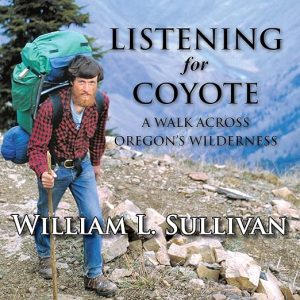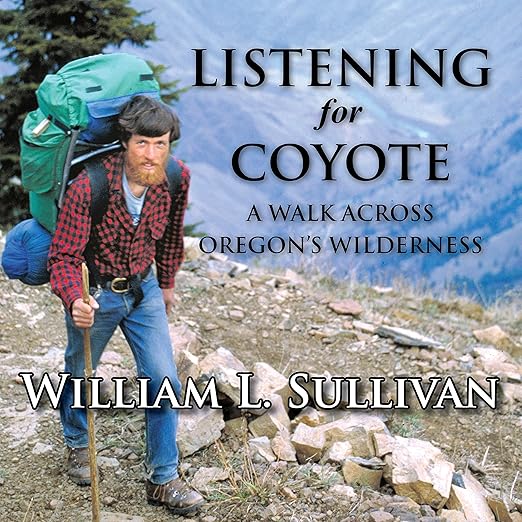
I came across Listening for Coyote while researching Oregon trail literature for a piece I was writing, and the description of a 1,361-mile solo backpacking trek across the state arrested my attention immediately. I am not a distance hiker. I do most of my outdoor reading in cities. But William Sullivan's account of his 65-day crossing, from the Owyhee Canyonlands in the east to the Pacific Coast in the west, held me for all eight-plus hours partly because of what he describes and partly because of how he describes it. The memoir was selected by the Oregon Cultural Heritage Commission as one of the state's 100 Books, the most significant literary works in its history. That is not a distinction given lightly.
Sullivan narrates his own book, which is always a gamble. Authors are not always the most effective performers of their own prose. Sullivan is an exception: he reads with the cadence of someone who has spent a great deal of time in quietness, and the pace of his narration matches the experience of the trail in ways that a professional narrator without that physical reference point might not achieve. One reviewer described listening straight through, which I understand. The book does not feel like it is trying to hold your attention; it simply rewards sustained listening in the way that long wilderness experiences reward sustained presence.
How Listening for Coyote Holds Up
What distinguishes this from standard adventure memoir is Sullivan's commitment to the people he meets as much as to the landscape itself. He is a careful observer of human beings at the edge of settlement: the political scientist who left his classroom to fight logging roads on Bald Mountain, the elk hunter who hopes to be reincarnated as a stag, the elderly widow living alone in a remote gold-mining cabin. These figures are not colorful locals deployed to illustrate a point about wilderness character. Sullivan renders them as people with specific commitments and specific relationships to the land they inhabit, which is a different kind of writing from most trail memoir. The book is as much a record of what Oregon's wilderness means to the people who live nearest to it as it is a record of one man's crossing.
Why Listening for Coyote Works as an Audiobook
The historical and geological annotations Sullivan weaves through his daily journal entries are handled with the same light integration. He does not stop to deliver context; he allows the context to arrive when the terrain or a chance encounter makes it relevant. A reviewer who praised the additions of history, geology, and the people Sullivan met as the highlight above the hiking descriptions has identified the book's real strength. The hike is the armature. The meaning is in everything Sullivan notices along it. In audio, with Sullivan's own measured delivery, that integration feels remarkably natural. He reads his campfire journal entries with a specificity of detail that makes the physical environment vivid without straining for beauty. The descriptions of blizzards, bears, and poisonous mushrooms are grounded in the same unsentimental observation as the passages about geology.
Weak Spots in Listening for Coyote
This memoir was originally published in the late 1980s and covers a trek Sullivan completed in 1985. The landscape it describes has changed in forty years: some of the logging debates are now resolved, some of the remote communities he visited may no longer exist in their described form. Sullivan's book is a record of a particular moment in Oregon's environmental history as much as it is a personal journey, and the distance between that moment and the present is part of what gives the text its elegiac quality. Listeners looking for a contemporary account of Oregon's trail systems will need to supplement with more recent sources. What the book offers instead is a portrait of what was at stake, and for whom, in the wilderness debates of the 1980s, rendered through human encounters rather than policy arguments.
Who Should Listen to Listening for Coyote
Outdoor memoir readers who want something more intellectually layered than a standard trail narrative will find this book in the company of John McPhee's landscape writing or Edward Hoagland's natural history essays rather than in the straightforward adventure memoir category. Listeners interested in Pacific Northwest history and land-use debates will find the historical and political context woven throughout the journey unusually rich. Those who respond strongly to author-narrated memoirs where the voice carries lived experience rather than performed drama will find Sullivan an ideal reader of his own work. Listeners who want sustained action and physical peril as the primary mode should know this book is more meditative than propulsive.
Before You Press Play
- Narration: William L. Sullivan narrates his own memoir, and his voice carries the particular authority of someone recounting lived physical experience rather than performing it.
- Themes: Wilderness as meaning-making, the human communities that persist at the edge of settlement, stewardship versus ownership of land
- Mood: Contemplative and richly textured, with an undertow of genuine physical hardship
- Verdict: A memoir that earns its place among Oregon's most significant literary works, and that becomes something different in audio when Sullivan himself reads it.