Quick Take
- Narration: Andrew Joseph Perez handles the dual register of scholar and experiential witness with distinction, navigating both the philosophical passages and the visceral vision accounts without flattening either.
- Themes: Ayahuasca as sacrament, insider-outsider religious scholarship, consciousness, selfhood, and mystical transformation
- Mood: Immersive and philosophically dense, lit from within by genuine spiritual inquiry
- Verdict: An extraordinary work of religious scholarship that reads also as a personal record of transformation, one of the most unusual and rewarding audiobooks in its genre.
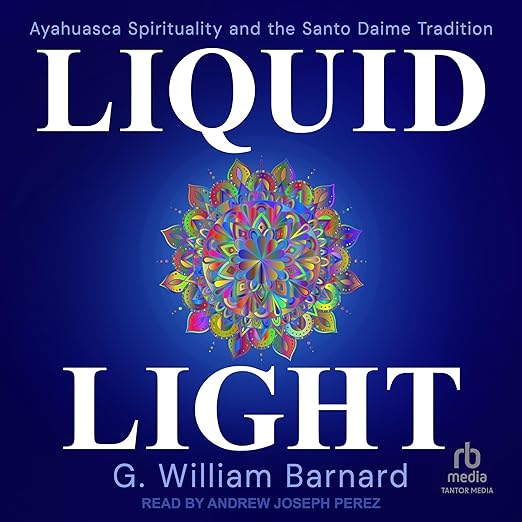
There are books that require you to bring something to them, and Liquid Light is one of them. G. William Barnard is a professor of religious studies who is also an initiate of the Santo Daime, a syncretic religion that arose in the Amazon in the middle of the twentieth century and now has communities worldwide. That dual position, insider and academic, is the book’s structural premise and its primary achievement. I spent several late evenings with this one, which was probably the right setting for material that is itself concerned with altered thresholds of consciousness and what happens when the ordinary borders of experience dissolve.
The Santo Daime’s central practice is the sacramental consumption of ayahuasca, a psychedelic brew made from Amazonian plants, within regular ceremonial contexts. Barnard is not writing about ayahuasca as a pharmaceutical phenomenon, a wellness trend, or a subject of clinical psychedelic research, though the broader conversation around psychedelics is clearly relevant context. He is writing about a specific religious tradition: its history, its ritual life, its theology, and the transformative experiences it generates in its practitioners.
Our Take on Liquid Light
What makes this book genuinely unusual in the literature on entheogenic religions is the combination of scholarly apparatus and personal witness. Barnard draws on the philosophy of William James, whose work on mystical experience remains foundational to religious studies, and Henri Bergson’s theories of consciousness to provide a conceptual framework for what the Daime experiences might mean philosophically. He is not simply asserting that the experiences are real and significant; he is trying to explain, with intellectual rigor, why they might be real and what that would mean for questions of consciousness, selfhood, and the nature of reality.
Those personal accounts are remarkable. Barnard describes his journeys into nonordinary states of consciousness with the kind of specificity that makes experiential religious writing compelling rather than vague. He is honest about the difficulty of some experiences, the not-only-enlightening but humanly very challenging moments that one reviewer specifically praised, which gives the text a credibility that more reverential or promotional accounts of psychedelic religion tend to lack. He is not selling the Santo Daime. He is describing it as precisely as language allows.
Why Listen to Liquid Light
Andrew Joseph Perez handles this material with notable range. The text moves between several distinct registers: academic analysis citing James and Bergson, historical narrative about the origins of the Daime in the Brazilian Amazon, ethnographic description of ceremony and ritual, and first-person vision accounts that are essentially literary in their texture. Perez navigates all of these without homogenizing them, which is exactly what the material requires. The vision sequences in particular need to feel different from the analytical passages, and they do.
At nearly fifteen hours, this is a long audiobook, and it earns its length. Barnard’s project is ambitious enough that brevity would undermine it. Understanding the Santo Daime as a religious tradition, understanding the philosophical stakes of Barnard’s argument about consciousness, and following the arc of his own transformative experience, these three threads require space to develop, and the audio format rewards sustained engagement in ways that casual reading might not.
What to Watch For in Liquid Light
Listeners should be aware that this is not a general introduction to ayahuasca or to psychedelic experience broadly. It is a study of one specific religious tradition, written by someone who has practiced within it for decades. Readers looking for a comparative overview of different ayahuasca traditions, or for the neuroscience and pharmacology of the brew, should look to other sources. What Barnard offers is depth within a particular tradition rather than breadth across the landscape of psychedelic religion.
The philosophical sections referencing James and Bergson are genuinely substantive, not decorative. Listeners without background in philosophy of religion or the philosophy of consciousness may find those passages demanding. The payoff is worth the effort, Barnard is making an actual argument about the nature of mystical experience, not simply validating his personal experiences through academic citation, but the argument requires sustained attention.
Who Should Listen to Liquid Light
This is an ideal listen for anyone with a serious interest in religious experience, consciousness studies, or the anthropology of Amazonian spiritual traditions. It will particularly resonate with listeners who have had some direct experience with the Santo Daime or with ayahuasca in other contexts and want a rigorous framework for understanding what those experiences might mean. Casual curiosity about psychedelics will get you through the first few chapters; genuine intellectual and spiritual interest is what sustains the full fourteen-plus hours.
Frequently Asked Questions
Is Liquid Light primarily a personal memoir or an academic study?
Both simultaneously, which is precisely what makes it unusual. Barnard is a religious studies scholar who writes with academic rigor while also providing detailed first-person accounts of his own ceremonial experiences within the Santo Daime. The two registers are woven together rather than separated into different sections.
Do I need to have any prior experience with ayahuasca or the Santo Daime to follow this audiobook?
No, but you should come with genuine curiosity rather than casual interest. Barnard provides context for the Santo Daime’s history, beliefs, and practices. Some background in religious studies or philosophy of consciousness makes the more theoretical sections more accessible, but it’s not strictly required.
How does Barnard’s position as both an initiate and a scholar affect the credibility of the book?
For many readers and reviewers, it’s precisely what makes the book credible. He has the insider knowledge of a practitioner and the analytical tools of an academic, which allows him to describe the tradition accurately while also interrogating its philosophical and psychological significance rather than simply promoting it.
Is this audiobook appropriate for listeners who are skeptical about psychedelic or mystical experience?
Yes, and possibly especially so. Barnard is writing from within the tradition but arguing philosophically rather than proselytizing. He draws on William James and Henri Bergson to make an intellectually serious case for what mystical states might reveal about consciousness, an argument that can be engaged on its merits regardless of your prior stance on psychedelics or religion.