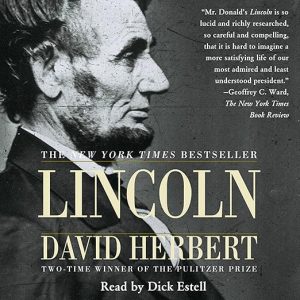
Abraham Lincoln's life has attracted so many biographers that readers sometimes assume the subject is exhausted. David Herbert Donald spent decades producing peer-reviewed scholarship before writing this 1995 Pulitzer Prize-winning biography, and that accumulated research is visible in every section of this audiobook. David Herbert Donald spent decades proving otherwise, and his 1995 Pulitzer Prize-winning audiobook Lincoln, narrated by Dick Estell, makes that argument across thirty hours and twenty-one minutes of dense, carefully constructed history. What does it mean to watch a man assemble a moral self from almost nothing? Donald built his entire biography around that question, and the audiobook format gives the answer room to breathe.
Comically Underqualified for the Office He Held
Donald's central insight is that Lincoln did not arrive at greatness prepared. He was, by the standards of the era, almost comically underqualified for the office he eventually held: self-educated in a rural Kentucky cabin, with minimal formal training, patchy legislative experience in Illinois, and a single undistinguished term in Congress before the presidency found him. The biography traces how a man shaped by those narrow origins developed, slowly and sometimes painfully, into a leader capable of holding the Union together and abolishing slavery. That arc of gradual transformation is what gives Donald's work its force, and it is what distinguishes it from the great-man hagiographies that dominate the Lincoln shelf. The writing is disciplined and precise. Donald resists the urge to retrospectively endow young Lincoln with the moral clarity he would eventually display, which means the portrait stays honest through the middle sections, when Lincoln's positions on slavery were considerably more cautious than admirers tend to remember.
There is another dimension worth noting before committing to thirty hours: Donald's Lincoln is primarily a political biography. Those who want sustained access to Lincoln's interior life will find the book more interested in decision and consequence than in consciousness. The emotional portrait is constructed from the outside in, through behavior and outcome. One reviewer noted a legitimate structural problem: Donald distributes attention unevenly, giving the Gettysburg Address roughly the same coverage as Lincoln's search for a competent postmaster general. That critique is fair. The biography's commitment to comprehensiveness sometimes flattens the hierarchy of significance, so listeners who want those major set pieces to be given their full rhetorical weight may find the pacing frustrating. But that granularity is also what makes the book so useful as an adult history listen. The texture of daily governance, the petty quarrels with cabinet members, the stream of office-seekers crowding the White House corridors: this is political life as it actually operated, and Donald renders it without glamorizing it.
Estell's Restraint Across Thirty Unbroken Hours
Dick Estell's narration is the right instrument for Donald's prose. Estell has a measured, unhurried delivery that suits a biography this long: he does not try to dramatize the material with vocal theatrics, but he keeps it from becoming a dry recitation. The Illinois political debates and the wartime dispatches receive the same calm, considered treatment, which means the emotional weight in the text has to come from Donald's words rather than from Estell's inflections. On balance, that restraint works. A biography of this scope requires a narrator who can be trusted across thirty hours without becoming monotonous, and Estell manages it. The audio experience rewards sustained listening sessions rather than ten-minute commute fragments; the argument builds through accumulation, and listeners who engage with it in longer stretches will feel that momentum.
The opening sections on Lincoln's Kentucky and Indiana childhood are some of the most valuable, partly because Donald anchors Lincoln's later habits of mind firmly in the poverty and intellectual isolation of those early years. The determination to self-educate, the voracious appetite for political argument, the comfort with plain language that made the later speeches so accessible to ordinary people: Donald locates all of these traits in a specific biographical soil, and Estell carries those sections with patience that pays off in retrospect.
A Third of the Running Time, Before the War
The middle sections of the audio biography, covering Lincoln's years in Illinois politics and his relationship with Mary Todd, are sometimes slow, and listeners who come specifically for the Civil War presidency may feel the preamble is extended. That preamble constitutes roughly a third of the running time. But Donald earns it: the presidency only makes sense if you understand how improbable it was, and how much Lincoln had to teach himself before the country put its survival in his hands. The war chapters that follow are among the strongest in any Lincoln biography, particularly the material on the Emancipation Proclamation, where Donald painstakingly reconstructs the political calculation and moral evolution that produced a document Lincoln himself once considered constitutionally dubious. The biography does not present Lincoln as having always been an abolitionist at heart; it shows him getting there, which is a more complicated and ultimately more instructive story.
There is also a thread running through the biography about Lincoln's relationship to religion and fate that rarely surfaces in shorter treatments. Donald takes Lincoln's fatalism seriously as a psychological category rather than as a rhetorical device, and the audio format allows that theme to develop across many hours in a way a summarized version cannot.
Rewarding Only for Listeners With Real Patience
Listeners who want a substantive, historically grounded portrait of Lincoln and have the patience for thirty hours of careful scholarship will find this one of the most rewarding presidential biographies in audio. It is particularly well-suited to listeners who already have a passing familiarity with the era and want the gaps filled in rather than a dramatic introduction. Casual listeners looking for a swift narrative focused on the war years and the assassination might prefer a shorter, more selective treatment. This audiobook rewards attention and sustained engagement; it is not designed to be consumed in an afternoon.