Before You Press Play
- Voice: Raymond Todd's measured, unpretentious delivery matches the speech's own restraint rather than performing false gravitas.
- Big ideas: National reconciliation, moral reckoning with slavery, presidential rhetoric under pressure
- Atmosphere: Solemn, contemplative, quietly powerful
- Worth it?: A rewarding listen for anyone who thinks the Gettysburg Address is Lincoln's only great speech.
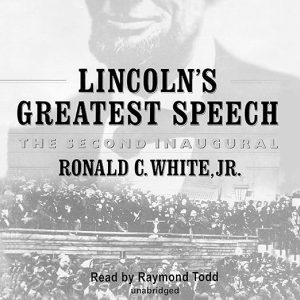
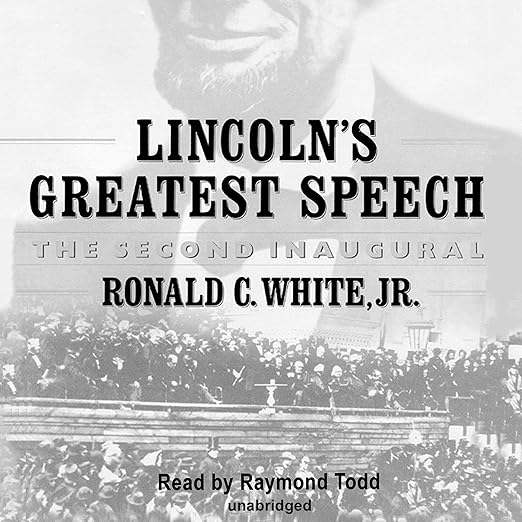
March 4, 1865: Lincoln stands for his second inauguration with the Civil War nearly over, and instead of delivering the victory speech the North wanted, he offers something far stranger and more demanding, a call for national reconciliation that refuses to let the North off the hook entirely or blame the South alone for slavery. This audiobook, built around Ronald C. White Jr.'s close reading of that Second Inaugural Address, treats the speech's now-famous closing call for malice toward none and charity for all as the culmination of Lincoln's entire rhetorical and moral development, arriving just weeks before his assassination.
Splitting War's Blame Between North and South
White's real subject is not just what Lincoln said but how he arrived at saying it. The book traces the speech's genesis, according to the synopsis, as the product of Lincoln's own hard-won victory over doubt, framing the address less as a triumphant announcement and more as the output of years of moral reckoning with a war that had cost far more than anyone expected on either side. That developmental approach gives the book real narrative shape rather than functioning as pure textual analysis.
What makes the argument land is White's insistence on splitting responsibility for the war's suffering evenly rather than letting the North claim clean moral victory. The synopsis's own language, that Lincoln addressed the suffering of all, North, South, soldier, and slave, captures why this speech gets treated as more morally serious than a conventional victory address, and White's analysis treats that seriousness as the whole point rather than an incidental detail of the historical record.
One Speech, Zoomed In From a Full Biography
Ronald C. White Jr. has built a career specifically around Lincoln's rhetoric and moral development, including a full biography, A. Lincoln, that traces similar territory across Lincoln's entire life rather than a single speech. This book functions almost like a close-up companion to that broader work, taking one moment White clearly considers pivotal and giving it the extended, granular attention a full biography's pacing cannot afford to give any single speech, however important.
The book's series context matters too: it sits within the Simon and Schuster Lincoln Library, a collection built around close studies of specific facets of Lincoln's life and legacy rather than single comprehensive biographies. Listeners who already own a full Lincoln biography and want depth on one specific dimension, in this case his rhetorical and moral development at the war's end, are exactly the audience this series format is designed to serve.
Todd's Restraint Matches a Speech That Warns
Raymond Todd brings a measured, unpretentious delivery to material that could easily be performed with more theatrical gravitas than the speech itself actually calls for. Lincoln's Second Inaugural is a relatively brief, restrained text, and White's analysis of it deserves a narrator who matches that same restraint rather than overselling the moment with dramatic weight the material does not need to land its full impact.
One reviewer specifically argues the Second Inaugural 'rivals and in some ways even surpasses the more acclaimed Gettysburg Address,' crediting White's book with a 'masterly vindication' of that claim through careful tracing of the speech's genesis and implications, both political and moral. For listeners who have only ever encountered the Gettysburg Address as Lincoln's defining rhetorical achievement, that comparison alone is worth the listen, and Todd's steady delivery gives the argument room to build its case without rushing.
The speech arrived at a specific, fragile moment: Sherman's March to the Sea had reached Savannah months earlier, Petersburg's siege was finally nearing its end after nearly a year, and total Union victory was close enough to see but not yet secured. Lincoln could have used the moment to claim vindication. That he chose instead to warn against triumphalism and insist on shared national responsibility for slavery's sin is precisely the moral risk White's book treats as Lincoln's most significant rhetorical achievement, more demanding of an audience than a simple victory speech would have been.
Six Hours, Tightly Bound to a Single Speech
This is focused, scholarly analysis of a single speech rather than a broad Lincoln biography, and listeners expecting comprehensive coverage of his presidency, the war's military campaigns, or his earlier political career should adjust expectations accordingly. At six hours and forty-one minutes, the book stays tightly focused on the Second Inaugural specifically, using Lincoln's broader life and the war's final months mainly as context for that one speech's development.
The book's central argument, that this speech deserves recognition alongside or even above the Gettysburg Address, is a real critical position rather than settled consensus, and listeners should engage with it as White's own carefully argued case rather than uncontested fact. The speech's continued relevance to questions of national division and reconciliation is likely to resonate with different listeners in different ways depending on what they bring to it.
Malice Toward None Rewards Close Listening
The speech's closing line, 'with malice toward none, with charity for all,' rewards close listening specifically because of how much moral work those few words do. Lincoln is not offering forgiveness from a position of safety after the fact; he is asking a still-bleeding nation, on both sides, to commit to reconciliation before the war has even technically ended. White's analysis spends real time on exactly why that timing, promising charity before victory is secured rather than after, made the line so difficult and so consequential in 1865.
Listeners should also know that White's own admiration for the speech is not disguised as neutral analysis; this is an advocacy-adjacent work making a specific critical case, well-argued and well-sourced, but a case nonetheless, for why this particular text deserves more attention than it typically receives relative to Lincoln's other major addresses.
Rhetoric Fans Get a Transferable Critical Lens
This audiobook is a strong fit for Civil War history enthusiasts and anyone with a serious interest in presidential rhetoric, especially listeners who already know the Gettysburg Address well and are curious about White's case for this later, less-discussed speech. It also works well for readers of the wider Simon and Schuster Lincoln Library series looking for a more focused entry after broader biographical treatments. It is also a strong choice for listeners interested in the craft of political rhetoric more broadly, not just Lincoln specifically, since White's close analysis of how a speech balances moral conviction against political reality offers a genuinely transferable lens for evaluating persuasive writing well beyond this one historical example.
Skip it if you are looking for a full Lincoln biography or a comprehensive account of the Civil War's final year; this is deliberately narrow in scope, and listeners without at least some existing interest in presidential rhetoric or Lincoln's moral development specifically may find the tight focus on one speech, however significant, less compelling than a broader historical narrative would be.
Does this audiobook include a full reading of Lincoln's Second Inaugural Address itself?
Yes, the speech's text is central to White's analysis and is worked through closely, including its now-famous closing call for malice toward none and charity for all.
How does this audiobook compare Lincoln's Second Inaugural to the Gettysburg Address?
Directly and deliberately. White argues the Second Inaugural rivals or even surpasses the Gettysburg Address in moral seriousness, a position at least one listener review calls a masterly vindication after hearing the full case laid out.
Do I need a Civil War background to follow this audiobook?
Some basic familiarity with Lincoln and the war's final year helps, but White provides enough context around the speech's creation that a general history listener can follow without deep prior Civil War study.