Before You Press Play
- Performance: Weggemann reads her own memoir, which matters most in the closing section addressed straight to the listener.
- What it covers: Paralysis after a routine procedure, a second injury and second recovery, faith, disability beyond the visible kind.
- Feel: Direct, warm, insistently forward-facing.
- Our call: Strongest for listeners living the adjustment it describes, and honest enough to be worth their time.
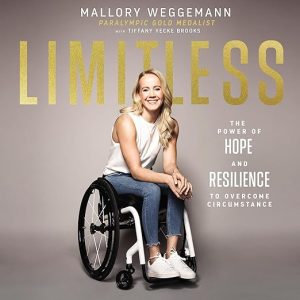
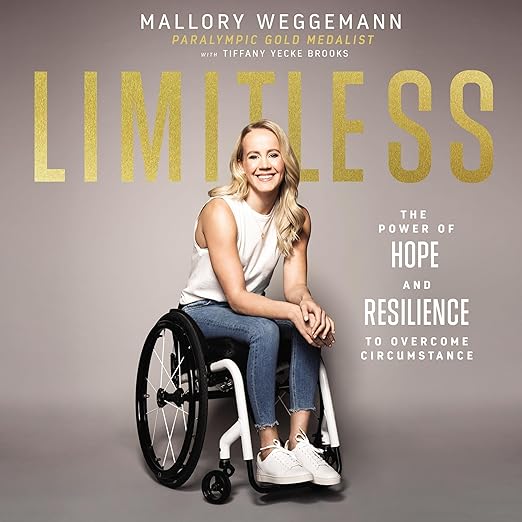
Eight world records inside two years of being paralyzed is the kind of fact that wrecks a memoir's pacing before an author has written a sentence. Mallory Weggemann was left paralyzed from the waist down on January 21, 2008, after what the description calls a routine medical procedure, and by the 2012 Paralympic Games she held fifteen world records and thirty-four American ones. Any writer handed that sequence faces the same problem: told straight, it reads as a highlight reel and stops being a life. This audiobook, which Weggemann narrates herself across seven hours and twenty-three minutes, works hard against that risk.
What makes the structure genuinely difficult is the second half of the story. Two years after those Games, a fall severely damaged her left arm, which meant two reconstructive surgeries and an extended rehabilitation, and then two gold medals and a silver at the 2019 World Para Swimming Championships. Two catastrophes and two recoveries is a shape that resists the usual rising arc, and it explains why the book keeps returning to the question of what recovery even means. Thomas Nelson released it on March 2, 2021, and it now carries a 4.6 average across 240 ratings.
Weggemann on Healing That Isn't Chronological
The description's answer to the pacing problem sits at the end, where the story converts into instruction addressed directly to the listener. Six lessons are named: redefine your limits, remember that healing is not chronological, be willing to fail, lean on your community, embrace your comeback, and write your own ending. Five of those could appear in any book on this shelf. The second could not. Healing is not chronological is the one idea here that comes out of the specific experience of being injured twice, and it quietly contradicts the recovery narrative the rest of the genre runs on.
Self-narration earns its place here for a reason that has little to do with authenticity. The lessons are addressed in the second person, which means the audio edition puts a listener in the room with the person issuing them rather than reading a transcript of that instruction. A hired voice can deliver the sentence about healing running out of order perfectly well. Only the person who went through a second injury after the world records can make it land as testimony rather than as advice, and the whole final movement of the book depends on that distinction.
Aaron J. Brooks makes the reframing argument most clearly, and it is the one prospective listeners most need. That review insists the book is not one woman's story about life in a wheelchair, and that as Weggemann points out 'it's about the limits we all have', before running through physical, mental, social, financial and emotional among them. Worth noting alongside that: the notice is dated March 2, 2021, the release date itself, and its headline carries a promotional hashtag. Faith is also named openly in the description as one of the roots of her resilience, and the publisher sits on that shelf, so the register should surprise nobody.
What You're Born With Versus What Happens Later
The most persuasive evidence comes from readers whose own circumstances gave them something to measure against. Brianna, who reports having spinal issues, calls it the first time in years that somebody got it and could be related to, and comes away with hope and determination after reading it. Kevin Althage, born with a physical disability, brings a sharper distinction, separating physical disability into what a person is born with and what happens to them later, arguing that adjusting to the second is considerably harder, and observing that Weggemann has adjusted well over time.
That second reading is more useful than a general recommendation, because it identifies what the book is actually demonstrating rather than what it says about itself. Adjustment after acquired injury is the hard case, and a memoir written from inside it has evidentiary value that no amount of encouragement can substitute for. The 240 ratings behind the 4.6 average are a solid base by the standards of this shelf, and the written responses cluster around people who came looking for recognition of their own situation rather than for motivation in the abstract. That is a narrower recommendation than the cover implies, and a truer one.
Why the Numbers in This Record Blur
Be clear-eyed about the mode before buying. This is inspirational memoir with an explicit lesson framework attached, and listeners who find that register grating will find it grating here, since the description leans into refusing limits, meeting any challenge, and doing it on your own terms. The one response below five stars, from Deborah A., gives four and then offers two short sentences of unqualified praise without explaining the missing star, which is not much to work with. The rest of the written pool is warm and brief rather than analytical.
Numbers are the next practical consideration. The competitive record arrives as a dense run of figures, eight world records first, then a combined total near fifty across two record categories by 2012, then two golds and a silver, and numbers blur in audio in a way they never do on a page you can glance back at. Expect a general impression of the achievement rather than a ledger. Beyond the figures, the book is also less about swimming than the sports shelving suggests: Hans Lee, writing from the response pool, comes away thinking almost entirely about the people around her, wondering aloud what recovery would have looked like without anyone to love her through it.
Holding That Many Figures Is Something Audio Does Badly
Adjusting to an acquired disability, or living beside somebody who is, makes you the audience this book was built for, and two reviewers writing from inside that experience say so directly. It suits readers of sports memoir who want the interior story rather than the training regimen, and listeners who appreciate a faith-informed frame stated openly rather than implied. Coaches, physical therapists and anyone who works with people mid-rehabilitation will find the idea that healing runs out of order more useful than most of what is written for them.
Inspirational nonfiction with a numbered lesson framework is not a form everybody can tolerate, and that framework is structural here rather than decorative, so anyone allergic to it should stop now. A detailed account of elite Para swimming as a sport is not what this is either, since the competitive material serves as the spine of the story rather than as its subject. Holding that many figures at once is something audio does badly, so anybody who wants the athletic record laid out precisely will want it on a page.
Does Mallory Weggemann narrate the Limitless audiobook herself?
Yes. She is credited as the narrator of her own memoir, which matters more than usual here because the closing section converts the story into six lessons addressed in the second person. Hearing those from the person who lived through two separate injuries changes them from advice into testimony.
Who gets the most out of this audiobook?
Listeners adjusting to an acquired disability, and the people around them. Two reviewers writing from inside that experience found it unusually recognizable, one calling it the first time in years that anyone seemed to understand, the other noting how much harder adjustment is after an injury than after a lifelong condition.