Quick Take
- Narration: Martin Freeman is a casting choice so right it almost seems obvious in retrospect, his particular brand of exasperated warmth is the perfect container for Adams’s cosmic comedy.
- Themes: The indifference of the universe to human significance, the comedy of bureaucratic immortality, why cricket may be the key to understanding everything
- Mood: Delightfully strange and slightly melancholy, with the specific pleasure of wit operating at maximum efficiency
- Verdict: One of the best Hitchhiker’s recordings available, with Freeman’s Arthur Dent establishing exactly the tone the novel needs.
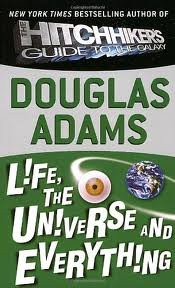
Douglas Adams wrote about the universe in the way only someone who was simultaneously enchanted by it and exhausted by it could. He loved physics, hated the fact that it was largely indifferent to him, and found in that indifference the engine for his most persistent joke: that the universe is not hostile to humanity, which would at least be interesting, but rather spectacularly, cosmically, unaware of it. Life, the Universe, and Everything is the third book in the Hitchhiker’s Guide series, and it is the one where Adams began to take that cosmic indifference seriously as a subject rather than just a backdrop.
I came back to this one on a late Thursday afternoon when I needed something that would make the forty minutes between leaving the office and starting dinner feel like a gift rather than an obligation. At five hours and forty-eight minutes, the novel fits comfortably into a few such sessions, and Martin Freeman’s narration has the specific quality of making the time feel even more gracefully proportioned than it is.
The Krikkit Problem and Why It Is Actually About Everything
The novel’s premise involves the inhabitants of the planet Krikkit, who are the only species in the universe that has managed to go through its entire history without knowing the universe existed. When they discover it, their response is to attempt to destroy it. This is Adams at his most structurally elegant: the punchline to a joke that takes an entire novel to set up. The Krikkit storyline also involves robots, a stolen trophy, time travel, and a character being trapped in a recursive time loop for an extremely long time before anyone notices, which is how Adams does most of his best structural work.
The synopsis notes that the novel reveals things about Earth that the previous two books have left conspicuously unaddressed, specifically why Earth has always been shunned by the rest of the Galaxy. The reveal, when it comes, is perfectly calibrated: significant and absurd in exactly equal measure, which is Adams’s preferred register for anything important.
Martin Freeman and the Specific Weight of Arthur Dent
Arthur Dent is the most put-upon man in the universe, and he knows it, but not in a way that has made him remotely better at dealing with it. Freeman, best known to much of the world as a version of bewilderment-under-pressure from multiple beloved properties, carries Arthur with a kind of weary specificity that captures the character’s core quality: he is not stupid, he is not brave, he is not resourceful in any conventional sense, and he would very much like a cup of tea. What makes him endearing is that he keeps going anyway, not out of heroism but out of a kind of stubborn refusal to admit that the situation is beyond him.
The Hitchhiker’s series has been read by Adams himself in earlier recordings, and those recordings have a legendary quality among fans. Freeman’s interpretation is different rather than lesser: where Adams narrated with a kind of distracted authorial authority, Freeman gives Arthur a more consistently inhabitable interior life. For new listeners especially, this may be the more accessible entry point into the series in audio.
Adams’s Comedy at the Level of the Sentence
The novel has no reviews in the available metadata, which means I am working from the text itself rather than reader response. What I can tell you is that Adams’s comedy operates at the sentence level in a way that rewards close listening: a subordinate clause will carry a joke that gets paid off three pages later, and a throwaway observation about the nature of time will turn out to be the architecture of an entire plot resolution. Freeman’s pace respects this structure. He does not rush the sentences that need to breathe, and he does not drag the ones that want to move. At under six hours, this is a short audiobook by contemporary standards, but it is also one of the most efficiently funny pieces of English prose from the twentieth century.
Who Should Listen, Who Should Skip
Listen if you have read or listened to the first two Hitchhiker’s books and are ready to continue the series. While individual Hitchhiker’s novels are sometimes described as standalone, Life, the Universe, and Everything benefits considerably from knowing who Ford Prefect is, why Arthur is adrift in time and space, and what the previous narrative context established. Martin Freeman’s narration is reason enough to listen even if you have encountered the novel before.
Skip if you want an entry point into the Hitchhiker’s series: start with The Hitchhiker’s Guide to the Galaxy and work forward. Also skip if you need your comedy novels to have clean narrative resolution: Adams is famously uninterested in conventional endings, and this novel is no exception.
Frequently Asked Questions
Can Life, the Universe, and Everything be listened to without reading the first two Hitchhiker’s books?
Technically possible but not recommended. The novel references characters, events, and relationships established in the first two books without re-explaining them. Arthur Dent’s situation and Ford Prefect’s role in his life are assumed knowledge. New listeners will get the sentence-level comedy but miss significant structural and character payoffs.
How does Martin Freeman’s narration compare to Douglas Adams’s own recordings of the series?
Adams read several of the Hitchhiker’s novels himself, and those recordings have a legendary quality among fans. Freeman’s approach is different: where Adams narrated with a kind of distracted authorial authority, Freeman gives Arthur a more consistently inhabited interior. Both are excellent for different reasons. Freeman’s version may be more accessible for first-time listeners encountering the series in audio.
At under six hours, is this significantly shorter than the other Hitchhiker’s books?
The Hitchhiker’s novels vary in length, and this one is on the shorter end. The brevity reflects Adams’s commitment to efficiency: he does not pad. Every digression is doing work, even when it appears to be purely decorative. The runtime is appropriate to the material rather than a sign of thinness.
Is the cricket element in the novel actually significant, or is it a throwaway joke?
In Douglas Adams’s universe, cricket and a throwaway joke are not mutually exclusive categories. The Krikkit storyline has genuine structural importance: the name, the mythology Adams builds around a species that never knew the universe existed, and the sport’s ritualized combat origins in this telling are all load-bearing elements of the plot. The cricket connection is both genuinely funny and, by Adams’s standards, surprisingly earnest.