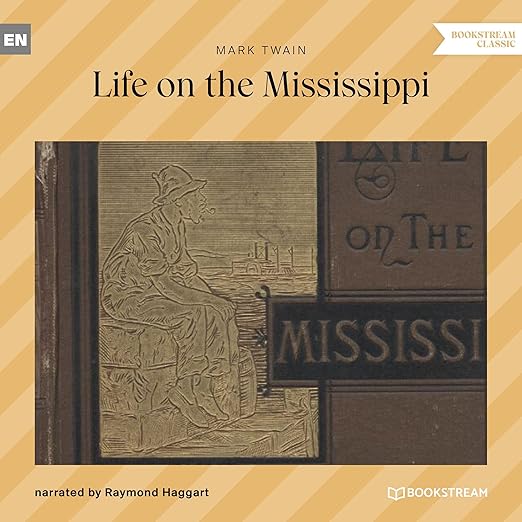
One title, two books, and the audiobook has to be both of them. The description says as much in two sentences: a memoir of Mark Twain's days as a steamboat pilot on the Mississippi River before the American Civil War, and a travel book recounting a trip back up that same river from New Orleans to Saint Paul many years after the war ended. One half is a young man acquiring a trade. The other is an older man returning to find out what became of it. Thirteen hours and thirty-seven minutes holds both, and Raymond Haggart has to make the seam between them audible without letting it become a break.
Two Books Sharing One Title and One River
Structure is the whole interest here, and the listing barely acknowledges it. A memoir of apprenticeship written by someone who has already lost the world he apprenticed in is a different animal from a memoir written from inside that world. Twain published in 1883, decades after the piloting years, and then bolted on a return journey. The first movement teaches you to value something. The second shows you it has been superseded. Nothing has to be said about loss for loss to be the governing subject.
That double time signature also explains the length. Thirteen and a half hours is generous for a memoir and about right for a memoir plus a travelogue plus the distance between them. The river functions as both setting and clock: the same water, the same route, two men who happen to be the same person.
A River Revisited by a Country That's Changed
It matters, too, that the return happens after the war rather than before it. The description puts the piloting years on one side of the American Civil War and the journey on the other, so the river being revisited is not merely older; it belongs to a country that has been through something. The book never has to argue that. The dates do the work on their own.
What the page does not tell you is anything else at all. The description runs to two sentences and reads like a catalogue entry rather than a summary. No indication of how the halves are proportioned, no mention of the recording, no note on whether the text is complete. For a book this old the text is easy enough to verify elsewhere, but a listener deciding between editions gets no help here.
River Jargon Heard as Sound Before It's Understood
Both halves are first-person, which makes a single reader the natural form rather than a compromise. Memoir and travel writing want a voice that sounds like it is remembering and noticing in real time, and Haggart is carrying an unbroken monologue across two eras without an ensemble to hide behind.
River vocabulary is where audio does something a page cannot. Piloting has its own technical language, and printed editions tend to send you to footnotes for it. Listening, you receive the terminology the way an apprentice would have: as sound first, meaning assembled from context afterward. For a book whose first half is literally about learning to read a river as a language, absorbing the jargon by rhythm rather than by definition is closer to the experience being described. Some listeners will find that frustrating. It is also, arguably, the point.
Against that, nineteenth-century prose asks for patience at speaking pace. Sentences that a reader can take at their own tempo arrive here at Haggart's, and a long periodic sentence in the ear demands attention that a commute does not always allow. This is a listen for a walk or a long drive rather than for a noisy train.
Two Responses About an Object You Can't Hear
Both written responses on this page are about a different product entirely, and they are not subtle about it. One describes an object: good-looking, good quality for the money, a book the buyer wanted to carry around precisely so as not to take their good copy anywhere. That is a spare physical volume for travel, which is not a thing an audio file can be. The other consists of a single line praising the value of a large print edition. Large print is a typographical format. Neither buyer was listening to anything.
Both were also posted years before this recording appeared, in 2019 and 2020 against a May 2023 release. Sixteen votes stand behind the badge, and the only two explanations attached to them describe paper. If you are trying to decide whether Raymond Haggart is worth thirteen and a half hours of your time, this column has nothing whatsoever to offer.
An Edition Label That Doesn't Match the Audiobook House
The second oddity is the title itself. It carries an edition label from one publishing operation while the audio is credited to a different audiobook house entirely. Both names sit on the same page without explanation. I am not going to arbitrate which text was actually recorded; I am telling you the two labels disagree, and that a listener who specifically wants one particular edition should confirm before buying rather than trusting the title field.
Last, the shelving. This sits under biography and memoir with a cultural and regional tag, which fits the first half neatly and undersells the second. Half of what you are getting is travel writing, and anyone who came for a straight autobiography should expect the ground to shift.
Memoir That Turns Into Elegy Without Announcing It
Take it on if you like memoir that turns into elegy without announcing the turn. Listen if working life fascinates you, particularly a skilled trade with its own language and hierarchy, learned young and rendered obsolete within one lifetime. Listen if a slow thirteen-hour drift down and back up a river sounds restful rather than static.
This is the wrong pick for anyone wanting a fast narrative or a clean plot. The book meanders on purpose, which is what a river book does, and the second half in particular is organized by geography rather than by incident. It is also the wrong pick if you need to know exactly which text you are buying, since the page gives conflicting edition signals and no one has written in about the recording.
My practical advice: sample a few minutes of the piloting material before committing. If Haggart's handling of the technical passages holds you when you do not yet know what half the words mean, the rest of the journey will take care of itself.