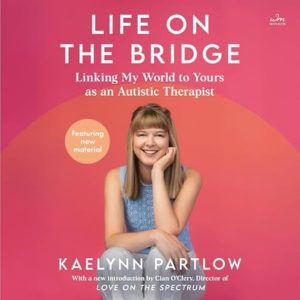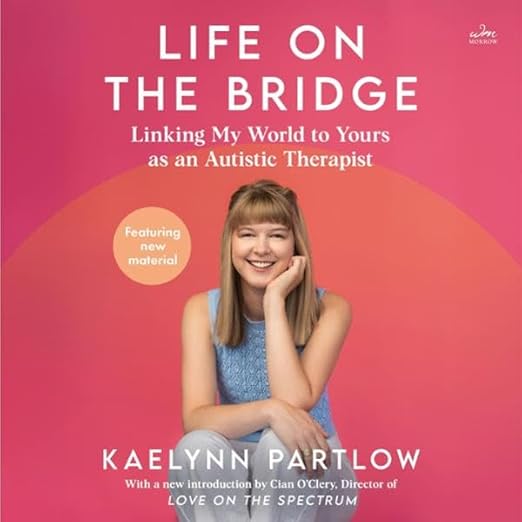
Netflix viewers know Kaelynn Partlow from Love on the Spectrum, where her direct, unfiltered communication style made her one of the show's most quietly compelling cast members, and Life on the Bridge is what happens when that same directness gets put in service of an actual clinical framework. Partlow is a working ABA therapist as well as an autistic advocate, and this audiobook is narrated by her, in her own voice, walking listeners through behavior, communication, and the daily mechanics of understanding autism from a rare vantage point: someone qualified to explain it professionally and living it personally at the same time.
Partlow's Bridge Curriculum Comes With Audiobook-Only Extras
The content is organized as a genuine curriculum rather than a loose memoir: what autism is and isn't and the misunderstandings that follow from confusing the two, communication strategies for avoiding common breakdowns, the origin and mechanics of meltdowns, stimming, and sensory distortion, the daily realities of autism-related loneliness and disability accommodation, and a plain-language walkthrough of DSM-V diagnostic levels and therapy routes including ABA. That's a lot of structured ground covered in five hours and forty minutes.
The title itself does real work. Partlow frames herself as a bridge between autistic individuals, their families, and professionals, three perspectives the book describes as historically difficult to reconcile, and that bridging framework shapes every chapter rather than functioning as just a catchy title.
The audiobook edition includes material the print book doesn't: a new introduction read by Cian O'Clery, the director of Love on the Spectrum, and a bonus conversation between Partlow and Lisa Lane, co-CEO of the real nonprofit Project Hope Foundation. Both additions are genuine audiobook-exclusive value, not padding.
ABA, applied behavior analysis, is the specific therapeutic framework Partlow practices professionally, and it's also one of the more debated approaches within autism therapy, with real, ongoing disagreement inside the autistic community about its methods and history. Partlow addresses this directly rather than avoiding it, walking through what ABA is, what it isn't, and why the debate exists at all, which gives the book more credibility with skeptical listeners than a framework advocate simply assuming the audience already agrees with her professional approach going in.
The Common Questions section tackles material many autism guides avoid entirely: what DSM-V diagnostic levels actually mean in practice, why they matter for accessing services, and how a listener should think about therapy options including but not limited to ABA. Partlow handles these more clinical, sometimes contentious questions with the same directness as the rest of the book, refusing to soften genuinely complicated answers into false simplicity.
The book's framing around immediate, actionable options rather than long-term theoretical understanding is a deliberate choice that shows throughout; nearly every chapter ends with something a listener could try that same day, whether that's a specific communication adjustment or a concrete way to reduce sensory overload in a shared space.
Temple Grandin's Endorsement Backs Partlow's Own Voice
Self-narration here isn't a stylistic choice, it's the entire premise of the book. Partlow's ABA therapist training shows up in her pacing and structure, while the first-person authenticity of an autistic narrator explaining autistic experience from the inside is not something any hired voice actor, however skilled, could replicate.
The endorsements carry unusual weight for this specific field. Temple Grandin, whose own reputation in autism advocacy is enormous, praised Partlow's 'practical pointers on how to be more direct and specific when talking to autistic individuals,' and a Furman University psychology department chair called Partlow poised to become 'this generation's Temple Grandin.' Those aren't casual jacket-copy compliments; they're specific professional endorsements from people positioned to actually judge the claim.
Listener reaction extends well past the autism community narrowly defined. One reviewer with ADHD and OCD, married to someone with dyslexia, called the book 'relatable and eye-opening' for neurodivergence broadly, not just autism specifically, while another recommended it for parents, caregivers, and therapists alike.
Partlow appeared on the first season of Love on the Spectrum as one of the cast members looking for connection herself, not as a hired expert commentating from outside the experience, and that distinction matters throughout this book. Her own dating history on the show, including a relationship that ultimately didn't work out, means the interaction and loneliness chapters here come from recent lived experience rather than theoretical distance.
The bonus conversation with Lisa Lane adds a service-provider's operational perspective that the solo-narrated chapters don't otherwise cover; where Partlow speaks from clinical training and personal experience, Lane speaks from having built and run an actual nonprofit autism service organization, and hearing the two perspectives in direct conversation rather than summarized separately gives listeners a fuller sense of how advocacy translates into real-world service delivery.
Not a Memoir, More a Clinical Understanding Guide
A supplemental enhancement PDF accompanies the audiobook, but this is framed as genuinely supplemental rather than essential the way a true workbook would be; audio-only listeners lose less here than in books built entirely around written exercises.
This is a communication and understanding-focused guide rather than a clinical diagnostic manual or a substitute for ABA certification training. It serves the audiences it names well, but shouldn't be mistaken for formal professional coursework.
This is explicitly a communication and understanding guide rather than a memoir, so listeners expecting extended personal storytelling about her own life or the show itself will find the book stays disciplined, returning quickly to instructional content whenever a personal anecdote appears rather than lingering on it.
Listeners hoping for a comprehensive academic literature review of autism research should recalibrate expectations; this stays grounded in practical, lived, and clinical application throughout rather than surveying competing research findings or academic debates in the field at any length.
Listeners should know this audiobook moves at a brisk, information-dense pace suited to its relatively short five-hour-and-forty-minute runtime; it covers a lot of clinical and personal ground quickly, which rewards a second listen or active note-taking more than a single passive pass straight through.
For Families and Educators Seeking Lived Experience
This is built for parents and family members of autistic individuals, therapists, educators, and autistic listeners themselves who want to hear their own experience reflected back with real clinical precision rather than secondhand interpretation.
Educators working directly with autistic students in mainstream classrooms will find the interaction and accommodation chapters especially practical, since they're framed around real daily scenarios rather than abstract policy language pulled from a training manual.
Skip this if you need a structured clinical training course or formal ABA certification material rather than an accessible advocacy-and-understanding guide; Partlow calls this a bridge for a reason, and a bridge isn't the same thing as a textbook.
Questions Listeners Ask
Does Kaelynn Partlow narrate this audiobook herself, or is it read by a professional voice actor?
She narrates it herself, and that self-narration is central to the book's value; the combination of her own autistic experience and her ABA therapist training isn't something a hired narrator could replicate.
Is this audiobook only useful for parents of autistic children, or does it help autistic adults too?
Both, and reviewer reaction backs that up directly, including a listener with ADHD and OCD who found it relatable well beyond autism specifically, alongside recommendations aimed at parents, caregivers, and therapists.
Do I need to have watched Love on the Spectrum to understand this audiobook's context?
No, though it helps place Partlow. The Netflix connection is a helpful entry point for newcomers, but the audiobook's actual content stands entirely on its own as a communication and understanding guide.