Quick Take
- Narration: Daniel C. Dennett reads Dan Barker’s text with the dry, considered authority of a philosopher who means every word; the casting of one prominent atheist intellectual reading another’s work creates an unusual sense of dialogue-within-monologue.
- Themes: secular meaning-making, critique of purpose-from-above theology, the personal testimony of deconversion
- Mood: Earnest and argumentative, with stretches of genuine warmth and occasional polemic sharpness
- Verdict: A sincere, well-reasoned case for atheist purpose that works best for readers already sympathetic to the project; those expecting equal time on the title theme versus anti-theist argument will find the balance uneven.
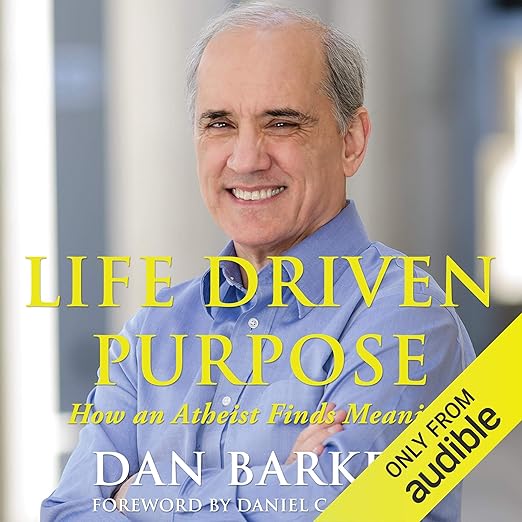
I picked this one up on a Sunday morning, which felt appropriate. I have been thinking about meaning outside religious frameworks for some time, and Dan Barker’s biography, a former pastor who walked away from evangelical Christianity to become co-president of the Freedom From Religion Foundation, promised a particular kind of authority on the subject. What I found was a book that does two things simultaneously, and does them with different levels of success.
Life Driven Purpose was written explicitly as a counter to Rick Warren’s The Purpose Driven Life, which has sold tens of millions of copies on the proposition that life’s meaning flows downward from God. Barker inverts that proposition: meaning and purpose arise from within life itself, not from a source beyond it. That is the thesis, and it is a meaningful one. The question is how much of the eight-hour runtime is spent developing it versus dismantling Warren’s framework specifically.
Our Take on Life Driven Purpose
The casting of Daniel C. Dennett as narrator is one of the more interesting decisions in secular audiobook publishing. Dennett, the philosopher and longtime atheist public intellectual, brings a voice of settled authority to Barker’s text. He does not perform enthusiasm; he reasons through the material with a kind of careful deliberateness that suits Barker’s argumentative mode. There is an implicit endorsement in the casting, one philosopher of atheism giving voice to another’s argument, and it shapes the listening experience in ways that are hard to fully separate from the content itself.
The reviewer who called the book brilliant and very meaningful captures one audience’s experience. The reviewer who noted that only a small amount of time is spent on Life Driven Purpose specifically and that most of the book is logical arguments about why there is no god captures a different but equally honest response. Both are accurate, and which description fits your experience will depend almost entirely on what you came looking for.
Why Listen to Life Driven Purpose
Barker’s personal testimony is the book’s most distinctive offering. His account of his own deconversion, from evangelical pastor to secular humanist, is genuinely gripping in a way that straight philosophical argument sometimes is not. The journey from inside a worldview to outside it carries the kind of experiential authority that no amount of theoretical argument can fully replicate, and Barker uses it well to ground his case in something more than polemic.
The smaller anecdotes about his family, flagged warmly by one reviewer who described loving the little anecdotes about Mr. Barker’s family, add a texture of lived happiness that serves the book’s central argument more effectively than most of its philosophical passages. If life driven by internal purpose rather than divine mandate can be this ordinary and this good, that is itself a kind of evidence.
What to Watch For in Life Driven Purpose
One reviewer offered the most practically useful assessment of the book’s structure: the author spent more time on the anti-theist argument than on the titled theme. If you are already persuaded that there is no god and you are looking specifically for a developed account of how secular meaning-making actually works in practice, you may find the book spending more time relitigating the debate than advancing the positive case. Sally Davis, who has read extensively in atheist literature, noted that there was not a lot of new material here, but found the Dan Barker specificity worth the listen.
Dennett’s narration is measured to the point of being occasionally flat in the more personal passages, where Barker’s warmth would benefit from a livelier delivery. It is a technically capable performance, but the match between narrator and material is slightly awkward in those emotional registers.
Who Should Listen to Life Driven Purpose
The ideal listener is someone in, or recently through, a process of religious deconversion who is looking for language and framework for the other side. Those already comfortable in secular worldviews will find it confirmatory rather than revelatory. Those still inside religious belief who are genuinely curious about atheist meaning-making may find it more polemical than inviting. Anyone who wants a sophisticated philosophical treatment of secular ethics should look to Dennett’s own work or to writers like Kai Nielsen; this is a personal and argumentative book, not a systematic one.
Frequently Asked Questions
Why is Daniel C. Dennett narrating a book he did not write?
Dennett, a prominent philosopher of science and one of the leading intellectual voices in contemporary atheism, was chosen to narrate Barker’s book as a gesture of solidarity and endorsement within the secular humanist community. The casting creates an unusual listening experience, with one atheist public intellectual giving voice to another’s argument.
How much of the book is actually about building a secular purpose framework versus arguing against religion?
This is the book’s acknowledged tension. Several reviewers note that the anti-theist argument occupies more runtime than the positive case for life-driven purpose. If you want a fully developed secular ethics of meaning, you will need to supplement this with other reading. If you want a vigorous, personal case against the premise of The Purpose Driven Life, the book delivers that thoroughly.
Is Life Driven Purpose accessible to readers who are not already secular or atheist?
The book is primarily written for readers sympathetic to its premises. Those inside religious traditions who are genuinely curious may find it more polemical than welcoming in places. That said, Barker’s personal deconversion narrative is honest about the real costs and real gains of his journey, which gives it more texture than pure polemic.
Does Dan Barker’s background as a former pastor add credibility to his arguments about religious meaning?
For many readers, yes. Barker spent years inside evangelical Christianity as a pastor and musician, which gives his account of what religious meaning feels like from the inside an authority that purely secular thinkers cannot replicate. His testimony about why he left and what he found on the other side is the book’s most distinctive contribution.