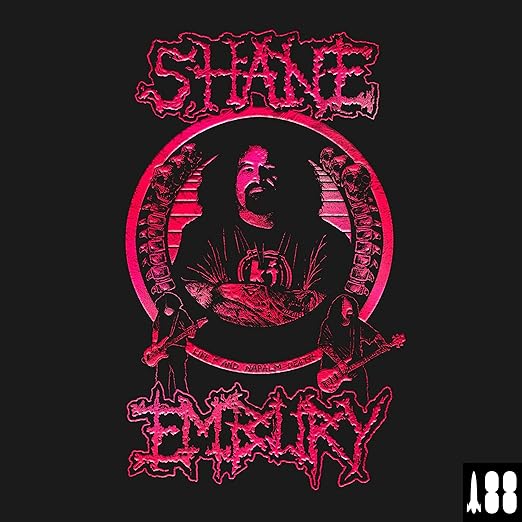
Grindcore was never a genre that made room for reflection, which is part of what makes this audiobook worth noticing. Shane Embury has been a major figure in that scene for more than four decades, and Rocket 88 gives him four hours and forty-six minutes to account for all of it, with Embury reading the book himself. The pitch is double: a life story, and a history of Napalm Death's part in how grindcore developed from the beginning to the present. Two subjects share one running time, and the balance struck between them is the first thing a buyer needs to know.
Narrating Every Bandmate Into His Own Register
The description promises the scene as Embury experienced it, the sights, sounds, places and people at the center of both the music and the life, told in what the copy calls his own inimitable style. That phrasing is a warning as much as a sell. A player's memoir of a small, fast, self-documenting scene tends to run on names, gigs and van stories rather than on strict chronology, and no chapter map appears anywhere a buyer can see it. What arrives is a voice, not a reference work.
Embury holds the reading credit himself, which matters more here than it would on most memoirs. A book about a band is a book full of other people talking, and a single reader will not separate them; every quoted bandmate, promoter and label owner arrives in the same register as the man remembering them. In exchange, nobody stands between the story and the man who was actually there, and the names in it come from someone with no need to guess at them.
Length is the number that shapes everything else. Set against more than four decades, the recording allows barely an hour for each of them, which forces the kind of selection the copy never explains. Anyone hoping for a record-by-record walk through the catalog will find the arithmetic against them before they start. What that scale suits is a portrait: the atmosphere of a scene, the people who built it, and the incidents Embury still thinks are worth telling.
He Played Bass Through the History He Tells
The strongest argument for this one is positional. Embury is not a journalist reconstructing a scene from interviews; he played bass through it, and the copy ties his story directly to the history of grindcore itself. Books written from inside a subculture tend to get the texture right in a way outside accounts rarely manage, and they get the arguments, the logistics and the practical business of how records were actually made. That is the trade on offer, and for this subject it is a good one.
Scope is the second argument in its favor. A history of Napalm Death running from the beginning to the present, written by the band's bassist, is not a common object. Most band books are either fan compilations or single-era snapshots. The copy is explicit that this one intends to be both a personal account and a history of the group's role in a genre, and it is that second half, the claim to explain a movement rather than just a career, that gives the recording its reason to exist.
Rocket 88 put it out on February 12, 2026, recently enough that the usual reference points for a band biography are not yet in place. The page shows eight ratings and a 4.8 average, a warm number resting on a very small base. Weigh it accordingly: at that count a single low vote drags the display down by several tenths, and the average tells you considerably less than the subject and the credit do.
A Review Eighteen Months Older Than the Book
Exactly one written response sits under this listing, and its date is the problem. It was posted on August 1, 2024, roughly eighteen months before the February 2026 recording existed, which means the only opinion attached to this page was formed on a different edition. It cannot speak to the audio, because the audio did not exist yet. That is nobody's fault, and it is worth stating plainly, because eight ratings and one warm response can look like consensus at a glance.
That single response is also second-hand. The buyer bought it as a gift and relays what the recipient said afterward: that he read it within a few days, and that he found out things he did not already know. The second clause is genuinely useful, since it implies a recipient who already knew something about the band and still learned from it. It remains one person's summary of another person's reaction, delivered in two sentences.
One last thing to check is the arithmetic of ambition. More than four decades of a scene and one life, both promised, both inside the same recording, means large stretches of the story are simply not here, and the copy does not say which parts were cut. If you come wanting the origin of a specific record or the story behind a specific lineup change, you may find that period handled in a paragraph. Go in expecting a selection rather than a survey.
Atmosphere Over Dates and Personnel
The clearest fit is a listener who already cares about the band and wants the version told by a member rather than by a critic. If your shelf holds scene memoirs, and you value the texture of how a subculture actually operated over a tidy chronology, this sits comfortably among them. It also suits anyone curious about grindcore as a development rather than as a noise, since the copy positions the book as an account of how the genre grew, not only of who played on what.
Skip it if you want an authoritative band history with dates and personnel you can cite. The scale rules that out, and so does the form: a first-person account delivered in a player's own style is a different instrument, closer to a long conversation than to a reference. Anyone assembling a discography timeline will do better with a book that promises one, and this one never does.
A middle case exists too: the curious outsider who has heard the genre named and never heard the story behind it. For that listener the compressed scale is an advantage rather than a limitation, because the book finishes before an unfamiliar scene turns into homework. Come for the person and the period, not for completeness. This is a player's account of a scene, sold on that basis and worth having on that basis.
A Few Questions About Life?... and Napalm Death
Who reads the audiobook, and does the band history fit alongside the memoir?
Shane Embury reads his own book, and Rocket 88 released the recording on February 12, 2026. The copy promises his life story alongside the band's role in how the genre developed, start to finish, so the two threads run together rather than sitting in separate sections.
Does the running time do justice to four decades in one scene?
It works out to roughly an hour per decade, so what reaches you is curated rather than comprehensive. Two mandates, one life and one band, compete for the same minutes. Expect people, places and specific incidents instead of a release-by-release account of the catalog.
Does the audiobook work if you do not already follow Napalm Death?
The copy sells atmosphere and personnel rather than a discography, which favors a curious outsider. Names in this kind of memoir do tend to arrive without introduction, though, and no glossary or timeline is advertised, so some familiarity with the band smooths the ride.
Why does the title look different in the description than in the header?
The listing shows a lowercase and in the title while the description capitalizes it. That is trivial to read past, but small variants like it split search results and library records, so try both spellings if you are hunting a print copy or a second edition.