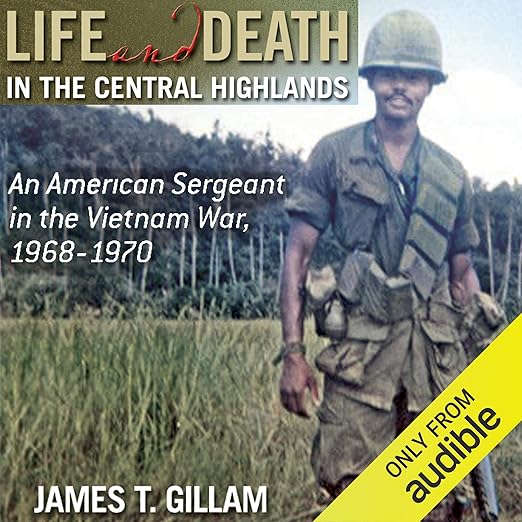
Down a lightless tunnel in the Central Highlands, two men, and one of them killing the other with his hands. This audiobook does not hold that scene back for a climax. It sits in the middle of a life that also contains a failed freshman year, a draft notice and, eventually, a university lectern.
From Trying to Avoid Contact to Running Ambushes
James T. Gillam was a poorly focused student at Ohio University in 1968, dismissed and then drafted. Unlike most Black men entering the Army that year he was made a sergeant and an instructor at the infantry school at Fort McClellan, and in September of 1968 he joined the First Battalion, 22nd Regiment of the 4th Infantry Division. Within a month, by his own account, he went from a sergeant trying to avoid contact to a soldier planning and running ambushes. He walked point regularly. He went into tunnels. By January 1970 he had a Combat Infantry Badge and a promotion, and by that spring he had been shot twice and hit by shrapnel twice.
What makes this memoir unusual is sitting in its own review column. One five-star entry reads, in full, that the writer was with the 22nd during that period and that this is a good book. Another comes from somebody who served in 1968 and calls the author educated, articulate and a fine stylist. When two responses on a page come from people who were in uniform during that war, one of them in the same regiment in the same months, you are looking at something closer to corroboration than to criticism. Military memoirs attract exactly that readership, and it is unforgiving when the details are wrong.
Confession Risks Becoming Performance in the Wrong Voice
Double vision is the reason to spend the eight hours. Gillam wrote this after becoming a history professor, which means the man describing the ambush is also the man who can place it inside the strategy that produced it. A five-star response captures the effect precisely: having taken a demanding college course on the American war in Vietnam, that reader found the book delivered both the day-to-day rigors of the bush and a history lesson covering both sides, and rated it more useful than the course.
Rare in itself, that combination also suits audio unusually well. A pure combat narrative delivered aloud becomes exhausting in about ninety minutes, because the sensory pressure never lets up and you have no page to look away from. Here the analytical passages act as breathing room, and the movement between them is the book's actual structure: contact, aftermath, explanation, back to contact. Eight hours and twenty-two minutes is roughly the length of two working days, and the material earns every one of them.
Todd Belcher takes on a first-person account of things the author did rather than things that happened to him, which is a specific problem for a reader. The admissions in this book are not softened. Gillam describes becoming a savage, describes the strangling, describes the determination to get home that made him more dangerous rather than less. A voice that oversells any of that turns confession into performance, and a voice that underplays it sounds evasive. It ranks among the harder jobs in nonfiction narration, and it is worth two minutes of the sample before you commit.
A Birthday Present That Isn't a Book Review
Know what you are agreeing to hear. This is not a reflective memoir about the meaning of service. It is an account of killing at close range, written by the person who did it, including hand-to-hand fighting in the dark and the night the enemy got inside the wire of a firebase during the Cambodian invasion. The book states that the nightmares and the guilt eventually left him, which is a harder thing to sit with than the alternative and is precisely why the account matters.
Fifty-seven ratings produced only five written entries, which makes the column thinner than the badge suggests. Of those, one is three words long under an automatically generated Four Stars headline, and another is not about reading the book at all. That second entry describes buying a signed copy as a birthday present for a grandson considering enlistment, and reports that the author, described as a local writer, offered to answer the teenager's questions personally. It is a lovely detail about the man and tells you nothing about the edition on sale here.
Everything else on this record is refreshingly consistent, which is worth saying because it so often is not. The series field matches the description, both placing the book fifth in the North Texas Military Biography and Memoir line, and the academic press behind the audio edition is the one you would expect for a university-press memoir. The only thing missing is a content note, which a memoir this violent could reasonably carry, and which a buyer shopping for a gift would certainly want.
The Honest Version of the Enlistment Conversation
Anyone reading seriously about the American war in Vietnam should have this on the list, and it belongs especially in the hands of readers who have only encountered the war through officers, journalists or film. A Black draftee who became a sergeant and an instructor before he ever saw combat is a vantage point the popular accounts rarely take, and the book is explicit about how unusual his path was at the time.
Approach with care if you are a veteran of close combat, or if graphic descriptions of killing sit badly with you, because the most memorable passages are the worst ones. And if you are considering enlistment, or you love somebody who is, this is the honest version of the conversation: not a recruitment argument, not a warning, an account of what a young man did and what it cost him to stop doing it.
- Narrator: Todd Belcher reads a first-person account of the author's own killing, a balancing act between confession and performance that the sample will settle for you.
- Subjects: Vietnam infantry combat, a Black draftee's unusual path to sergeant, tunnel warfare, survival and its aftermath.
- Tone: Direct, unsparing, analytical between the firefights.
- Bottom line: One of the few Vietnam memoirs whose author can explain the strategy that put him in the tunnel, and one of the few whose review column includes someone who served in the same regiment.
Questions Listeners Ask
How graphic is this audiobook?
Extremely, and without euphemism. The account includes killing at close quarters, fighting inside a tunnel with no light, being wounded four times, and a night attack on a firebase. The author describes his own conduct in blunt terms rather than distancing himself from it.
Is the audiobook suitable for a teenager thinking about enlisting?
For an older teenager, yes, on the understanding that it pulls nothing. What it offers is neither encouragement nor deterrence, just a precise account of what the job asked of one young soldier, including the parts he is least proud of and the ones he could not explain to himself afterward.