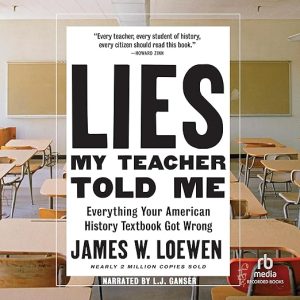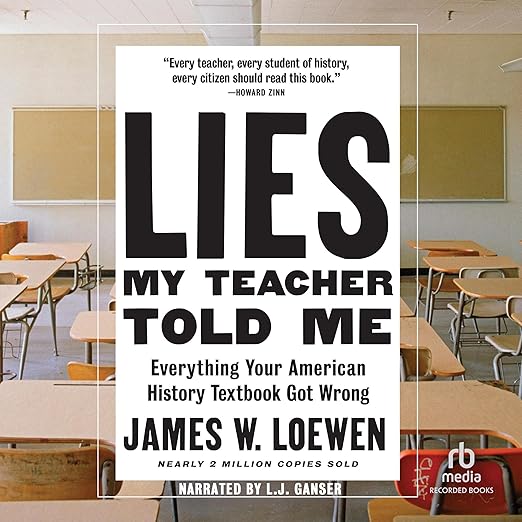
I was a teenager when Lies My Teacher Told Me was first published in 1995, and I remember the controversy it generated among history teachers: was it an attack on educators, or an attack on the system that constrained them? James Loewen's updated second edition clarifies his position in a new preface that is, if anything, more pointed than the original. He is not blaming teachers. He is blaming the textbooks that teachers are required to use, and the cultural and economic forces that keep those textbooks sanitized, heroicized, and stubbornly resistant to complexity.
The audiobook runs seventeen and a half hours, narrated by L.J. Ganser, and it covers an enormous range: pre-Columbian history, the myths around figures like Helen Keller and Christopher Columbus, the treatment of Reconstruction, the first Thanksgiving, My Lai, 9/11, and the Iraq War, all viewed through the lens of what American history textbooks choose to include, exclude, or distort. Loewen evaluated twelve leading textbooks for the first edition and six additional books for the second. The second edition also adds analysis of how inadequate history education contributed to the political climate of the mid-2010s, which gives the book an urgency the original could not have anticipated.
How Lies My Teacher Told Me, 2nd Edition Holds Up
Howard Zinn's endorsement on the cover, describing the book as both a refreshing antidote to what has passed for history and a one-volume education in itself, is accurate but undersells the methodological rigor Loewen brings to his argument. This is not a rant. It is a sustained, documented comparison between what the historical record actually shows and what textbooks present, chapter by chapter, figure by figure. The American Book Award and the Oliver Cromwell Cox Award for Distinguished Anti-Racist Scholarship reflect that rigor. When Loewen is at his best, he is not telling you what to think; he is showing you the difference between two accounts of the same event and asking you to notice that.
L.J. Ganser's narration is well calibrated to the book's academic register. He reads Loewen's arguments with authority rather than advocacy, which is the correct approach for a book that wants to be persuasive through evidence rather than tone. The seventeen-hour runtime is substantial but not repetitive; each chapter opens new territory rather than rehearsing the same critique with different names attached. Multiple reviewers describe the book as eye-opening even for people who considered themselves informed about this period and these subjects, which is a meaningful endorsement. One reviewer who lived through the era of the Loving v. Virginia case described learning through a different Loewen-adjacent title that they had known almost nothing about events unfolding around them in real time. That kind of realized ignorance is what this book specializes in producing.
Weak Spots in Lies My Teacher Told Me, 2nd Edition
One substantive critical review flags the book's title as potentially misleading and insulting to teachers, who are often the intended primary audience. That critique has merit. Loewen's argument is that textbooks fail teachers as much as they fail students, but the title places blame in a direction his argument does not fully support. The second edition also reflects a specific political moment in the mid-2010s in its new preface, and Loewen's commentary on that moment will resonate differently depending on where listeners sit politically. The academic historians whom Loewen calls out for abandoning truth in favor of misguided objectivity will not find him a neutral observer.
The Right Listener for Lies My Teacher Told Me, 2nd Edition
This is essential listening for anyone who teaches American history at any level, for students approaching US history seriously, and for adult listeners who want to audit what they were actually taught versus what the historical record supports. It functions well as a companion to more narrative histories of the same periods, including Howard Zinn's own work, which Loewen's analysis implicitly echoes. Those looking for a purely celebratory account of American history should know upfront that this book exists to challenge exactly that impulse.
Does the second edition differ significantly from the 1995 original in its conclusions?
The core argument remains the same: American history textbooks systematically distort, omit, and heroicize in ways that undermine genuine historical literacy. The second edition adds evaluation of six additional textbooks, a new preface connecting inadequate history education to contemporary political dynamics, and updated analysis throughout.
Is Loewen's critique aimed at teachers or at the educational system more broadly?
Primarily at the system, specifically at the textbook industry and the cultural and economic incentives that keep textbooks sanitized. One critical reviewer noted that the title unfairly implies teacher blame despite Loewen's actual argument. Loewen explicitly addresses teachers as part of his intended audience.
Is a 17-hour audiobook justified for this content, or does the argument feel padded?
Reviewers do not describe the content as repetitive. Each chapter addresses different historical figures, events, or periods, so the length reflects genuine breadth. The book originated as a survey of twelve history textbooks, and that scope naturally generates substantial content.
How does this book hold up for listeners who already consider themselves well-read in American history?
Multiple reviewers who described themselves as history buffs or informed readers reported learning significant new material. The book's focus on comparing textbook accounts to primary and secondary historical sources means it surfaces information that even engaged readers may not have encountered.