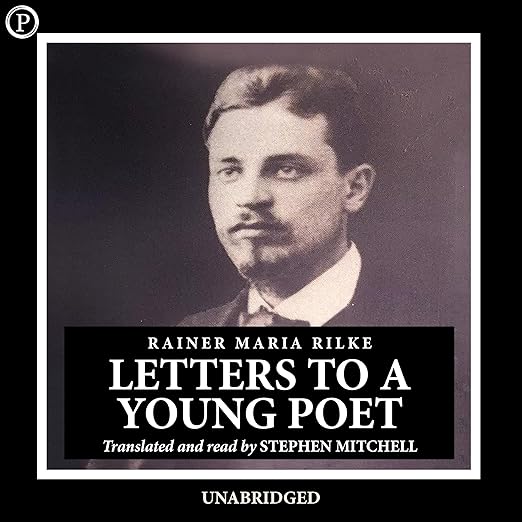
In Brief
- Performance: Stephen Mitchell is listed as narrator on this edition - note that this Penguin release's production notes describe a dual performance by Max Deacon and Dan Stevens, so verify the specific recording before purchasing if narrator casting matters to you.
- What it covers: Creative solitude as necessary practice, love and suffering as formative forces, the ethics of advice
- Feel: Quiet and demanding - requires active listening rather than passive absorption
- Our call: Rilke's ten letters to Franz Kappus contain more practical clarity about the creative life than most full-length books on the subject - under ninety minutes, this audiobook is among the most concentrated listens in the literary catalog.
Rilke wrote his first letter to Franz Kappus in 1903, when Kappus was a nineteen-year-old officer cadet hoping for judgment on his poems, and what Rilke returned was not criticism but a philosophy of creative living. This audiobook edition of Letters to a Young Poet by Rainer Maria Rilke, narrated by Stephen Mitchell, runs just over an hour and eighteen minutes - a duration that matches the material exactly, since Rilke's ten letters were never long and derive their force from compression rather than elaboration. For anyone who has spent years in proximity to creative work, this is a record that rewards return visits more than most recordings of comparable length.
The letters are justly famous and frequently quoted, often in fragments that reduce them to inspirational abstraction. Hearing them in full sequence, in audio, restores their character as an actual correspondence: Rilke addressing a specific young man, at specific moments in his development, with the patience of someone who takes the questions seriously rather than deflecting them with easy encouragement. The central instruction - go into yourself and find the deep place where your life takes its rise - is not mysticism but methodology. Rilke is describing a practice of attention that he himself maintained with discipline, and the letters communicate that practice through example as much as through explicit instruction.
This Penguin edition includes the Letter from a Young Worker, written near the end of Rilke's life, which functions as a counterweight to the main correspondence. Where the letters to Kappus are intimate and advisory, the Letter from a Young Worker is a polemic against organized Christianity's appropriation of suffering - more angular and confrontational in tone, and valuable precisely because it shows Rilke's thinking in a register different from the reflective quietness of the main letters. Lewis Hyde's introduction situates the letters historically, and Charlie Louth's afterword addresses the religious and sexual dimensions of Rilke's language with scholarly care. At under ninety minutes total, this audiobook covers more critical apparatus than its running time suggests, and the supplementary material rewards attention rather than serving as packaging around the core text.
More Than Ambient Wisdom, Thanks to the Afterword
One reviewer describes the experience of returning to this book as an adult and feeling the particular guilt of having encountered it in college without fully receiving it. That pattern is common with Rilke: the letters are short enough to seem simple on first encounter, and their simplicity conceals how much they actually ask. The audio format makes the demand legible in a way the page sometimes does not. Hearing the letters spoken aloud slows the reader down to Rilke's pace, prevents the skimming that erodes meaning in short texts, and makes the rhetorical structure of each letter audible - the way Rilke circles a question before answering it, the way his answers tend to reframe rather than resolve the problem being posed.
The secondary materials, Hyde's introduction and Louth's afterword, are worth the listening time on their own terms. Hyde's framing of isolation as creative force is directly relevant to how contemporary artists think about distraction and deep work. Louth's attention to Rilke's religious and sexual language opens the letters to a reading that goes beyond their most quoted passages and resists the reduction of Rilke to an inspirational-quote source. Together they provide a critical frame that prevents the audiobook from functioning merely as ambient wisdom and pushes it toward genuine engagement with what Rilke was actually doing in each of his ten letters to a young man he had mostly never met.
A Formulation of Solitude as Chosen Separation
The third and fourth letters contain Rilke's most precise formulation of solitude as creative condition - not loneliness but chosen separation, which he presents as the natural state of serious creative work rather than something to be overcome or apologized for. These letters also contain his thinking on love, which he treats as a relationship between two solitudes that protect and greet each other - a formulation that has been quoted widely enough to become familiar but deserves to be heard in its full argumentative context rather than as a standalone aphorism. The Letter from a Young Worker, which comes at the end of this edition, shifts from private advice to public argument and demonstrates that Rilke's thinking about suffering and meaning was not only directed inward toward individual artists but outward toward the social uses of religion in modern life. It is less often read than the main correspondence and more often overlooked by anthologists, but it sharpens the whole collection.
A Single Focused Session Beats Commute Listening
Writers, artists, and anyone engaged in creative practice will find the most direct application, but the letters' frame is broad enough to speak to anyone asking how to live seriously rather than just efficiently. Listeners who have encountered the book in fragments through quotation will find that the full sequence changes its meaning considerably - Rilke's individual formulations are powerful, but the arc of the correspondence, the way his thinking develops across ten letters over five years, is what gives the letters their permanent resonance. The under-ninety-minute runtime makes this ideal for a single focused session rather than commute listening, since the letters reward continuous attention rather than intermittent encounters. Skip it if you want narrative and emotional arc - this is philosophical correspondence, not memoir or fiction, and the pleasure it offers is reflective rather than immersive.
A Few Questions About Letters to a Young Poet
Is the audiobook of Letters to a Young Poet narrated by a single voice, or does it use a cast format?
Officially, yes, Stephen Mitchell is the credited narrator here. But this specific Penguin release's own production notes point to something different: a two-voice recording, with Max Deacon and Dan Stevens splitting the performance rather than a single reader carrying it alone. Given that discrepancy, anyone who cares about who exactly is reading should double check the recording details before completing the purchase.
At just over an hour, is this audiobook long enough to be worth purchasing given its brief runtime?
For the material it contains, yes - Rilke's compression means that under ninety minutes carries more substantive content than many four-hour audiobooks. The brevity is a feature of the letters themselves, not a limitation of the recording, and multiple listens compound the value.