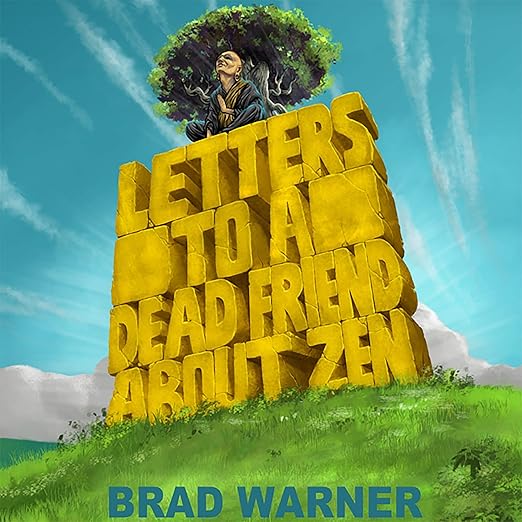
Quick Take
- Narration: Brad Warner reads his own work, and that intimacy is exactly what this material needs, his voice carries the grief and dry humor in equal measure without ever tipping into performance.
- Themes: Grief and impermanence, Zen practice as lifeline, authenticity over doctrine
- Mood: Quietly reflective, unexpectedly funny, and deeply personal
- Verdict: A rare Zen book that trusts the reader to sit with the uncomfortable parts rather than resolving them neatly.
I came to this one on a rainy Tuesday evening when I needed something that wasn’t trying too hard. I’d been putting off a difficult conversation with someone I’d grown distant from, and I wasn’t entirely sure why. Within the first thirty minutes of Brad Warner’s narration, I found myself pausing, not to take notes, but just to sit with what I’d heard. That almost never happens to me with audiobooks classified as religious or spiritual nonfiction.
The setup is deceptively simple: the night Warner learns his childhood friend Marky has died, he is about to speak to a group of Zen students in Hamburg, Germany. Rather than cancel the lecture, he goes. And then, as he continues touring Europe, he begins writing letters to his dead friend, explaining what he does, why he sits and meditates, what any of it means. What emerges is something far more honest than most Zen introductions manage to be.
Our Take on Letters to a Dead Friend About Zen
This is not a book that will teach you how to sit in the correct posture or outline the lineage of Soto versus Rinzai. Warner himself says plainly that he is not all that interested in Buddhism, he is interested in what is true. That single sentence does more to explain Zen than most introductory texts manage across hundreds of pages. The letters to Marky provide a container for ideas that might otherwise feel abstract or institutional, and grief turns out to be a surprisingly useful lens for examining attachment, impermanence, and the nature of consciousness.
Longtime Zen practitioners quoted in the reviews note that Warner’s translations of key texts come alive in ways that more scholarly renderings often do not. He goes into the original Japanese, explains his phrasing choices, and contrasts his approach with other translators, all without making it feel like a footnote-heavy academic exercise. His irreverence is real, not performed. He is the Gen X punk rocker who found himself ordained as a Zen priest, and that biographical fact matters here because the book never pretends otherwise.
Why Listen to Letters to a Dead Friend About Zen
Warner narrating his own work is the right call for this material. His voice is unhurried and conversational, occasionally self-deprecating, and the grief underneath everything comes through without melodrama. The humor lands because the timing is his own. There are moments where a professional narrator would have smoothed out the slightly awkward edges that Warner lets stand, and those edges are part of what makes the book feel true rather than polished. One reviewer with over two decades of Zen practice recommended it specifically for teachers, which tells you something about the level of substance underneath the accessible surface.
The structure, a series of letters written while on tour, means the book moves between reflection and anecdote naturally, never staying in abstract territory long enough to lose the listener. Warner writes about grief, about what it means to bow to nothing, about why sitting quietly still feels like the most important thing he can do with his time. These are not small questions, and he does not pretend to have resolved them. That honesty is the book’s greatest asset.
What to Watch For in Letters to a Dead Friend About Zen
One reviewer noted occasional sections where the wording felt forced or awkward, and that is a fair observation. Warner is not a literary stylist in the conventional sense, and some passages have the slightly uneven quality of someone working through ideas in real time rather than polishing a final manuscript. Whether you read that as a flaw or as authenticity will depend on what you’re looking for. If you want elegant prose, this is not the right book. If you want someone thinking honestly in front of you, it is exactly right.
There is also the question of prior Zen exposure. Warner assumes very little, so experienced practitioners may occasionally feel they are moving slowly through territory they already know. But the personal narrative around Marky’s death gives even familiar concepts a freshness that makes the listening worth it regardless of where you are starting from.
Who Should Listen to Letters to a Dead Friend About Zen
Frequently Asked Questions
Do I need prior knowledge of Zen or Buddhism to follow this audiobook?
No. Warner writes explicitly for someone who has no background in either, using Marky’s presumed ignorance as a framing device. That said, the book is substantial enough that experienced practitioners consistently report finding it worthwhile.
Does Warner’s self-narration work for a book this personal?
Yes, and arguably it is essential to the listening experience. His voice carries the grief and dry humor that a professional narrator would have to approximate, and the slight roughness in some passages feels authentic rather than unpolished.
Is this a book primarily about grief, or primarily about Zen?
Both, and the two are inseparable here. The death of Marky provides the emotional frame, while Zen provides the intellectual and philosophical content. Neither strand works without the other.
Is Running Blind the same as The Visitor by Lee Child?
That question belongs to a different book in this batch. For Letters to a Dead Friend About Zen specifically: the audiobook runs just over nine hours, which is a comfortable length for the amount of territory it covers.