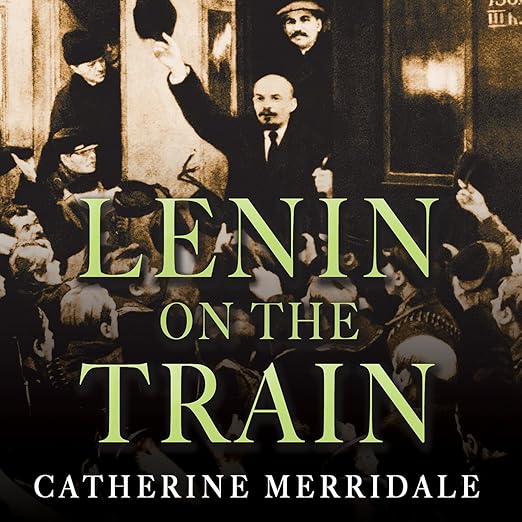
Quick Take
- Narration: Gordon Griffin delivers a measured, authoritative performance that suits the book’s dense historical texture without ever making it feel like a lecture.
- Themes: revolutionary intrigue, wartime espionage, the contingency of history
- Mood: Tense and atmospherically detailed, with stretches of deliberate pacing
- Verdict: A serious work of narrative history that rewards patient listeners interested in the intersection of geopolitics, ideology, and personality at a pivotal twentieth-century moment.
I finished Lenin on the Train on an overcast Sunday, about halfway through a longer stretch of reading on early Soviet history. Catherine Merridale had been on my list for a while, largely because of the reputation of her previous books on the Russian experience of the Second World War. I came to this one with some prior familiarity with the period and a particular curiosity about how she would handle the journey itself, a moment that has passed into a kind of compressed mythology about the origins of the modern world.
The setup is genuinely dramatic. April 1917. Tsar Nicholas II has abdicated. Lenin is in Zurich, thousands of miles from Petrograd, and the revolution is happening without him. To return, he has to cross Germany, Russia’s enemy in the ongoing war, and accept German assistance to do it. The sealed train through enemy territory, arranged with German military intelligence that had its own reasons to want Lenin back in Russia and destabilizing it from within, is one of those real events that sounds constructed. Merridale does not let the inherent drama carry the book; she earns it through research and context.
What the Journey Actually Occupies
One reviewer flagged something that prospective listeners should know before they begin: the train journey itself occupies roughly twenty pages out of nearly three hundred. If you come to this expecting a sustained, immersive account of the rail crossing, you may find the structure disorienting. Merridale’s book is more accurately a study of Lenin’s character, the political context of 1917, and the underground networks of espionage and finance that made the journey possible. The journey is the spine, but the flesh of the book is the world it moved through, and that world is rendered in compelling detail.
Merridale traces the counter-espionage operations, the German Foreign Office’s calculations, the Swiss exile community’s internal tensions, and Lenin’s own formidable capacity for ideological certainty. One reviewer described the book as producing a portrait of a highly intelligent and well-read individual who spoke many languages fluently and read incessantly, and whose passion for his cause was absolute. That portrait is built slowly, through accumulation of detail rather than dramatic revelation, and on audio the pace can feel demanding in places. Merridale is not writing for impatient readers.
The question of what Lenin himself thought about accepting German assistance is handled with characteristic candor. Merridale does not pretend the archival record yields a simple answer. Lenin publicly dismissed the notion that the journey represented any kind of compromise with capitalist or imperialist powers, framing it as a purely tactical matter of revolutionary necessity. Whether he was fully candid with himself about those terms is one of the questions the book leaves productively open. What is clear is that both sides understood they were entering a transaction with significant costs, and that each calculated those costs differently.
The German Calculation No One Discusses Enough
The aspect of this history that Merridale handles most interestingly is the German side of the arrangement. The German military and Foreign Office were not naive idealists helping a revolutionary out of sympathy. They were betting that Lenin’s return would accelerate Russian instability and potentially force Russia out of the war, relieving pressure on the Eastern Front. One reviewer noted that after reading this book, you realize the twentieth century owes not one but two catastrophes to German strategic miscalculation. That framing is blunt, but the underlying point is well made: the Bolshevik revolution was not solely an internal Russian event. It was partly a product of international geopolitics and wartime desperation playing out across multiple capitals simultaneously.
Merridale is good on the financial dimensions too. The question of how the revolution was funded, and what strings might have been attached to that funding, is handled with appropriate historiographical caution. She draws on available evidence without overclaiming, which distinguishes her from more polemical treatments of the same period.
Gordon Griffin and the Challenge of Dense History
Gordon Griffin is a reliable and experienced narrator whose voice carries an appropriate weight for serious historical narrative. He does not attempt to dramatize the text in ways that would feel incongruous; his is a clear, well-paced delivery that keeps the listener oriented through what is, in places, a dense web of names, dates, and political factions. For a book covering Russian revolutionary politics and German wartime bureaucracy simultaneously, that clarity is not a small thing. He handles the Russian and German names with consistency, which matters more than it might seem when you are following a cast of dozens across multiple countries and organizational affiliations.
At just over ten hours, the audiobook is a substantial commitment. It does not feel padded, but it does reward listeners who are willing to be patient with a book that builds rather than accelerates toward its conclusions.
For Serious History Readers and Those Who Should Approach Differently
This is the right audiobook for listeners already interested in the Russian Revolution, early Soviet history, or the geopolitics of the First World War. Merridale’s writing is nuanced and her research is evident on every page. If you want something that reads like a thriller and keeps the throttle open throughout, this may frustrate you. The disclaimer from one reviewer who expected a sustained account of the train journey and found something broader is worth taking seriously. What Merridale delivers is not a taut narrative of a single journey but a richly contextualized study of how that journey came to be possible and what it meant that it succeeded in the way it did.
Frequently Asked Questions
How much of the book actually covers the train journey itself?
Less than you might expect from the title. Merridale’s account of the rail crossing through Germany occupies roughly twenty pages. The majority of the book is devoted to context: Lenin’s character, the revolutionary milieu in Zurich, German wartime strategy, and the political situation in Russia. Listeners expecting a sustained narrative of the journey itself will need to adjust expectations.
Does this cover the broader Russian Revolution of 1917 or only the train journey?
It covers a significant stretch of the revolutionary period, from the February events that toppled Nicholas II through to the Bolshevik seizure of power in October, using Lenin’s journey as the central thread. It is genuinely useful as an introduction to the milieu of 1917 even beyond the specific episode.
Is prior knowledge of Russian history helpful for getting the most out of this audiobook?
It helps but is not strictly necessary. Merridale provides enough context to orient newcomers to the period. Listeners with some familiarity with the revolutionary events will find the material easier to navigate and will appreciate the depth of the analysis more readily.
How does Gordon Griffin’s narration handle the large cast of Russian and German names?
Griffin handles the names with consistency and clarity, which is important given how many political figures, factions, and organizations appear throughout. His approach is measured rather than dramatic, which suits the scholarly but accessible tone of Merridale’s prose.