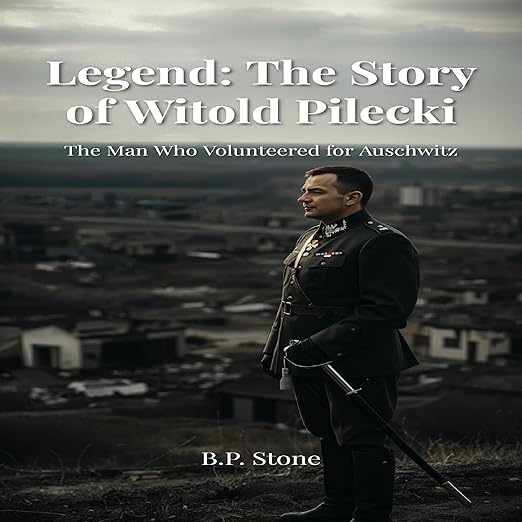
Before You Press Play
- Read by: Anthony F. Armagno moves briskly through wartime urgency, clandestine tension, and camp-set horror without losing the story's emotional throughline.
- At its heart: WWII resistance, Auschwitz infiltration, moral courage under occupation
- Vibe: Tense, fast-moving, and unflinching
- Short version: A compressed but genuinely gripping fictionalized account of an extraordinary true story, best suited to listeners who want momentum over exhaustive detail.
Witold Pilecki volunteered to be arrested on purpose so the Allies could learn what was really happening inside Auschwitz, and B.P. Stone's fictionalized account of that decision is a rare historical novel that earns its ambition in a little over four hours. I want to be upfront about the runtime, because a story spanning the Polish-Soviet War, the occupation of Warsaw, and years inside a concentration camp usually asks for a much longer commitment than this audiobook does, and that compression is worth understanding before you press play.
This is fiction built on an extraordinary true story. Pilecki was a real Polish cavalry officer who organized resistance from inside Auschwitz itself and smuggled out some of the first eyewitness reports of the Holocaust to reach the outside world, reports many Allied officials initially found too horrifying to fully believe. Stone dramatizes that history rather than presenting it as a straight biography, which shapes how the book should be read and judged.
Closer to a Well-Paced Film Than a Text
The novel traces Pilecki from the embattled family estate through the trenches of the Polish-Soviet War, into the clandestine cellars of occupied Warsaw, and finally into Auschwitz itself, where he built a covert resistance network under starvation, brutality, and the constant threat of discovery. Stone's version leans into cinematic pacing over granular historical detail, moving Pilecki through each phase of his life with the momentum of a thriller rather than the accumulated weight of a traditional biography.
That choice is exactly what one listener responded to directly, describing the book as entertaining and quick while still delivering a real sense of what the experience must have been like, closer to a well-paced film than a dense academic account. For a subject this heavy, that pacing is a genuine asset: it keeps four hours of concentration-camp material from becoming numbing without ever softening what actually happened inside the wire.
A Hero Persecuted Twice, by His Own Country
The real Witold Pilecki's story did not end with his escape from Auschwitz in 1943; he went on to fight in the Warsaw Uprising and continued resistance work after the war, only to be arrested, tortured, and executed in 1948 by Poland's postwar communist government on fabricated charges, his full record suppressed for decades until Poland's political transition finally allowed his story to be told openly. That afterlife, a hero persecuted twice, first by the Nazis and then by his own country's new regime, gives even more weight to a book focused primarily on his wartime years.
That cinematic, scene-driven writing style, prioritizing momentum and vivid, filmable moments over dense historical exposition, happens to translate unusually well to audio specifically, since a listener does not need to pause and reread a complicated paragraph the way denser narrative history sometimes demands. The same quality that reads as slightly thin on the page for readers wanting exhaustive detail becomes a genuine asset in the ear, where forward motion and clarity matter more than density.
Armagno Shifts From Idealism to Survival
Anthony F. Armagno narrates, carrying a story that moves from a young cavalry officer's early idealism through calculated resistance work to the daily calculus of survival inside Auschwitz. The tonal range required, wartime urgency, clandestine tension, and the numbing horror of the camp itself, all within a fairly brisk runtime, asks for a narrator who can shift registers quickly without losing the story's emotional center.
Pilecki's own reports were genuinely among the first detailed intelligence about the Holocaust to reach the West, smuggled out on scraps of paper and carried by the memories of the few prisoners who managed to escape. That real history gives this novelization a foundation most fictionalized war stories do not have, and it is worth knowing going in that the extraordinary parts of this plot, the deliberate self-arrest, the camp resistance network, the smuggled reports, are not novelistic invention.
Pilecki's own name has only become widely known outside Poland relatively recently, decades after his 1948 execution and subsequent political rehabilitation, which makes a novel like this a genuinely useful entry point for English-language listeners who may never have encountered his story at all. Stone's decision to dramatize rather than simply document his life makes that introduction more immediate and memorable than a dense historical monograph likely would for a general audience.
One Rating Backs This Five-Star Average
At four hours and fourteen minutes, this covers an enormous span of history, multiple wars, a clandestine resistance network, years of camp survival, in a fraction of the time comparable WWII narratives typically take. That is a function of Stone's compressed, cinematic approach rather than evidence of an abridged edition, but listeners expecting the granular pacing of a longer historical epic should recalibrate expectations toward a fast-moving dramatization instead.
Because this is billed explicitly as a novel rather than a straight biography, some scenes and dialogue are necessarily invented or reconstructed rather than documented fact. Readers who want rigorously sourced nonfiction about Pilecki specifically may want to treat this as a compelling entry point rather than a definitive historical record, and pair it with nonfiction research if the subject grabs them the way it clearly grabbed this book's one reviewer.
Only a single rating currently backs this title's 5.0 average, which is worth flagging plainly: strong as that one reviewer's reaction is, it is not yet the kind of broad consensus a larger rating pool would provide, so treat the enthusiasm as a genuine, specific endorsement rather than proof of universal reception.
One Commute or One Focused Evening
This suits listeners drawn to WWII history who want a fast-moving, emotionally direct entry point rather than an exhaustive academic treatment, and anyone specifically interested in resistance and intelligence-gathering stories rather than battlefield narratives alone. The four-hour runtime also makes it a realistic pick for listeners who want a complete, satisfying historical arc without a multi-week commitment.
Listeners who want granular, heavily sourced nonfiction detail, or who are sensitive to concentration-camp content handled with real narrative directness rather than distance, should go in with clear expectations. For anyone who wants to understand who Witold Pilecki was and why his story matters, delivered with real narrative momentum, this is a strong, efficient way in.
At just over four hours, the runtime also suits a single long commute or one focused evening far better than a multi-week commitment would, which is worth naming as a practical reason to pick this up even for listeners who might otherwise hesitate at heavier WWII subject matter.
Frequently Asked Questions
Why is this audiobook only about four hours for a story spanning multiple wars?
B.P. Stone compresses Pilecki's life into a fast, cinematic pace rather than a dense, exhaustive biography, which is a deliberate storytelling choice rather than a sign of an abridged edition.
Does this audiobook go into detail about life inside Auschwitz?
Yes, a substantial portion covers Pilecki's time inside the camp, including the resistance network he built and the intelligence he smuggled out, handled with narrative directness rather than graphic excess.
Is prior knowledge of Witold Pilecki needed to follow this audiobook?
No. The novel introduces Pilecki from his early life onward, so listeners with no prior familiarity with his real history can follow the story without additional background reading.