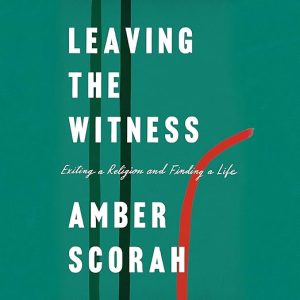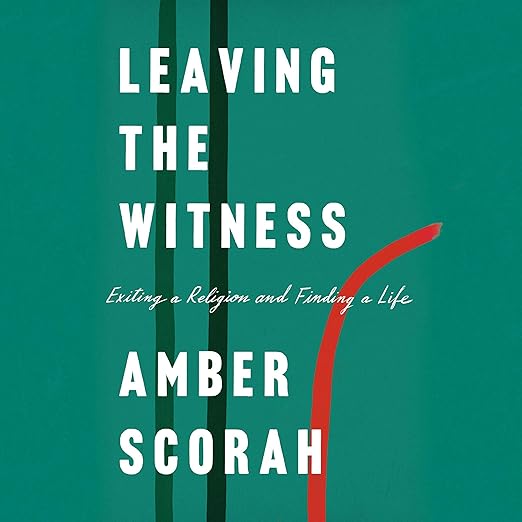
I came to Leaving the Witness through a circuitous route: I had read Tara Westover's Educated twice and was looking for something that inhabited a similar territory without replicating it. The comparison that O, the Oprah Magazine makes, comparable to Educated, is apt in some ways and misleading in others. Both are memoirs of women who escaped closed, high-control communities and rebuilt themselves in the absence of the framework they had always assumed was permanent. But Westover's book is structured like a coming-of-age arc with a clear trajectory. Scorah's memoir is quieter, more digressive, and stranger in the best sense of that word.
Amber Scorah was born into the Jehovah's Witnesses as a third-generation member. She volunteered to become a covert missionary in Shanghai, where the organization's activities were illegal. The Chinese setting is not incidental decoration: immersion in Mandarin and Chinese culture, getting to know people outside the Witness community for the first time in her life, finding work at a language learning podcast that gave her an unexpected creative outlet, these are the conditions under which Scorah's faith began to unravel. Not through a dramatic confrontation with doctrine, but through the quiet accumulation of evidence that the world outside the organization was not the catastrophe she had been promised.
The Review
What Scorah captures with unusual precision is the mechanism by which high-control communities sustain belief: not through argument but through isolation. Remove the isolation, even partially, and the argument loses its force. Shanghai, for Scorah, was an accidental decompression chamber, a place where she could have one relationship outside the organization, then another, then a friendship that became an escape hatch. The writing in the Shanghai sections is the memoir's most alive prose: specific, observational, full of the texture of learning to navigate a city in a language you are teaching yourself. One reviewer who studied cults found the book valuable precisely because it illuminates how this particular closed system operates from the inside.
The theology and eschatology of the Jehovah's Witnesses are present in the book not as caricature but as a belief system Scorah held genuinely and lost painfully. That distinction matters. This is not a book that mocks what it has left behind. It mourns it, which gives the departure its weight and prevents the narrative from becoming a simple liberation story. The loss of faith here is accompanied by the loss of community, family relationships, and the entire framework within which her identity had been constructed, and Scorah does not minimize any of those losses.
The New York Times Book Review called the memoir earnest, fueled by a plucky humor and a can-do spirit that endears. That's accurate, but it undersells the degree to which Scorah's restraint is a formal choice. She is not a confessional writer in the mode that produces cathartic release. Her sentences are spare. Her most painful disclosures are made without the scaffolding of emotional commentary that memoir often provides. One reviewer noted that some sections feel anticlimactic, the pace can drag in the middle sections, when Scorah is recounting the mechanics of her Shanghai life before the crisis that changes everything. That observation is fair, but the pacing is also part of the point: this is what a year of covert missionary work actually feels like, unglamorous and repetitive.
Scorah narrates her own audiobook, and this is the correct choice for this material. Her voice is measured and precise, qualities that match the prose. She does not perform her own suffering. She describes it with the same observational clarity she brings to the Shanghai streets, which creates an odd emotional effect: the listener feels the weight of what's being described more heavily than if the narration were emotive, because nothing is being amplified or underlined for effect.
Weak Spots in Leaving the Witness
The book's final movement, set in New York, contains a personal tragedy that the synopsis gestures toward with the phrase a personal tragedy forces her to look for new ways to find meaning in the absence of religion. I won't specify what that tragedy is. What I will say is that it is handled with the same quiet precision as everything else in the memoir, and it is the hardest section to read without stopping. Scorah does not sentimentalize it or reach for the kind of meaning-making that would make it easier to bear. She simply describes what happened and what remained.
One reviewer finished the book still partially crying. The book's refusal to deliver a clean arc of recovery, the loss of faith as liberation, the new life in New York as uncomplicated freedom, is what distinguishes it from the inspirational memoirs it superficially resembles. The ending is more nuanced and more honest than that framing would allow, and that honesty is one of the memoir's genuine and lasting strengths.
Who It's For
Former members of high-control religious communities, particularly anyone who has experienced shunning or the loss of an entire social world along with their faith, will find Scorah's account unusually accurate and potentially cathartic. Readers with a general interest in cults and closed communities will learn more from this memoir than from most academic treatments. Those who need their memoirs to move at pace may find the middle sections slow. And anyone approaching this expecting a triumphant story of secular liberation should know that the ending is more nuanced than that, which is one of the memoir's genuine strengths and why it stays with you.
Key Details
- Read by: Amber Scorah reads her own memoir with a quality that is neither performed nor raw, carefully measured, which mirrors the precision of her prose.
- At its heart: religious deconstruction, identity reconstruction, the cost of community belonging
- Vibe: Quiet and precise, with an undercurrent of permanent loss
- Short version: A memoir about leaving the Jehovah's Witnesses that stands apart through its Shanghai setting, its spare prose, and the genuine tragedy of its final chapters.