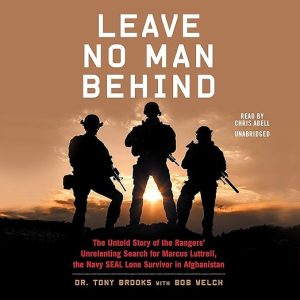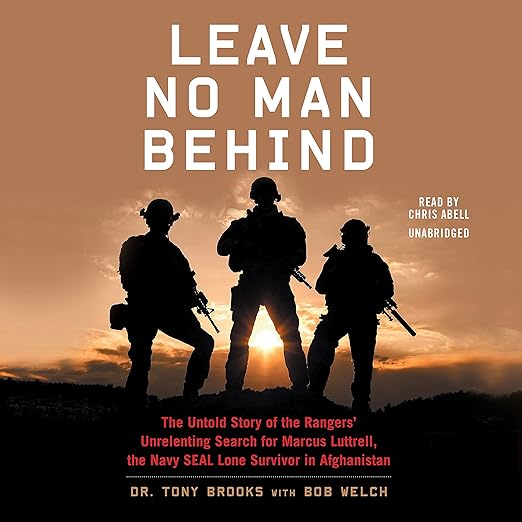
Operation Red Wings already had its canonical telling. Lone Survivor gave the world Marcus Luttrell's account of what happened on Sawtalo Sar on June 28, 2005, and the film brought that version to a mass audience. What Leave No Man Behind offers in this audiobook, written by Dr. Tony Brooks and narrated by Chris Abell, is the story that neither the book nor the film included: the Rangers who came after. Brooks was a newly minted Army Ranger when his regiment received the call to recover the crew of Turbine 33 and locate the surviving SEAL reconnaissance team. His account is not a retelling of Luttrell's ordeal. It is the other half of the same operation, told from the ground by someone who was there.
What We Made of It
The strength of Brooks's account lies in what it refuses to dramatize. He does not reconstruct the inner lives of the men who died. He does not inflate the mission with retrospective heroism that the participants themselves would likely reject. What he does is describe, with the discipline of someone trained to observe and report, the specific conditions his unit faced: inadequate intelligence assessment, terrain that punished every tactical assumption, weather that grounded aircraft at the worst moments, and an enemy that did not fight the way Western military doctrine predicted. These are the mundane, structural failures that get lost when stories about special operations become mythology, and Brooks holds them in front of the listener throughout. The result is a more honest portrait of what large-scale combat rescue actually looks like than most books in this genre attempt.
One reviewer described Brooks as writing with raw perspective and emotion, and that is accurate, but it underestimates the control involved. The rawness is disciplined rather than unprocessed. Brooks allows emotion into the narrative without letting it do the analytical work, which keeps the account credible. He acknowledges the axiom - Leave No Man Behind - not as a slogan but as a weight his unit carried literally across rugged peaks under fire. The cost of that commitment is the operational and human core of the book.
The audiobook format suits this material particularly well because Brooks's voice, as channeled through Chris Abell's narration, is fundamentally oral in its construction. The sentences are direct, the transitions move at the pace of a man recounting something he has thought about for years but has never spoken in full before. Abell preserves that quality without adding theatrical texture that would work against it. His reading style matches the emotional temperature Brooks sets: controlled, precise, and occasionally stripped down to a single declarative sentence that lands harder for its brevity. For listeners who have already heard Lone Survivor in audio form, this companion piece will feel immediately coherent in tone while offering an entirely different vantage point on the same events. The Turbine 33 crash - the single deadliest incident in Afghanistan special operations to that point - is described here not as backdrop but as a specific, recoverable scene that the Rangers were tasked with making whole again. The human cost of that recovery shapes everything that follows.
Brooks also writes about the 75th Ranger Regiment with the insider detail that only a firsthand account can provide. The institutional culture, the chain of command decisions, the way Rangers absorbed loss and continued operating - all of this is present in the narrative and grounded in specific operational context rather than general military atmosphere. The book does not romanticize the Rangers, but it makes a sustained case for their competence and their commitment, which is different from hagiography.
The broader context of JSOC and its operational culture is present in the audiobook without being the primary subject. Brooks writes as an insider who understands the institutional machinery without needing to explain it from first principles, and that insider fluency gives the account a texture that distinguishes it from outside reporting on the same events. Listeners who have consumed a lot of special operations nonfiction will recognize what is and is not being said, and that negative space - the things a Ranger cannot or will not narrate directly - is part of the account's honest architecture.
Weak Spots in Leave No Man Behind
At five hours and forty-eight minutes, the audiobook is lean by military history standards, and that pace means Brooks does not linger on any single moment. Listeners who want deep background on the geopolitical context of the Afghan campaign, or detailed analysis of the intelligence failures that preceded Operation Red Wings, will find the book's focus remains steadily on the mission itself and the men who executed it. This is a feature of the account's perspective - Brooks saw what a Ranger on the ground saw, not what the full intelligence apparatus knew - but it is worth knowing before you listen. There are moments where the constraints of operational classification are visible: Brooks can describe what he did without always fully explaining why the intelligence picture was what it was. This does not undermine the account; it reflects the honest limits of first-person military narrative.
Best Suited For
Anyone who read or listened to Lone Survivor and wondered what happened on the other side of that operation owes it to the full story to hear this audiobook. Military history listeners with a specific interest in special operations and Joint Special Operations Command will find the tactical and institutional detail genuinely informative. Brooks's account also works for listeners with no prior knowledge of Operation Red Wings - the audiobook provides enough context to follow the mission without having read Luttrell's book first, though the two together give a far more complete picture. Listeners who prefer military narratives built on geopolitical analysis rather than ground-level testimony will find this less satisfying; the emotional core here is personal, not strategic.