- What it covers: Java fundamentals, object-oriented design, AI-assisted learning, the gap between understanding code and writing it
- Feel: Fast and orderly, more briefing than tutorial
- Our call: A usable two-hour orientation to Java and to learning with an assistant, provided you never mistake it for the course itself.
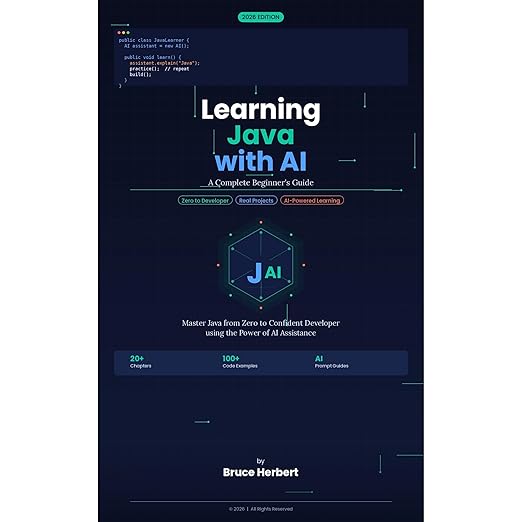
Java in under two hours is the proposition, and the arithmetic deserves attention before anything else does. Bruce Herbert's audiobook runs one hour and fifty-nine minutes, and in that time it undertakes to carry someone with no programming knowledge through variables, data types, operators, control flow, arrays, collections, reusable methods, object-oriented design, exception handling, file reading and writing, generics, lambdas, streams and a finished real-world application. Set against a syllabus that fills a semester almost everywhere it is taught, a hundred and nineteen minutes is the first thing a buyer has to reckon with.
Vocabulary and a Map, Built With AI Prompts
Take the promise literally and it collapses; take it as an orientation and it holds up. A hundred and nineteen minutes can define a class, explain why objects exist, describe what an exception is for and sketch the shape of a stream operation. It cannot teach anyone to write those things, because writing them requires typing, failing, reading an error message and trying again, none of which happens while listening. What you get is the vocabulary and the map, delivered quickly, which is a legitimate product as long as nobody expects to close the file able to build anything.
Method is the genuinely modern part here. Each chapter is built to hand you prompts you can put to a chat assistant, with ChatGPT, Claude and GitHub Copilot named in the copy, so the assistant explains the difficult concept, generates the example, and walks you through the error you just caused. That is how a substantial share of beginners actually learn now, and a book that structures itself around the practice rather than pretending it does not exist is more honest than most introductions on the shelf.
Emoji Headers and a Doubled Period Throughout
Listing hygiene is a different matter. The displayed title carries a floating space before its colon, the description opens by calling the book A Beginner's Complete Guide while the title says A Complete Beginner's Guide, and the copy signs off with a doubled period after a sentence about becoming a confident developer. Add a description assembled from emoji headers and check marks and you are looking at a page produced quickly. None of that touches the content, but it is the kind of detail a book about clean code invites you to notice.
Used as a Warm-Up, the Runtime Becomes the Point
Concepts survive the trip to audio better than syntax does. Why a language separates data from behavior, what inheritance is actually for, why exceptions exist as a separate mechanism from return values, what a lambda replaced: all of that is ordinary explanation, and hearing it argued in sequence is often clearer than meeting it as a boxed sidebar between two code samples. Herbert spends real time on the reasoning, and the reasoning is the part beginners usually skip and later regret skipping.
Employability is a real part of the case. The copy points at Android apps, enterprise software, banking systems and large-scale platforms, and that reach is why the language keeps appearing in job descriptions long after fashion moved elsewhere. A short audio introduction is a cheap way to find out whether the language's formality suits how your head works before committing to a course, a bootcamp or several hundred pages of reference.
Preparation is the job this length actually fits. Listening to this before a first class, a first tutorial series or a first week on a team using Java means the words arrive already familiar, and familiarity is what stops a beginner from freezing when someone says the word constructor. Used as a warm-up rather than as the course itself, the runtime stops being a shortfall and becomes the point.
Code Passages Pass By as Noise
Synthetic delivery is the first structural problem, and code is the worst possible material for it. The reading credit says Virtual Voice, which means text-to-speech rather than a person. Braces, semicolons, parentheses and camel case have to be spoken as instructions if they are to mean anything, indentation has no audible form at all, and a variable name like maxRetryCount can be pronounced as one word or spelled out with wildly different results for a listener trying to picture the line. Expect the conceptual passages to land and the code passages to pass by as noise.
Prompts carry the same problem in a sharper form. Chapter prompts you can paste into an assistant are the most useful thing this book offers, and a prompt heard aloud is a prompt you have to reconstruct from memory before you can use it. Anyone intending to work the AI angle properly needs the written edition open alongside the audio. The named tools will also age faster than the Java material: assistants change behavior, interfaces and capabilities within months, and the file went on sale in March 2026.
One promise at the end of the copy needs qualifying. By the close of the book, it says, you will have written dozens of Java programs and be ready to build your own projects. Writing dozens of programs requires a keyboard, a compiler and a great deal more than a hundred and nineteen minutes, and nothing on the record mentions a code repository, a companion file or a download where those exercises might live. Read that sentence as ambition rather than as a description of the audio edition.
Two Hours of Listening, Not a Full Course
Two hours of listening will genuinely help the curious non-programmer deciding whether to start, the student about to begin a Java module who wants the terminology in advance, and the professional who needs to follow conversations with a development team without writing anything themselves. For all three, a compressed conceptual tour with an AI-assisted study method attached is a sensible use of an afternoon.
Nobody should expect this to replace a course, a textbook or the hours at a keyboard that turn understanding into skill. Anyone who wants to work through code line by line, or who cannot easily keep a written copy open beside the recording, will get much more from a print or ebook edition. Come for the map, and go somewhere else for the territory.
Questions Listeners Ask
Do I need any programming background to follow this audiobook?
None at all. The copy addresses complete beginners, students, self-taught developers and professionals switching fields, and it starts from what a program is. The only real prerequisite is a tolerance for abstract explanation delivered without a screen in front of you.
Does it stop at the basics, or reach modern Java features?
The advertised range runs well past introductory material into generics, lambdas, streams, collections and file handling, finishing with a complete application. Depth at each stop is necessarily shallow given the length, but the coverage itself is not limited to first-week topics.
How long is the audiobook, and who reads it?
One hour and fifty-nine minutes, with the reading credited to Virtual Voice rather than to a person, meaning a synthetic text-to-speech delivery. That combination makes it an easy single-sitting listen and a poor fit for anyone hoping to follow code by ear.