Quick Take
- Narration: David Ault’s measured, unhurried delivery is ideally matched to Shah’s conversational mode, he creates space for the ideas to land without rushing toward the next exchange.
- Themes: The nature of Sufi learning, traditional psychology applied to modern life, how spiritual understanding develops and deteriorates
- Mood: Contemplative and gradually disorienting, in the best sense, it asks you to read differently than you’re used to
- Verdict: One of the most unusual listening experiences in the spirituality catalogue, intellectually demanding, practically resonant, and unlike anything else in Shah’s output.
I want to describe where I was when I started this audiobook because the context genuinely matters. I was on a long drive through a part of the country I don’t know well, and I had picked up Learning How to Learn without much preparation, I knew Idries Shah’s name, knew he was the primary Western conduit for Sufi teaching in the twentieth century, but I had not read him before. About forty minutes in, I pulled over and sat with it. Not because I was confused exactly, but because I wanted to give the material space I hadn’t expected to need.
That’s the book. It does that.
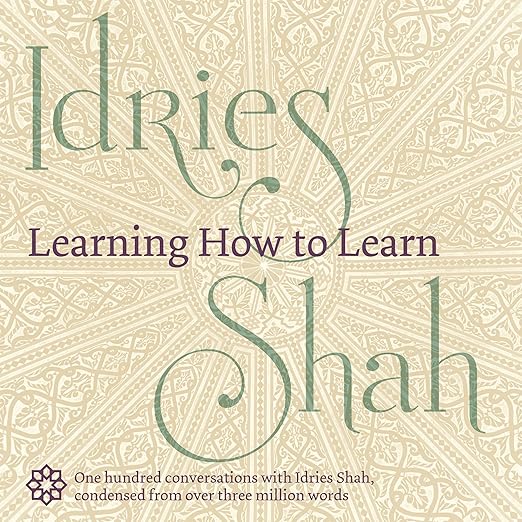
Condensed from more than three million words of conversations, Shah’s exchanges here cover housewives, cabinet ministers, professors, and assembly-line workers, all discussing, in one form or another, the question of how traditional psychology and Sufi understanding illuminate problems that contemporary frameworks can’t quite reach. More than a hundred tales and extracts from eight centuries of Sufi lore thread through the conversations. David Ault reads it with a stillness that the material requires.
Our Take on Learning How to Learn
What makes this book distinctive within Shah’s catalogue, and one reviewer who had read him extensively called it unique, is that Shah here actually answers questions. His other works tend to operate through story and indirection, leaving the reader to work things out. In this volume, he provides guidance to students who are uncertain where they’ve gone wrong, where the rails are, and how to recognize the difference between genuine learning and the performance of learning.
That guidance is not reassuring in the conventional sense. Shah is quite specific about how people fool themselves, how conditioning masquerades as insight, how the desire for spiritual experience can become its own obstacle, how reading the same extract again can reset its meaning to zero. One reviewer described the strange experience of re-reading passages of Shah and finding them newly opaque despite having studied them closely before. That’s not a bug; it’s reported across multiple serious readers as a characteristic of the material.
Why Listen to Learning How to Learn
The audiobook format has a specific advantage here: you cannot underline Shah. You cannot annotate him in the margins. You have to sit with what you’ve heard and let it settle rather than immediately categorizing it. That enforced passivity is actually consonant with what Shah is teaching about how learning happens, less about accumulation, more about receptivity. Several listeners describe the experience of re-listening to sections and finding different resonances, which mirrors exactly the re-reading experiences described in the reviews.
David Ault brings a professional voice actor’s discipline to material that could easily be flattened into lecture. He reads the Sufi tales and the contemporary exchanges with the same register, which is the right call, Shah doesn’t want you to know in advance which form the teaching will take.
What to Watch For in Learning How to Learn
One reader noted, correctly, that there is no religious content in this book in the conventional sense. Another noted that the topics actually belong to management or psychology as much as spirituality. Both observations are accurate. Shah consistently resists categorization, and listeners who arrive expecting devotional material will be wrong-footed. This is not a book about belief. It’s a book about how learning works and how we systematically fail at it.
The difficulty is real. This is not accessible self-help. Shah expects sustained attention and a willingness to sit with ambiguity. The payoff is proportional to the investment, but the investment is genuine.
Who Should Listen to Learning How to Learn
Ideal for listeners drawn to contemplative traditions who want intellectual rigor alongside depth, readers of Thomas Merton, Krishnamurti, or Gregory Bateson will find Shah a natural companion. Also well-suited to anyone curious about Sufi thought specifically who wants a more direct engagement with Shah than his purely story-based collections offer. Not the right starting point if you’re looking for practical self-help with actionable steps, or if ambiguity in spiritual material is frustrating rather than interesting. This book asks more of you than it explains to you, and that’s precisely the point.
Frequently Asked Questions
Is this a good first Idries Shah book, or should I read something else first?
It’s actually a particularly good entry point, precisely because Shah is more direct here than in his other works. He answers questions rather than relying solely on parable. That said, having some general awareness of Sufism as a tradition, even Wikipedia-level familiarity, will help contextualize the material.
How long are the individual conversations and extracts, is this easy to listen to in segments?
The conversations and tales vary in length but most are relatively short, making this well-suited to episodic listening. It’s not a book that requires continuous multi-hour sessions, shorter, more attentive listening windows may actually serve the material better.
One reviewer mentioned finding the same extract opaque on re-reading despite having studied it closely. Is that a common experience?
Yes, multiple serious readers describe this phenomenon across Shah’s works. It’s referenced in the reviews and in wider Shah scholarship as characteristic of the material rather than a reading failure. Some listeners find this disconcerting; others find it part of what makes the work worth returning to.
Is David Ault’s narration paced slowly enough for dense philosophical material, or does it move too quickly?
Ault is deliberate and unhurried, his pace suits the material well. Listeners who want to pause and reflect will find the audiobook controls useful; he doesn’t rush through the Sufi extracts any more than through the conversational sections.