In Brief
- Narrator: Valentino Blanco shifts convincingly between a calm sleep register and an engaged driving register across fifty-plus hours.
- Subjects: passive language acquisition, commute-based learning, sleep-learning science
- Tone: Calm and flexible
- Bottom line: Worth it for the driving half alone; treat the sleep-learning claims with healthy skepticism.
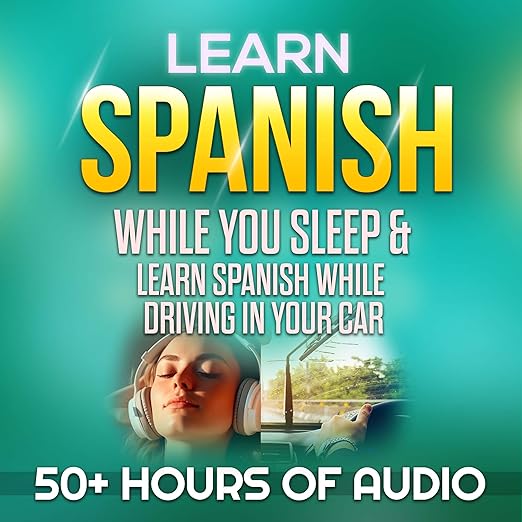
Brown noise hums under every lesson in the sleep half of this course, a deliberate production choice meant to smooth a listener into a relaxed state while Spanish vocabulary loops quietly underneath. I tested the driving half across a week of actual commutes before touching the sleep edition at all, since that felt like the more honestly reviewable half of this fifty-one-hour, two-in-one audiobook from Patrick Jackson.
The course splits cleanly into two functional halves. The sleep edition carries the ambient production treatment described above, while the driving edition drops the ambient sound entirely in favor of clear, engaged Latin American Spanish lessons meant for active listening during a commute, workout, or household chores.
Content-wise, the course covers real ground, basic vocabulary through more complex conversation, aimed at learners moving from beginner toward intermediate rather than absolute newcomers who need foundational grammar explained from scratch. Patrick Jackson's structure treats the two editions as genuinely complementary rather than redundant: the sleep half for passive reinforcement, the driving half for the actual instructional heavy lifting.
One reviewer frames the sleep-learning premise around REM-phase brain activity, and while the general idea that the brain stays active during REM sleep is accurate, the leap from that fact to reliable vocabulary acquisition during sleep is a much larger claim than the science currently supports. That gap between an appealing premise and a settled result is worth knowing before treating the sleep half as a primary learning method rather than a pleasant supplement.
Sleep-learning as a concept has a much longer, more contested history than this course's marketing copy suggests. Vocabulary encoding entirely from scratch during sleep has been tested and largely discredited since mid-twentieth-century hypnopaedia experiments, the same idea Aldous Huxley satirized decades earlier in Brave New World. What current sleep research supports more credibly is targeted memory reactivation, cueing material a listener already partially knows during sleep to help consolidate it, a meaningfully narrower claim than teaching brand-new Spanish vocabulary from zero overnight.
The 4.3 rating from 122 reviews sits in solidly good but not exceptional territory for a language-course audiobook, which tracks with a course this ambitious in scope: covering both a genuinely novel sleep-learning premise and a more conventional driving-focused instructional track in one fifty-one-hour package leaves more surface area for individual listener disappointment than a narrower, single-purpose course would.
The two-part title itself, joined by an ampersand rather than presented as two separate purchases, signals the bundled, all-in-one positioning clearly: buyers aren't meant to choose between the sleep and driving editions, they're meant to use both as complementary tools.
Blanco Shifts Tone Between Sleep and Driving
Valentino Blanco's delivery genuinely shifts register between the two editions: calm and unhurried for the sleep half, more engaged and present for the driving half, and that tonal split is doing real pedagogical work, not just following a production note. A single flat delivery across both formats would undercut the whole premise that one mode is for winding down and the other is for active attention.
The course teaches authentic Latin American Spanish specifically, which matters if your travel or conversational goals point toward Latin America rather than Spain. The accent, vocabulary choices, and cultural references throughout are calibrated accordingly rather than defaulting to a generic or European standard.
Reviewer T T Thompson's account is the most useful real-world data point here: skeptical at first that language learning could fit into an already packed schedule, then reporting 'picking up vocabulary and basic sentence structure' after 'just a few nights and commutes.' That kind of low-friction entry point, learning that happens inside time already being spent on something else, is the course's clearest genuine selling point regardless of how the sleep science ultimately shakes out.
Brown noise itself is a real, distinct category from the more familiar white noise, carrying more low-frequency rumble and less high-frequency hiss, and it has a genuine, separate reputation as a sleep aid independent of any language-learning claim layered on top of it. Even a skeptical listener gets a legitimate secondary benefit from the sleep edition purely as ambient sound, regardless of how much Spanish actually sticks.
Reviewer Cara Boardwine's more measured four-star response is a useful counterweight to the two five-star raves: genuine curiosity about the approach and appreciation for its practical focus, without the more dramatic transformation claims the other reviews lean into. That range, from cautious interest to enthusiastic conversion, gives a more honest composite picture of what to expect than either extreme alone.
Value on a pure hours-of-content basis is hard to argue with here: that same enormous runtime, split across two genuinely distinct formats, is an unusual amount of material for a single purchase, even setting aside any debate about how much of the sleep half actually lands as intended.
Weight Your Expectations Toward the Driving Half
Because the sleep half's premise leans on genuinely unsettled science, the practical move is to treat it as a relaxing bedtime companion rather than an accountability system for measurable progress. Listeners who want to track real gains should lean on the driving edition and treat any overnight absorption as a pleasant bonus rather than the plan.
Fifty-one hours and fifty-one minutes is an enormous runtime for a language course, and a large share of that total belongs to the sleep edition specifically, material designed to play in the background rather than demand active attention. Listeners chasing efficient, measurable progress should weight their expectations toward the driving-focused half, where the actual instructional content concentrates.
The companion PDF available in your Audible library is not a minor bonus here; it carries structured reference material, vocabulary lists and grammar notes most likely, that the audio-only sleep and driving formats are not designed to replace on their own. Skipping it means missing a real part of what this course is actually built to deliver.
Sustaining fresh instructional content across fifty-one hours without noticeable repetition is a genuine production challenge at this scale, and while none of the attached reviews flag padding or filler specifically, a course this long inevitably faces more pressure to recycle vocabulary and sentence patterns than a tighter, more conventional five-to-ten-hour course would.
Commuters Convert Drive Time Into Spanish Practice
Commuters and multitaskers get the clearest value here: people who already spend real hours driving, cooking, or exercising and want to convert that time into Spanish exposure without carving out dedicated study blocks.
Curious sleep-learning skeptics turned cautious believers, like the reviewer who called this a genuine game changer for a packed schedule, will find the driving edition delivers even if the sleep half never fully proves out on its own.
Skip this course if you specifically want a structured, classroom-style method with call-and-response drilling and a clear curricular sequence. This format rewards passive exposure and flexible scheduling over rigorous, trackable progression, and listeners who need firm structure to stay motivated should look for a course built around it instead.
Questions Listeners Ask
Do I need to listen to both halves of this audiobook, or can I just use the driving edition?
They're designed as complementary but independent modes, so you can use only the driving edition if the sleep-learning premise doesn't appeal to you, without losing access to the core vocabulary and grammar content.
Is the science behind the sleep-learning half of this audiobook actually solid?
It's genuinely contested. Passive absorption during sleep is a real area of ongoing research, but it's far from settled science, so treat the sleep edition as a relaxing supplement rather than your primary learning method.
What kind of Spanish does this audiobook teach, Latin American or European?
Latin American Spanish throughout, which matters if your goal is travel or conversation specifically in Latin America rather than Spain.