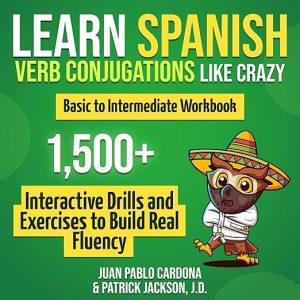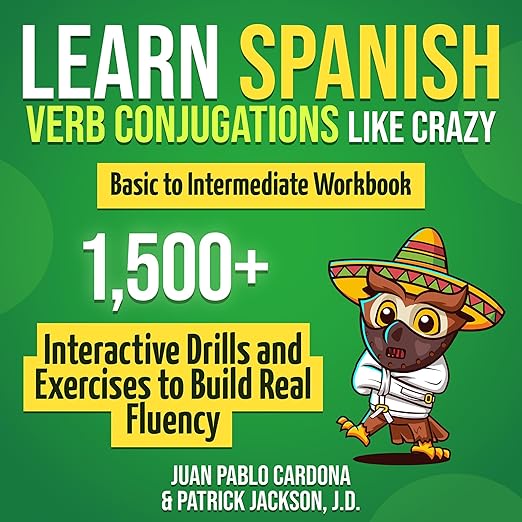
Spanish verb conjugations remain the central obstacle for most learners at the intermediate level, and Juan Pablo Cardona built this program specifically to address that obstacle directly rather than working around it. Learn Spanish Verb Conjugations Like Crazy: Basic to Intermediate Workbook is an audiobook in the most literal sense: a listening-based drill program spanning forty-one hours and four minutes, narrated by Cardona himself, designed to move verb recall from effortful conscious retrieval into something that approaches automatic production. Cardona is known as "The Voice of Real Latin American Spanish," and his self-narration gives the program an authenticity that a hired voice actor delivering the same scripted drills would simply not have in the same way.
The program sits within the larger Learning Spanish Like Crazy system created by Patrick Jackson, which has reached hundreds of thousands of learners across decades of consistent use. The workbook format refers to the structured exercise sequences embedded throughout, more than 1,500 drills in total, that build systematically from present-tense regular verbs through stem-changing forms, reflexive verbs, the critical ser and estar distinction, the verb gustar, and the present progressive. Each category is addressed with enough sustained repetition that the target forms have time to move from conscious rule-application to something closer to genuine automatic production. A companion PDF is available in the Audible Library for visual reference and session tracking across the program's considerable length.
The reviewer who called this program "sticky verbs" and observed that "verb charts don't teach you Spanish, reps do" has identified the program's core philosophy precisely and accurately. The academic consensus on motor learning and declarative memory in language acquisition supports this approach: the gap between knowing a grammatical rule and being able to apply it at conversation speed requires exactly the kind of massed and distributed practice this audiobook systematically provides. Cardona does not theorize extensively about the learning science at work; he simply constructs the practice architecture and lets it do what repetition-based programs do when they are built with genuine structure rather than random accumulation.
One reviewer who added it to a homeschool curriculum and another who noted that "things start to stick" after working through a few sections both point toward the same quality: the drills are structured with enough variation that the practice feels purposeful and progressive rather than merely mechanical, but with enough strategic consistency that the target forms genuinely consolidate across sessions. That balance is considerably harder to achieve in a long-form drill program than it appears from the outside, and not all programs at this length manage it.
Cardona's Voice Trains the Auditory-Motor Loop
The case for this audiobook over a textbook-and-app approach is direct. Listening-based practice builds a qualitatively different kind of memory than visual pattern recognition or typed responses, because it involves the auditory-motor loop that actual spoken conversation requires. When you hear a sentence, anticipate the correct conjugation, and then hear it confirmed, you are training exactly the mechanism that real conversation depends on. The forty-one-hour runtime is substantial, but the program is designed to be worked through in focused sessions of thirty to sixty minutes rather than consumed sequentially, and the companion PDF allows learners to track their precise position across sessions that may be weeks apart.
Cardona's narration is also notable specifically for exposing learners to Latin American pronunciation patterns from a native speaker rather than the neutral or Castilian accent that some programs default to for perceived accessibility. For learners planning to use their Spanish in Latin America, with Latin American immigrant communities, or in any context where Latin American regional speech is the target, that natural exposure is genuinely valuable rather than merely incidental to the drilling exercise.
Context-Rich Drills Teach Ser and Estar
The ser and estar chapters deserve particularly careful attention because the distinction between these two verbs for what English encodes as a single "to be" is one of the most conceptually difficult points in Spanish grammar for native English speakers. Cardona addresses the distinction through context-rich drills rather than rule recitation, which is the pedagogically sound approach supported by the research literature, but it requires the learner to trust the process rather than seeking explicit grammatical explanation before exposure. Listeners who need the rule spelled out clearly before they can internalize it through practice may find supplementary grammar reference valuable alongside the audio program.
Also pay attention to the pacing during the reflex drills, where the program is deliberately calibrated to cue a response faster than deliberate conjugation allows. The goal is to force production before the conscious rule-application process has time to complete, which is what generates the automatic fluency the program is aiming at. Some learners find this initially frustrating; the frustration is actually productive, because it marks exactly the gap the drill is targeting.
Bridging Grammar Knowledge and Conversational Speed
This audiobook is best suited to learners who have already established basic Spanish vocabulary and sentence structure and need to make their verb production automatic rather than effortful and slow. True beginners will lack the contextual foundation needed to make sense of the drills at operational speed. Advanced learners will find the basic-to-intermediate scope too narrow for their current level. The program's genuine sweet spot is the intermediate learner who understands Spanish conjugation rules as grammar knowledge but cannot produce them at conversation speed without a noticeable conscious pause, which describes a very large percentage of Spanish learners at the two-to-five-year study mark.
Key Details
- Narration: Juan Pablo Cardona narrates his own program, and his voice carries the natural cadence of a native Latin American Spanish speaker, which is especially valuable when he models the drills himself. The distinction between instruction and practice audio is clear throughout.
- Themes: Verb conjugation mastery, active recall through drills, conversational fluency building
- Mood: Focused and repetitive in the best sense, with the satisfying rhythm of a program that knows exactly what it is trying to accomplish
- Verdict: For Spanish learners who have moved past absolute beginner level and need to make verb conjugations automatic, this forty-one-hour drill program delivers genuine results through sheer structured practice.
A Few Questions About Learn Spanish Verb Conjugations Like Crazy
How do I use this audiobook effectively given that it is 41 hours long?
Work through it in focused sessions of thirty to sixty minutes rather than listening passively. The companion PDF tracks your position across sessions, and the program is designed to be paused and returned to repeatedly rather than consumed sequentially.
Does having a native Latin American Spanish narrator make a practical difference for this audiobook?
Yes, particularly for learners targeting Latin American Spanish. Cardona's natural pronunciation, rhythm, and accent patterns in the drill sentences give learners authentic input that carries over into their own production more directly than a neutral or Castilian model would.
What verb tenses and forms does this audiobook cover?
The program covers present-tense regular and irregular verbs, stem-changing verbs, reflexive verbs, the ser and estar distinction, the verb gustar, and the present progressive. It is explicitly a basic-to-intermediate workbook and does not address past, future, or subjunctive tenses.