Quick Take
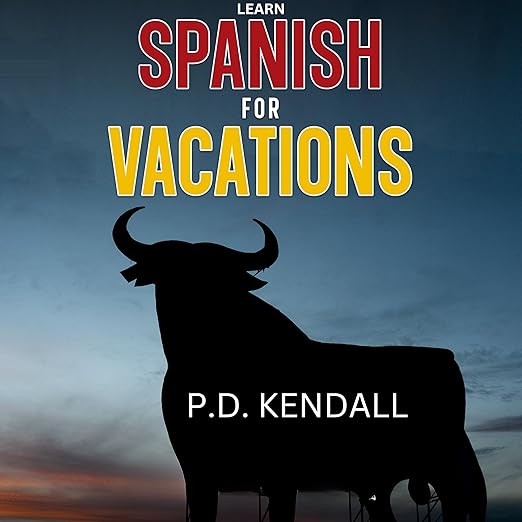
- Narration: Reynaldo Pacheco delivers the Spanish phrases and dialogues with native fluency, creating a realistic model of what actual conversational Spanish sounds like in travel contexts.
- Themes: Travel communication, practical phrase acquisition, cultural confidence
- Mood: Warm and conversational, narrated with a storyteller’s instinct rather than a textbook’s register
- Verdict: A thoughtfully built travel Spanish resource grounded in real situations, the author’s personal experience in Costa Rica gives this a credibility that generic phrasebook compilations lack.
The author of Learn Spanish for Vacations opens with a confession that I found more useful than any amount of marketing language: he was once that guy. The one who found himself in a remote part of Costa Rica where nobody spoke English, who resorted to miming things to bemused locals, who left feeling embarrassed and motivated in equal measure. Out of that experience he did something practical, on a later trip to a Spanish-speaking country, he wrote down every phrase he actually used. What is in the car rental check-in? The bakery? The hotel? The moment when the waiter asks you something you have not anticipated?
That origin story gives the course a specificity that most travel Spanish resources conspicuously lack. P. D. Kendall’s source material is not a compilation assembled from other phrasebooks; it is, in his telling, a field-tested log of real communicative events. Whether that backstory is precisely accurate matters less than whether the content reflects that practical, situation-specific quality, and by all available evidence it does. The 4.9 average from twenty-six ratings is the second-highest in this batch and reflects a product that is consistently meeting listener expectations.
The Situation-First Architecture
What distinguishes this course structurally from most beginner Spanish audio is the framing around situations rather than grammatical categories. You are not working through a chapter on object pronouns or the subjunctive. You are preparing for specific encounters: the car rental desk, the restaurant, the hotel checkout, the market. Each scenario is framed around what people will ask you, not just what you will want to say, but what you need to be prepared to receive and respond to.
That receptive dimension matters more than it might initially appear. Most phrasebook-style resources give you a sentence to produce. Fewer prepare you for the answer, the follow-up question, the thing the waiter will definitely ask you. Kendall’s framing, grounded in his own experience of being caught off-guard, explicitly addresses this. The synopsis lists what the waiter will definitely ask, what people will ask at the car rental check-in, and what people will ask in supermarkets, all questions oriented around comprehension as well as production.
Reynaldo Pacheco and the Native Speaker Advantage
Narrator Reynaldo Pacheco brings native fluency to the Spanish content, which is the appropriate standard for a resource explicitly aimed at helping listeners develop an ear for real spoken Spanish. Travel preparation that teaches you to speak but not to hear will fail at the moment of first contact. Pacheco’s performance of the Spanish content, at whatever pacing the course uses, should give listeners a model of what the language actually sounds like rather than the deliberate, slightly artificial enunciation of a non-native narrator trying to be clear.
The course runs three hours and thirty-seven minutes, which is substantial for a travel Spanish product. That length suggests more than a basic phrasebook, there is enough material here to cover an extended range of situations, perhaps including Kendall’s promise of items like how to ask for the Wi-Fi code, which he notes pointedly is not actually Wi-Fi code in Spanish. Details like that, the ones that come only from real experience in the country, are the content that makes the difference between a tourist who gets by and one who actually connects.
The PDF Companion
The product description notes that a companion PDF is available in your Audible Library alongside the audio. For a travel phrasebook-style course, this PDF is worth downloading and keeping on your phone. When you are in a situation and need to quickly verify a phrase, a visual reference is often faster than scrubbing through an audio file. The audio does the work of building your ear and anchoring phrases in spoken memory; the PDF serves as a quick-reference backup in the moment of need.
Geographic and Cultural Scope
The course mentions travel to Costa Rica, South America, and Spain, which suggests it is not exclusively Mexico-focused like some competitors in this space. The author notes that the reception in a restaurant when you open in Spanish is night and day from mumbling in English, a claim that holds across Spanish-speaking regions, not just one country. That broader applicability makes this a more versatile purchase than a course tied specifically to one nation’s vocabulary or slang.
Who Should Listen
This is for the adult traveler heading to a Spanish-speaking destination who wants to feel capable and confident rather than helpless and conspicuous. The Kendall backstory will resonate with anyone who has been that guy in a foreign country. Skip it if you are looking for systematic grammar instruction, if you are an intermediate or advanced Spanish speaker, or if you are not actually planning travel and want a more structured language learning path.
Frequently Asked Questions
Is this course specific to one Spanish-speaking country, or does it cover a range of destinations?
The course references Costa Rica, South America, and Spain, suggesting a broader geographic applicability than Mexico-specific resources. The foundational phrases for common travel situations translate across Spanish-speaking regions, though regional vocabulary differences will exist.
Does the course teach you to understand spoken Spanish, or only to produce phrases?
The course explicitly addresses both production and comprehension, including what people will ask you in specific situations, the rental desk, the restaurant, the supermarket. This dual orientation is one of its distinguishing features compared to purely output-focused phrasebooks.
How does this compare to Spanish in 60 Days for vacation preparation?
Both are travel-focused audio Spanish resources, but they approach the goal differently. Spanish in 60 Days has a strong Mexican slang component and a conversational tone; Learn Spanish for Vacations is more systematically situation-organized and draws from the author’s personal field experience across multiple countries. The latter has a higher rating and more substantive runtime.
Is the companion PDF accessible offline for use during travel?
The PDF is delivered to your Audible Library and can be downloaded for offline access via the desktop site. Downloading it before your trip for offline reference on your phone is a practical step the product description recommends.