Quick Take
- Narration: Pacho delivers the content at a measured pace suited to beginners, though the instructional register can feel dense over twenty hours of listening.
- Themes: Grammar fundamentals, verb conjugation, vocabulary building
- Mood: Instructional and systematic, more structured classroom than casual conversation
- Verdict: A comprehensive but textbook-heavy approach to beginner Spanish that works best for listeners who want grammar explained before they practice it.
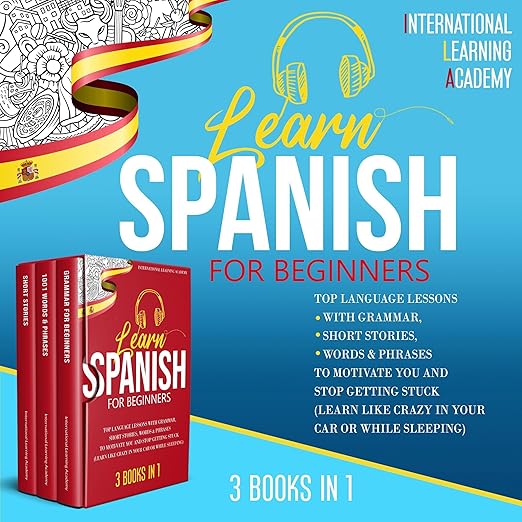
Twenty hours is a significant commitment for a language learning audiobook, and it is the first thing I want to address honestly about Learn Spanish for Beginners: 3 Books in 1 from the International Learning Academy. By comparison, a full Pimsleur Level 1 program runs about fifteen hours of active sessions. The question for any twenty-hour audio language course is whether the material genuinely warrants that runtime, or whether the length reflects repetition and explanation-of-explanation rather than density of useful content.
The three-book-in-one structure is worth unpacking. This is a compilation of three separately available titles combined into a single audio product, covering what the synopsis describes as grammar rules, verb conjugation, adjectives, adverbs, nouns, pronouns, conjunctions, tenses, and conversation starters. The framing is ambitious, scientific research into language acquisition, proven techniques, mastery of grammatical gender, native mental patterns, but the underlying content is a fairly traditional grammar-forward introduction to Spanish.
Grammar First, Conversation Later
The approach here differs meaningfully from audio-first methods like Pimsleur or music-based systems like Earworms. Where those programs prioritize getting you producing spoken language quickly through conversation and repetition, Learn Spanish for Beginners builds from grammatical rules toward conversational application. You will understand what the masculine and feminine article distinction is and why it operates as it does before you are asked to use it in a sentence. That is a legitimate pedagogical choice, and for some learners, those who feel more secure knowing the rules before they try applying them, it is the right one.
The reviewer who found it easy to understand captured this well: the simplification of Spanish grammar into approachable explanations is the book’s real strength. Reviewer Bob called it an exceptional introduction to the language covering all the essential topics, which tracks with a product designed to give complete beginners a solid theoretical foundation. Another reviewer found it superior to trying to learn from context alone, praising its clarity for beginners. These responses suggest the book is succeeding at its stated goal for its target audience.
The Audio Format Question
Grammar instruction is where the audio format faces its toughest test. Verb conjugation tables, article rules, and the systematic presentation of pronouns are material that most learners process more effectively when they can see the paradigm laid out on a page. Narrator Pacho reads through this material clearly, and the included PDF companion addresses part of this gap, the product explicitly notes that the PDF is available in your Audible Library alongside the audio. For the grammar-heavy content at the core of this course, using the PDF as a visual companion while you listen is not optional; it transforms the product from a struggling audio-only grammar lecture into a proper blended learning experience.
The 4.5 rating from twelve listeners is a reasonable signal for a product in this category, though twelve is a small enough sample that I hold it loosely. The reviews that are present are consistently positive about clarity and accessibility, which suggests the product is delivering on its core promise for the learners who have engaged with it seriously.
Scope and Realistic Outcomes
The title’s claim of fluency is marketing language. Twenty hours of grammar-focused audio will not produce Spanish fluency, and no honest assessment of any single product in this category should suggest otherwise. What this course can do, if you engage with both the audio and the PDF companion and do the work of reviewing the material, is give you a thorough theoretical understanding of Spanish grammar and a lexical foundation that subsequent conversational practice can build on. It is a solid beginning, not an endpoint.
The slang and conversational content in the synopsis, the claim about native mental patterns and secret processes, appears in the marketing language but the substantive portion of the course, based on the reviewer descriptions, is foundational grammar. Treat the marketing framing as enthusiasm rather than a precise content description, and evaluate the course on its actual strength: a systematic, clear, beginner-accessible grammar introduction to Spanish.
Who Should Listen
This is for beginners who want to understand Spanish grammar before they practice speaking it, people who feel more confident with a rule in hand than with a phrase to repeat. The PDF companion is essential, not optional. Skip it if you want an audio-first conversational approach, if twenty hours of instructional content feels like more structure than you want, or if you are beyond the complete beginner stage.
Frequently Asked Questions
Is the PDF companion actually necessary, or can I follow along with the audio alone?
For grammar-heavy content like conjugation tables and article rules, the PDF is genuinely important. The audio alone will work for conceptual explanations, but having the visual reference for paradigm-based material makes the course significantly more effective.
How does this approach differ from Pimsleur for a Spanish beginner?
Pimsleur is audio-only and conversation-first, you produce spoken Spanish from lesson one through call-and-response drills. This course builds from grammar rules toward conversation, which suits learners who want to understand the structure before practicing it.
Can I use this as a standalone course to reach conversational Spanish?
It will give you a strong grammar and vocabulary foundation, but conversational fluency requires actual speaking practice. Use this as a structural foundation alongside a conversation-focused method or real practice with speakers.
The title says 3 Books in 1, are the three books clearly delineated in the audio?
The structure reflects a compilation of three separately published titles, and the content covers distinct areas (grammar basics, verb conjugation, conversation). How clearly these divisions are marked in the audio itself is not specified in the available metadata, so expect the course to flow as a unified program rather than three clearly separate sections.