Quick Take
- Narration: Victoria Villarreal delivers clear, pronunciation-forward narration well suited to a listening-based Spanish course, her pacing gives learners room to repeat and absorb.
- Themes: Vocabulary acquisition, practical travel communication, progressive skill-building
- Mood: Encouraging and methodical, with a classroom-without-walls feel
- Verdict: A solid broad-coverage introduction to Spanish vocabulary and conversation for absolute beginners who learn best by listening.
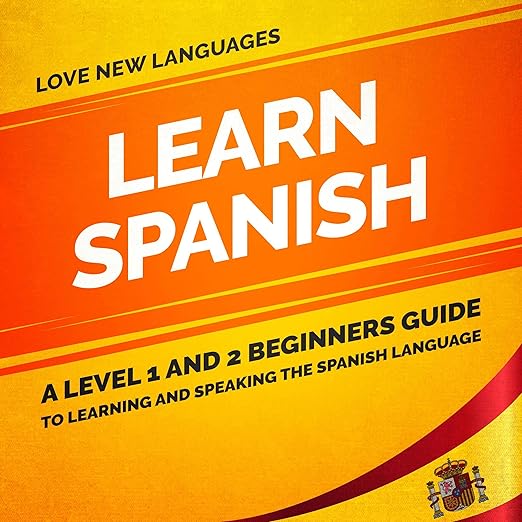
I tend to keep a language-learning audiobook running on weekday mornings, usually during the walk from the parking garage to the office, roughly fifteen minutes each way. It is not a romantic listening context, but it is consistent, and consistency matters more than any single method when you are building a new language. I started Love New Languages’ Learn Spanish: A Level 1 and 2 Beginners Guide on a Monday in February and finished it over the course of about three weeks, fitting in a lesson here and there between commutes and a long Saturday drive out of the city.
The premise is uncomplicated: two levels bundled into a single ten-hour audiobook, covering everything from numbers and days of the week through cognates, transition words, and short real-life conversation scenarios. Victoria Villarreal narrates with clean diction and a measured pace. There are no dramatic flourishes here, which is the right call for a reference-adjacent product. You need to hear the words accurately, and she delivers that.
What Ten Hours of Vocabulary Actually Gets You
The promise of 1,000 most-used Spanish words, spread across categories like clothing, professions, countries, foods, sports, and body parts, is essentially delivered. The structure is category-by-category, you work through animals, then places, then weather, which makes individual sessions feel self-contained. That is useful when you are listening in fragments. You do not need to remember exactly where you stopped in a grammar arc; you pick up with a new vocabulary cluster and move forward.
What the synopsis calls “small real-life stories” are brief listening passages that use the vocabulary in context. These are the most valuable parts of the audiobook. A list of words for restaurant items is serviceable; hearing those words used in a short conversation about ordering lunch is memorable. The cognitive difference between the two approaches is real, and to Love New Languages’ credit, the stories show up often enough to do meaningful work. They are not just decorative.
The second level introduces Spanish cognates, words that share roots with English, like “hospital” or “information”, and transition words for linking ideas in longer sentences. The progression from basic vocabulary to connective language is logically sequenced. By the time you reach Level 2 territory, the earlier vocabulary categories have been reinforced enough that the new structures feel like additions to something already partially built, not a fresh start.
The Limits of Audio-Only Vocabulary Learning
No audiobook is a complete language course, and this one is honest enough not to pretend otherwise. The format has two structural weaknesses worth naming plainly. First, there is no mechanism for active recall. You hear a word, hear it used, and move on. Retention depends almost entirely on how many times you replay a section or happen to hear the word again later. Compare this to Pimsleur’s spaced-repetition methodology, where you are prompted to retrieve vocabulary at intervals designed to consolidate memory, and the difference becomes apparent quickly. Passive listening builds familiarity; it builds confidence more slowly.
Second, pronunciation guidance is narration-dependent in a way that print learners do not face. Villarreal is consistent and accurate, but there is no phonetic breakdown, no explanation of regional variation, no moment where the audiobook pauses to explain that the double-L in “llegar” sounds different in Spain than in Argentina. For a beginner, this is mostly fine, you need a working pronunciation before you can refine it. But learners who already know a little Spanish may find the lack of phonetic nuance a gap.
Who This Works Best For
The ten-hour runtime and dual-level structure make this a genuine value proposition for the right listener. If you are an absolute beginner who wants an audio-native introduction to Spanish vocabulary before a trip or before starting a more structured course, this delivers. The category-based organization means you can locate the sessions most relevant to your needs, if food and restaurants matter most, you can spend extra time there. If you are already conversational and looking for grammar depth or cultural context, this is the wrong tool.
The 4.8 rating from over 100 listeners reflects the format’s appeal to its intended audience. People who are new to Spanish and want something accessible and portable tend to get what they came for. The reviews do not highlight a breakthrough or an exceptional design innovation, which is accurate, this is competent, accessible, and honest about what it is.
Who Should Listen, Who Should Skip
Listen if you are starting Spanish from scratch, you learn well through audio, and you want a broad vocabulary base across practical everyday categories. The dual-level bundle and Villarreal’s narration make the runtime efficient. Skip if you already have basic conversational Spanish and are looking for grammar explanation, cultural depth, or the kind of active-recall drilling that builds real retention. Pair this with a structured method like Pimsleur or Babbel rather than treating it as a standalone complete course.
Frequently Asked Questions
Does this audiobook cover both Level 1 and Level 2 Spanish in a single purchase?
Yes. The ten-hour runtime includes both levels, starting with basic conversation, numbers, and daily vocabulary in Level 1, then advancing to cognates, transition words, nature, health, and more complex conversational scenarios in Level 2.
Is there a PDF or reference companion included with this audiobook?
The synopsis does not mention a companion PDF, so the content is audio-only. Listeners who want to reinforce what they hear with written notes will need to create their own written reference alongside the sessions.
How does Victoria Villarreal’s narration handle Spanish pronunciation for English-speaking beginners?
Villarreal narrates with clear, consistent pronunciation that is useful for building an initial sound system. There is no phonetic breakdown or explanation of regional variation, so her delivery is the learner’s primary pronunciation model throughout the course.
Can I use this audiobook to prepare for travel to a Spanish-speaking country without any other resources?
It will give you a broad vocabulary base and some basic conversational phrases, which is a useful starting point. For confident travel communication, most listeners will want to supplement it with active speaking practice or a structured recall-based program like Pimsleur.