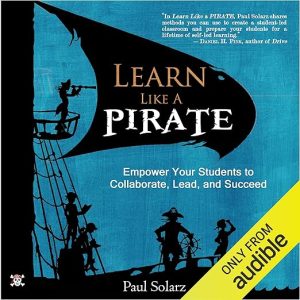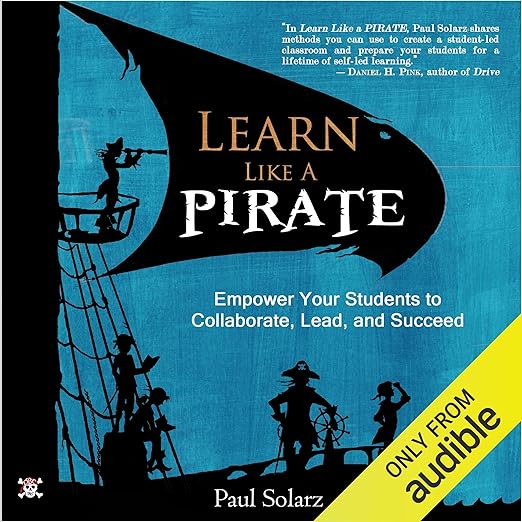
Paul Solarz runs his fifth-grade classroom differently from almost every other classroom in American education. He has handed genuine decision-making authority to his students: they manage daily routines, run class meetings, evaluate each other's work, and take on leadership roles that most teachers reserve for adults. Learn Like a PIRATE: Empower Your Students to Collaborate, Lead, and Succeed, narrated by Kelly Croy, makes the case for that transfer of authority through specific strategies and honest reflection on what it actually costs a teacher to let go of the front of the room. This audiobook runs 6 hours and 17 minutes, and every hour earns its place because Solarz stays close to observable classroom reality rather than drifting into motivational abstraction.
Feedback That Builds Capacity Instead of Answers
The PIRATE acronym - Peer collaboration, Improvement-focused learning, Responsibility for daily tasks, Active learning, Twenty-first century skills, Empowerment - is more than a mnemonic. Solarz uses each letter as a structural frame for real classroom practice, and the specificity is what separates this from the genre of inspirational education books that promise transformation without mechanism. He describes how students take on daily classroom management tasks, run their own meetings, and evaluate peer work in ways that build genuine accountability rather than performative participation. Reviewer Lex Icon wrote that "the real strength of this book - and it is VERY strong - is the writer himself," noting Solarz's credibility as a classroom practitioner rather than a theorist. That credibility is evident throughout: the book is built from observation and iteration rather than ideology or theory.
There is a chapter on feedback - how to give it in ways students can actually use without simply correcting their work for them - that is among the most concrete thirty minutes in any education audiobook I have encountered. Solarz distinguishes between feedback that builds capacity and feedback that just delivers answers, and he is specific about what that distinction looks like in a real classroom with real children who are accustomed to adults solving problems on their behalf. That specificity is the book's engine, and it runs consistently across all six chapters. The chapter on developing student leadership goes further than the usual advice about assigning student roles, distinguishing between giving a child a leadership title and actually building the confidence and practical skill to exercise leadership in real time under social pressure. That distinction matters enormously in practice.
Croy's Forward-Leaning Delivery, Minus the QR Codes
Kelly Croy's narration serves the material well. He reads with engaged, forward-leaning energy - not frantic, but genuinely present. Solarz writes the way a good teacher talks, with a relaxed fluency that can occasionally loop back on itself, and Croy keeps those moments from feeling meandering. The audio format allows Solarz's anecdotes to land as he likely told them in professional development contexts: with rhythm and proper build. Reviewer LKS noted that the book includes QR codes for additional resources, which are accessible only in print; audio listeners will want a companion copy for that material. That is a real limitation worth naming. The auditory substance - the strategies, the case studies, the parent letters, the student voice examples - translates well without those codes, but the full resource ecosystem is print-dependent.
Reviewer Brian, who described the book as reinforcing collaborative learning beliefs "but also gives fresh insights and ideas to try," captures the book's best function accurately: it works for skeptics and believers alike, because it grounds abstract values in observable classroom moves. Solarz is direct about the anxiety this model produces in teachers trained to control the learning environment. He does not paper over the discomfort of watching students struggle through problems they could have avoided with direct instruction. That intellectual honesty makes the book more persuasive than it would be if it only presented the upside. Reviewer LKS also notes that Solarz shares "notes from parents and students," which adds a layer of social proof that is harder to fake than authorial self-report alone.
Built in One Classroom, Adapted by Secondary Teachers
The model Solarz describes was developed in a fifth-grade self-contained classroom, and some of his most specific techniques depend on that context. Departmentalized secondary teachers will need to adapt the community-building components, since rebuilding a classroom culture each period is structurally harder than sustaining it all day with the same group of students. Secondary teachers whose curricular constraints and departmentalization limit the kind of sustained classroom community Solarz builds will get less direct applicability from the more environment-specific sections, though the principles around feedback, peer accountability, and student ownership of learning tasks are portable to any level. Solarz is explicit about where the model requires long runway: the first months of implementation involve significant anxiety on the teacher's part as new routines are established, and he does not minimize that investment.
Parents Get a Reassuring Look at Student-Led Learning
Elementary and middle school teachers who feel the tension between pacing requirements and meaningful student engagement will get the most from this. School administrators looking for professional development reading that produces concrete changes rather than theoretical frameworks should consider it for team study. The chapter structure makes it easy to assign specific sections to discussion groups, and the absence of jargon makes it accessible to educators at different career stages. Parents curious about what student-led learning looks like in practice will find it readable and reassuring about what is possible inside a standard public school classroom without special resources or special exemptions. If you want implementation tactics rather than inspiration, this audiobook delivers them consistently across its full runtime.
Is this audiobook relevant for teachers outside of elementary school?
The model Solarz describes was developed in a fifth-grade classroom, and many of his specific examples are elementary-focused. Secondary teachers can draw on the principles around feedback, peer accountability, and student ownership, but the whole-class community-building aspect is easier to implement in a self-contained elementary setting.
Does the audiobook include the classroom resources and QR codes from the print edition?
The spoken content - strategies, case studies, and Solarz's explanations - is fully intact in the audio version. However, the QR codes linking to supplemental resources require a print or e-book copy. Audio listeners who want the complete resource package will benefit from having a companion copy.