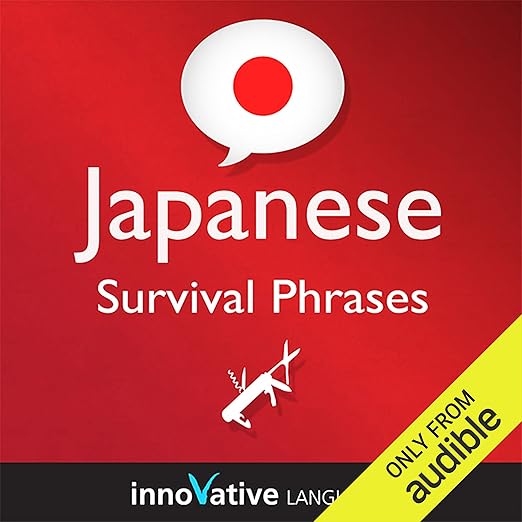
Quick Take
- Narration: JapanesePod101.com’s bilingual host team, a professional, bi-lingual teacher format rather than a single narrator, keeps the tone warm and the pacing practical; well-matched to the travel-use context.
- Themes: Japanese survival phrases, cultural etiquette, practical travel communication
- Mood: Light and purposeful, the format is conversational rather than academic, and each lesson moves quickly
- Verdict: A well-targeted pre-trip or early-study resource for anyone visiting Japan, the cultural context layer sets it apart from phrase-book equivalents.
One reviewer described loading this audiobook on their Kindle and listening to it on the flight to Tokyo. That is a perfectly calibrated use case, and it’s where this course genuinely delivers. I listened to the first fifteen lessons on an afternoon when I was preparing for a trip to Osaka, not expecting fluency, not expecting grammar, expecting the kind of oriented confidence that makes navigating an unfamiliar place marginally less intimidating. The course met that expectation precisely.
Innovative Language Learning’s Survival Phrases series differs from their full-level courses in scope and intent. This isn’t the place to learn Japanese verb conjugation or pitch accent. It’s thirty short lessons, each under ten minutes, covering the phrases, cultural habits, and social navigation tools that a visitor to Japan will encounter in the first 48 hours. The 5-star review from Jeff H., who wanted to avoid being rude rather than achieve fluency, describes the target audience exactly.
What 30 Short Lessons Can Reasonably Teach
The format is efficient. Each lesson opens with a target phrase in natural Japanese, broken down syllabically and then presented at normal speed. The bilingual host explains the cultural context, why you bow when you bow, why certain phrases carry more weight in Japan than their literal translation suggests, what the gesture of handing money with two hands communicates. This cultural layer is where the course earns its differentiation from a standard phrase list.
The 30 lessons cover the territory that matters most for visitors: greetings and their appropriate levels of formality, ordering in restaurants (including the etiquette around paying), asking for directions and understanding the response, introducing yourself and your companions, handling taxis and trains, and the social scripts for entering shops and asking for help. That’s a realistic scope for 2 hours and 46 minutes of audio instruction.
What surprised me, listening through the middle lessons, was how much the cultural instruction mattered. Knowing that “sumimasen” functions as both “excuse me” and “thank you” in service contexts, and understanding why, changes how you use it. The course explains these nuances without becoming an anthropology lecture. The pace stays practical.
The Structure Behind the Short Lessons
Each lesson follows a consistent architecture: target phrase introduction, pronunciation breakdown, contextual usage, cultural note, practice. The repetition is deliberate, you hear the phrase multiple times across the lesson, in different sentence positions and with different interlocutors. By the end of Lesson 5, the standard greetings feel automatic rather than effortful. That’s an appropriate baseline for someone landing at Narita with no prior Japanese.
The course bills itself as teaching Japanese rather than just providing translations, and that claim holds for the phonetic instruction. Japanese pitch accent, the feature that can change a word’s meaning based on where the voice rises and falls, is not addressed in depth, but the course does teach standard Tokyo pitch patterns for the phrases covered. For survival communication, that’s enough.
Volume 1 covers Lessons 1-30. If the course opens you to wanting more, and for some listeners it will, Volume 2 extends into different topic territory with the same lesson format. The volumes are independent enough that you can stop at 30 lessons without feeling the course was incomplete.
The One Real Limitation
The audio alone won’t teach you to read Japanese. Hiragana, katakana, and even common kanji signs appear everywhere in Japan, and the course doesn’t address them. If navigating written Japanese (menus, train signs, map labels) is part of your trip plan, this course needs a companion resource focused on scripts. That’s not a criticism of what the course does, it’s audio instruction for spoken survival, not a literacy program, but it’s worth knowing before you book your flights.
Who Should Listen / Who Should Skip
Ideal for travelers planning a trip to Japan with no prior Japanese knowledge, and for learners in the earliest stages who want practical spoken confidence before committing to a full structured course. The cultural content makes it useful even for business travelers who have a language colleague handling formal communication.
Skip if you want systematic grammar instruction, writing practice, or a course that will build toward conversational fluency. Also less useful if you already have solid beginner Japanese, the content won’t challenge you.
Frequently Asked Questions
Is this course appropriate for complete beginners with no Japanese whatsoever, or does it assume some prior exposure?
It’s designed for complete beginners. Lesson 1 starts from zero, how to say hello, how to say thank you, how to say you’re sorry. No prior Japanese is assumed or required.
Does the course teach the Japanese writing systems, or is it purely spoken Japanese?
Purely spoken. This is an audio survival phrases course focused on pronunciation and conversational use. Hiragana, katakana, and kanji are not covered. If reading signs and menus matters for your trip, you’ll need a dedicated writing system resource alongside this one.
How does this course compare to Pimsleur Japanese for someone preparing to travel to Japan?
Pimsleur Japanese builds conversational production through spaced recall across 30-minute lessons, it’s a longer commitment aimed at sustained language acquisition. Survival Phrases Japanese is shorter lessons with more cultural orientation, designed specifically for the visitor context. For a first trip to Japan with limited preparation time, the Survival Phrases format is faster to complete and more directly trip-relevant.
Can I use both volumes together, or does Volume 2 require Volume 1 as a prerequisite?
Volume 1 and Volume 2 can be used in any order, though starting with Volume 1 is sensible since it covers the most fundamental phrases. Volume 2 extends into different topic areas (shopping, healthcare, emergencies) with the same format. Neither volume is a strict prerequisite for the other.