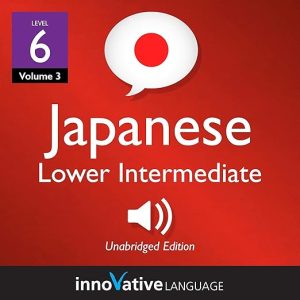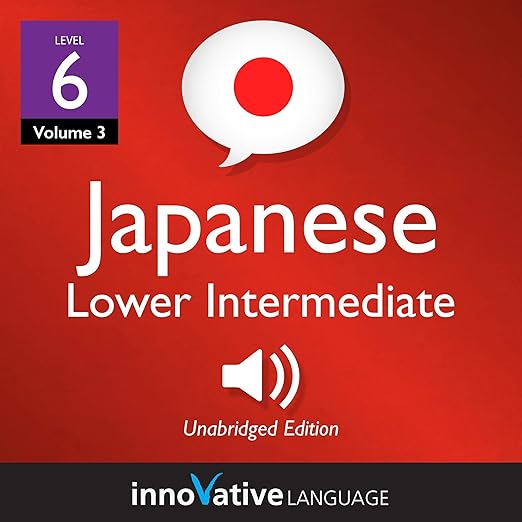
Language learning audiobooks are most useful when they acknowledge what audio format can and cannot do, and Learn Japanese - Level 6: Lower Intermediate Japanese, Volume 3 by Innovative Language Learning LLC builds its structure around that acknowledgment from the start. This is not an immersive narrative, not a vocabulary list, not a classroom simulation. It is a study program delivered in audio form, structured specifically to take advantage of what audio does well: native speaker modeling, pronunciation practice, repetition through varied contexts, and the flexibility of listening while engaged in other activities. The JapanesePod101 hosts are native Japanese speakers, and that fact matters at every level of the program's design.
Level 6 Volume 3 sits at the lower intermediate stage, targeting learners who have moved past beginner fundamentals and are ready to handle the grammatical complexity that defines genuine intermediate Japanese. Transitive and intransitive verb pairs, noun modification structures, Japanese conjunctions, and conditional forms are not ornamental grammar points. They are the structures that separate functional basic Japanese from versatile intermediate communication - the difference between surviving a conversation and navigating it with real flexibility. At five hours and forty-five minutes of lesson content, plus twenty-five review tracks and twenty-five dialog tracks, the listening material is substantial and systematically organized.
Three Tracks Teach Each Lesson Three Times
The JapanesePod101 methodology treats audio learning as a system rather than an approximation of a classroom. Each of the twenty-five lessons has a corresponding audio lesson track, a review track, and a dialog track. This means the same material is engaged from three angles: first explanation by native hosts who break down sentences, grammar, and vocabulary in accessible terms; then focused review of the new words and phrases; then the full dialog at natural conversational speed. That structural repetition is pedagogically sound for language acquisition. Encountering new grammar in explanation, in isolated review, and then in natural context produces retention in a way that a single encounter cannot.
The cultural tips embedded throughout add context that straight grammar study lacks. Japanese is a language where register, social relationship, and situational context heavily influence which structures are appropriate, and the brief cultural notes gesture at that complexity without overwhelming a learner who is still consolidating grammatical foundations. The series describes its content as practical - the focus is on conversation you can actually use rather than literary or formal register that sits above intermediate utility, which is the right emphasis for this stage of learning.
The transitive and intransitive verb distinction deserves specific mention because it is one of the most commonly cited stumbling blocks for English-speaking learners of Japanese at the intermediate level. English does not mark this distinction consistently in verb morphology, so speakers whose language intuitions come from English have no native framework for predicting which verb form to use in a given sentence. The lesson treatment of this distinction in the JapanesePod101 framework uses concrete dialog examples that make the pattern recognizable rather than requiring the learner to memorize abstract rules before applying them.
Hearing Pitch Accent Beats Reading About It
The format advantage of an audio language program over a text-based grammar guide is most evident with pronunciation, and Japanese presents specific phonemic challenges for English speakers. Japanese pitch accent and the phonemic distinctions that English does not differentiate are best learned through hearing and repetition rather than through written description. The native hosts model pronunciation at a pace calibrated for learners, and the review tracks build the automaticity that allows recognition without conscious translation effort.
For someone who has completed the earlier volumes in this series or has an equivalent foundation from other study, the progression here is well-calibrated. The grammar points covered represent real advancement rather than review material dressed up as intermediate content. The dialog tracks at natural speed give learners a realistic target for what the structures sound like in actual use rather than only in pedagogical slow speech, which is the most common limitation of language learning audio resources.
Two Hundred Ninety Pages Live Outside the Audio
This audiobook is not a standalone product in the way that a novel or nonfiction title is. It is Volume 3 of Level 6 in a continuing curriculum, and it presupposes the vocabulary, grammar, and listening familiarity built across the prior volumes. Learners who have not completed at least the early levels of the JapanesePod101 curriculum, or who do not have an equivalent intermediate foundation from other study, will find the pacing too fast and the assumed vocabulary too dense to follow productively. The series is internally consistent and the progression is logical, but it requires sequential engagement rather than dipping in at an arbitrary point.
The written companion materials - more than 290 pages referenced in the synopsis - are not included in the audio product. Audio-only learners receive the lesson, review, and dialog tracks, which are the core of the system. The full value of the program comes from using the audio alongside the written resources. Learners who can access both will have a significantly richer study experience than those working from audio alone.
Active Study Beats Passive Background Listening Here
This audiobook is for learners who have established a working Japanese foundation and are ready to tackle grammar structures that define genuine intermediate proficiency. It is structured for active study rather than passive listening - the review tracks require participation, not just attention. Listeners who are absolute beginners, or who have not completed equivalent earlier levels, should start further back in the series. For the learner at the right stage, the combination of native-speaker pronunciation modeling, structured repetition across three track types per lesson, and practical grammar focus on real intermediate challenges makes this a reliable study resource in a format uniquely suited to language acquisition.
- Performance: JapanesePod101 uses native Japanese hosts throughout, and the native speaker integration is the format's single most important feature for a language learning program. Pronunciation modeling is accurate and consistent.
- What it covers: Intermediate grammar structures, transitive and intransitive verbs, conditional and conjunctive forms
- Feel: Systematic and practical, structured for active study rather than passive immersion
- Our call: A solid intermediate-level audio program for dedicated learners who are ready for grammar structures beyond basic conversation.