The Short Version
- Narrator: Credited to JapanesePod101 rather than one reader, with the copy promising native Japanese teachers and voice actors and no synthetic speech.
- Subjects: Conversation-driven method, CEFR and JLPT alignment, ten-minute lessons, beginner to advanced ladder
- Tone: Brisk, repetitive by design and easy to dip into
- Bottom line: A serious volume of structured listening practice, worthwhile only if you pair it with reading and speaking work.
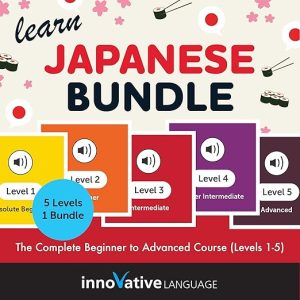
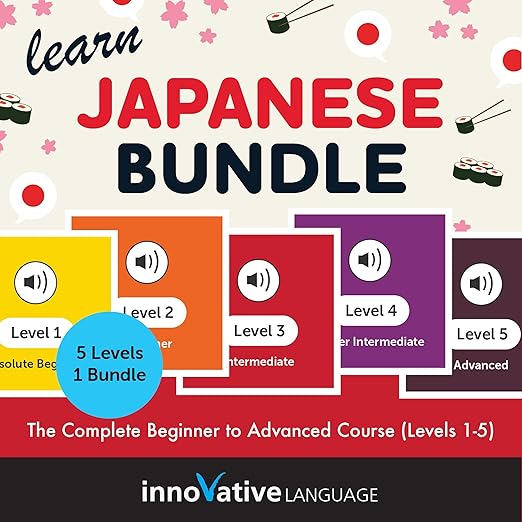
One hundred and seventeen hours is not an audiobook in any normal sense, it is a curriculum, and treating this bundle as anything else will lead you badly astray. Innovative Language Learning has packaged twenty-one of its JapanesePod101 titles into a single purchase that runs from Absolute Beginner to Advanced, built out of lessons the copy pegs at roughly ten minutes each. A companion PDF ships alongside the audio for reading along. The listing carries a 3.0 average drawn from two ratings and no written reviews at all, which is not a verdict on the material so much as the absence of one.
An Honest Admission That No Audiobook Suffices
The description is unusually honest for a language product, and that honesty is the first thing worth noticing. It opens by admitting the limitation of its own format: "No single audiobook will get you to fluency." Then it argues that a bundle can, which is a sales claim rather than a fact, but the framing at least concedes that ten hours of listening does not produce a speaker. What the product actually offers is stated plainly enough to hold it to: twenty-one separate courses, ten-minute conversation-based lessons, native speakers, English explanation of every dialogue, and alignment to the CEFR and JLPT frameworks.
The method is conversation-first rather than grammar-first. Each lesson presents an exchange between native speakers, then teachers translate and unpack it. That approach carries a real pedigree and a real limitation. It builds listening comprehension and usable phrases quickly, which is why podcast-style courses have taken over the beginner market. It is weaker at the structural understanding that lets you generate sentences you have never heard, and the copy's promise of "no grammar drills" reads as a feature to some learners and a warning to others. If you have tried a language this way before and stalled at the point where you could recognize far more than you could produce, that is the ceiling to plan around.
Twenty-One Courses, No Synthetic Voices Allowed
The strongest argument for the bundle is structural. Twenty-one courses bought separately is twenty-one decisions, and learners abandon languages at decision points far more often than at difficult ones. Having the whole ladder from absolute beginner to advanced in one place removes the question of what to buy next for as long as your motivation lasts. The ten-minute lesson length is the other real asset, because it matches the actual gaps in a day: a commute, a walk, the time it takes to cook dinner. Consistency beats intensity in language learning by a wide margin, and this bundle is built for consistency.
On the audio itself, the credit reads JapanesePod101 rather than a single narrator, and that is accurate rather than evasive, since these lessons are made by a rotating group of hosts and voice actors. The copy states that every lesson is made by native Japanese teachers and voice actors and, pointedly, that the recordings use no synthetic speech. For a language course that distinction is not marketing trivia. Learners copy what they hear, including pitch accent, rhythm and the small hesitations of real conversation, and a synthetic voice teaches a version of Japanese nobody speaks. Multiple speakers matter for comprehension too, because a learner trained on one voice struggles the first time a stranger opens their mouth. No listener review exists here to confirm the production, so treat those claims as claims, but they are at least the right claims to be making.
Ignore the 3.0 Rating From Two Reviews
The PDF is load-bearing and you should plan around it. A course that teaches through dialogue needs transcripts, and the description says so, promising that you can read along and never miss a word. Japanese compounds the issue, because a learner listening without text has no way to see which characters a word is written with, and nothing in the description promises instruction in hiragana, katakana or kanji. If you want to read Japanese as well as speak it, this bundle is one half of a study plan rather than the whole of it, and knowing that in advance saves a lot of frustration at the intermediate stage.
Two further cautions. First, the numbers on this listing carry almost no information: a 3.0 average drawn from two ratings, with zero written reviews, tells you nothing about quality in either direction, and I would ignore it rather than read it as a negative signal. Second, one hundred and seventeen hours spread across twenty-one courses will contain overlap. Level-based series repeat core vocabulary by design, which is pedagogically sound and can feel like padding when you work through it in sequence. Expect to skip material, and watch the seam between levels, which is where laddered courses most often lose people.
Commuters and Plateaued Learners Fit This Best
This suits the commuter, the walker and the gym-goer who wants to convert dead time into Japanese and is realistic about what listening alone achieves. It suits the learner who has bounced off app-based study and wants a structured sequence with human voices in it. It also suits anyone stuck on an intermediate plateau who needs volume of natural conversation rather than more explanation, since the upper rungs of the ladder are the part of this bundle that is hardest to assemble elsewhere.
It is a poor fit if you need to read and write Japanese for study or work, if you learn best from explicit grammar explanation, or if you want feedback on your own speaking, which no recording can give you. Treat it as a syllabus rather than a book: schedule it, work the levels in order, keep the PDF open on a second screen, and pair it with a writing system course and regular conversation with an actual person on the other end.
Common Questions
How long is the Learn Japanese Bundle audiobook?
It runs one hundred and seventeen hours and thirty-eight minutes, gathering twenty-one separate JapanesePod101 courses that span Absolute Beginner through Advanced. Individual lessons sit at around ten minutes each, so the length is meant to be worked through over months rather than consumed in sequence. Think of the running time as a syllabus rather than a book length.
Can this audiobook bundle actually get me to conversational fluency?
The description itself concedes that no single title will, then argues a bundle can. My reading is more cautious. Listening builds comprehension and a stock of usable phrases very efficiently, but speaking fluency needs production practice and feedback that no recording provides. Use this as the input half of a study plan and add conversation practice separately.
Do I need the companion PDF that comes with it?
Yes, if you want more than listening comprehension. The lessons are built around dialogues, and the PDF exists so you can read along with them. Japanese makes this more pressing than most languages, since audio alone gives you no view of how a word is written. Keep it open on a second screen while you work.