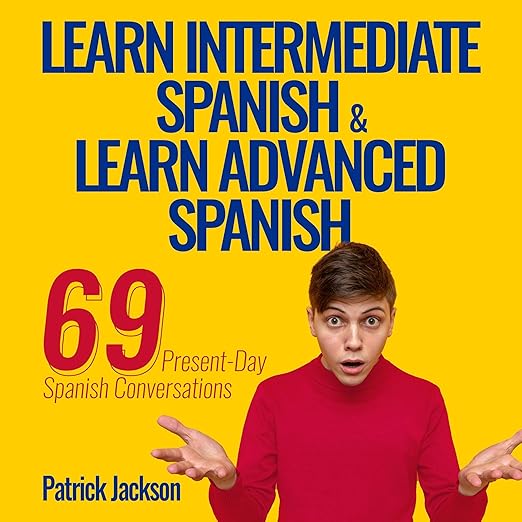
Quick Take
- Narration: Felipe Gonzalez is a genuine asset, delivering all 69 conversations as a native speaker with natural rhythm and contemporary intonation.
- Themes: Contemporary conversational Spanish, Latin American culture, modern vocabulary for digital-age topics
- Mood: Lively and practical, refreshingly modern
- Verdict: A well-designed listening resource that fills a real gap for intermediate learners tired of textbook dialogue.
I spent two years studying French in a classroom where the dialogues featured people checking into hotels and ordering croissants, and by the time I was ready to hold a real conversation, I had no vocabulary for anything that had been invented after 1987. That particular frustration is precisely what Patrick Jackson is solving with this audiobook, and he solves it with real care. I worked through several hours of the 69 conversations one weekend, and the experience is genuinely different from conventional language learning audio.
The premise is straightforward: if you are already past beginner Spanish and the existing resources keep recycling elementary conversations you mastered years ago, here are 69 dialogues built around the vocabulary and topics that contemporary Latin American Spanish speakers actually use. Conversations about digital nomad lifestyles, OnlyFans content creation strategy, electric car debates, AI, drone culture, and online dating horror stories. These are not topics you will find in Rosetta Stone, and that is entirely the point.
Our Take on Learn Intermediate and Advanced Spanish
Felipe Gonzalez does the heavy lifting in narration, and the choice to use a native speaker throughout is the right one. His delivery has the kind of natural pace variation that distinguishes real conversational Spanish from the careful enunciation of non-native instructors. The conversations are spoken first in Spanish, with the English translation following for reference, which mirrors the approach language teachers have long recommended for intermediate learners who already have grammatical foundations but need vocabulary immersion. A reviewer who teaches languages noted that the technique of listening while reading the accompanying PDF amplifies the effect considerably.
The topic selection is where Jackson earns his differentiation. The conversations about coding bootcamps, social media detoxes, transgender women in combat sports, the space race, and cryptocurrency are exactly the kind of material that comes up in actual conversations with people under 40 in Mexico, Colombia, or Argentina. One reviewer’s husband, studying practical Spanish while his wife used it for English-in-depth practice, found the topics immediately applicable and the phrasing usably contemporary.
Why Listen to Learn Intermediate and Advanced Spanish
What makes this work as an audiobook specifically is the format’s compatibility with commuting or exercise. Unlike text-based language learning, which demands visual attention, Gonzalez’s narration can accompany a walk or a gym session. The 13 hours and 57 minutes spread across 69 conversations gives the listening a natural modular structure, easily broken into sessions of whatever length fits your schedule.
The inclusion of a supplementary PDF in the Audible library is a genuine extra. Reviewers consistently mentioned this as adding value, and the combination of listening and reading creates the dual-channel reinforcement that language acquisition research supports. A reviewer who teaches language noted that reading along while listening is a technique with real educational grounding, not just a marketing add-on.
What to Watch For in Learn Intermediate and Advanced Spanish
The topic list includes some conversations that may not align with every learner’s priorities. The OnlyFans content strategy dialogue, for example, sits alongside more broadly useful conversations about eco-friendly living, yoga retreats, and digital finance. This is not a criticism; the deliberate variety mirrors how contemporary Latin American Spanish actually spreads across topics. But listeners should scan the full topic list before committing, to ensure the conversational terrain covers their specific context. Learners focused on business Spanish or academic environments will find some gaps that a more targeted resource would fill.
The 4.4 rating across 45 reviews is solid for a language learning audiobook, where opinion naturally divides based on individual skill level and learning objective. Reviewers who found the content genuinely useful were consistently those already at a conversational intermediate level. True beginners may find the pace and vocabulary density challenging without significant prior exposure to Spanish grammar fundamentals.
Who Should Listen to Learn Intermediate and Advanced Spanish
This is designed for intermediate to advanced learners who are bored with existing resources and want vocabulary for real, contemporary conversation rather than simplified dialogue. It works best for learners planning to travel to or live in Latin America, or who regularly interact with Latin American Spanish speakers in professional or social contexts. Absolute beginners should build a grammatical foundation first. Advanced speakers who are already fluent may find some sections redundant, but the topic-specific vocabulary could still serve as a useful brush-up.
Frequently Asked Questions
Is this audiobook useful for someone learning Castilian Spanish rather than Latin American Spanish?
The focus is explicitly Latin American Spanish, with vocabulary, idioms, and conversational norms specific to that regional variety. Castilian learners may still benefit from the conversational approach, but some vocabulary and pronunciation patterns will differ.
Does the audiobook work without the PDF, or is the PDF essential?
It works as a standalone listening resource, but reviewers consistently found the PDF companion significantly amplified comprehension and retention. The dual-input approach is the intended use case.
How explicit is the OnlyFans conversation, and is the content appropriate for all learning contexts?
The conversation covers content creation strategy and platform mechanics rather than explicit content. It is professional in tone, but learners in conservative workplace or educational settings should note the topic is present in the track list.
What Spanish level is assumed going in?
The audiobook targets intermediate and advanced learners who already have basic grammar and a working vocabulary. The title describes it as for adults who have already bought books, audiobooks, or apps without reaching conversational fluency.