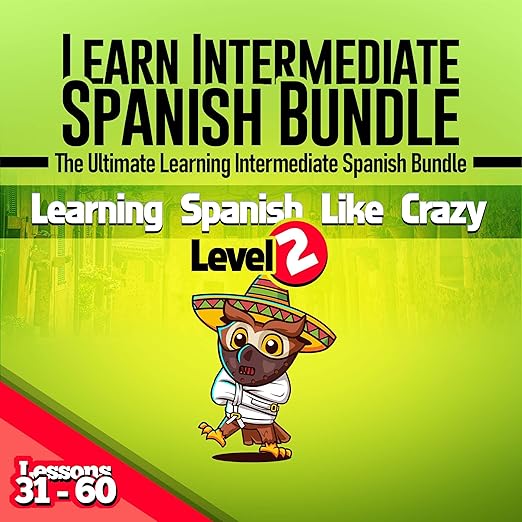
In Brief
- Voice: Native Latin American Spanish speakers voice the lessons, prioritizing clear pronunciation over dramatic flair.
- Big ideas: Conversational fluency, the Spanish subjunctive, structured intermediate progression
- Atmosphere: Methodical, encouraging, classroom-adjacent
- Worth it?: A solid pick for anyone who already survived beginner Spanish and wants a structured next step, not a starting point for true beginners.
Twenty hours and forty-three minutes of structured Spanish instruction is a serious time commitment, and this audiobook, part of the Learning Spanish Like Crazy program's second level, asks for exactly that kind of sustained investment from anyone who has already gotten past absolute-beginner Spanish. I worked through a chunk of the early subjunctive lessons on a long solo drive, which turned out to be close to the ideal setting: no page to glance at, just repetition and native-speaker pronunciation coming through the car speakers for thirty minutes at a stretch.
Ten Subjunctive Lessons Target the Hardest Leap
The listing title here, 'Learn Intermediate Spanish Bundle,' is a bit generic compared to the actual program name used throughout the synopsis itself, 'Learning Spanish Like Crazy Level 2,' worth knowing if you've looked into this specific program under its original branding before; this is the same product, just cataloged under a more search-friendly title. The core structure is clearly laid out: 35 core audio lessons at roughly 30 minutes each, 10 dedicated subjunctive lessons, 10 additional bonus lessons, and two extra colloquial-Spanish bonus lessons, all with downloadable PDF transcripts included.
That subjunctive focus is a meaningful, specific choice worth calling out: the Spanish subjunctive mood is one of the more genuinely difficult grammatical leaps for English speakers moving from beginner to intermediate fluency, since English doesn't use an equivalent mood in anywhere near the same way, and dedicating ten full lessons to it suggests a program built by people who understand exactly where intermediate learners tend to get stuck rather than one that just repeats beginner material at a slightly faster pace.
Ten additional bonus lessons, labeled A through J in the synopsis, plus two more colloquial-Spanish bonus lessons, push the total runtime well past twenty hours, a substantial addition on top of the 35 core lessons; this isn't a slim supplementary product but closer to a full intermediate curriculum in its own right, structured for a learner willing to move through it steadily rather than binge it in a weekend.
Modular Lessons Let You Target Weak Spots
The included PDF transcripts deserve a bit more attention than a passing mention, since they change the practical math of this being purely audio content; a learner can listen during a commute for the spoken repetition, then sit down separately with the transcripts for reading and writing practice, which meaningfully closes the audio-only gap raised elsewhere in this review without requiring a separate print purchase.
It's worth noting how the bundle framing works here: rather than a single continuous course, this is structured as discrete, modular lessons, core material, subjunctive-specific material, and colloquial bonus material, that a learner can technically sequence in more than one order depending on which specific skill feels weakest. That modularity is a genuine advantage over a rigid, strictly linear course for anyone who already has some sense of their own specific gaps in intermediate Spanish.
Dave Walton Broke His Rosetta Stone Plateau
The synopsis specifies native Latin American Spanish-speaking voice actors throughout, which matters for anyone specifically building toward conversational fluency for travel or relationships in Latin America rather than Spain; accent and vocabulary differences between regional Spanish varieties are real, and knowing which one you're training your ear toward before committing twenty-plus hours is a genuinely useful piece of information the listing provides upfront.
Reviewer Dave Walton offers the most compelling case for this specific program's approach: after completing all of Rosetta Stone's levels and still finding himself unable to hold a real conversation when visiting his girlfriend's family in Mexico, he turned to this Learning Spanish Like Crazy program instead and credits it with actually closing that gap. That's a meaningfully different kind of endorsement than generic praise, a direct comparison against a much larger, more expensive competitor.
The program's own pitch, promising to help learners move past a beginner-to-intermediate plateau quickly, is admittedly a bit of marketing bravado, but the specific structural details back it up more than most competing programs' vaguer promises do: named lesson counts, a specific grammatical focus area, and a clear before-and-after skill target, advanced conversational Spanish, rather than an open-ended 'fluency' claim that's harder to actually measure.
Rivera's Delivery Fits the Classroom-Instructor Genre
This is explicitly a level-two program, not a starting point; the synopsis is direct about this, describing it as the next step after 'beginner or intermediate-level Spanish,' so absolute beginners should look for the first level in this same series rather than starting here. Reviewer Eamon P McColgan confirms this positioning directly, calling it 'a continuation of their excellent learning Spanish program taking it from the beginner to the intermediate level.'
Audio-only instruction has a real, honest limitation for language learning specifically: reading and writing practice doesn't happen through listening alone, however good the pronunciation modeling is. Reviewer JB explicitly recommends buying the supplemental Kindle texts alongside the audio 'if you want to be able to review the text of the audio lessons,' and the included downloadable PDF transcripts serve a similar purpose; treat this as a genuinely audio-first but not audio-only program.
No performance-specific detail about Jose Rivera's individual delivery style appears in the available reviews, so this is best assessed on genre-fit grounds: language-instruction audio calls for clear, unhurried, precisely articulated pronunciation over dramatic personality, closer to a patient classroom instructor than an entertainer. It's also worth setting expectations around consistency across a program this long, since energy and pacing inevitably vary somewhat lesson to lesson in any course this comprehensive.
One more practical note: audio-based pronunciation modeling has a real advantage print methods can't replicate, since hearing a native speaker's actual cadence, intonation, and rhythm repeatedly is closer to genuine immersion than reading phonetic spellings ever could be, even though it means this program leans harder on repetition and listening discipline than a visually organized textbook would.
Shaky Beginners Ready to Push Past Plateaus
This audiobook is well suited to learners who already have real, if shaky, beginner Spanish and want a structured, no-frills program to push into genuine conversational intermediate territory, especially anyone specifically targeting Latin American Spanish for travel, family, or relationship reasons. It's also a strong fit for the exact commute-and-errand listening style reviewer JB describes: driving, walking, or exercising. Anyone who has hit a plateau with a different app or program, the way reviewer Dave Walton did with Rosetta Stone, and wants a structurally different approach built around spoken repetition rather than gamified drills, is a particularly good match for this specific format.
Skip this one if you're starting from zero; this program assumes real prior Spanish exposure and moves at a pace that would likely frustrate a true beginner. Listeners who prefer a heavily gamified app-based approach, or who specifically need European Spanish for an upcoming trip to Spain, should also look elsewhere, since both the accent and the format here are built around something different, and the same caution applies to anyone who learns better from visual grammar charts than from repetition and listening alone.
Do I need to finish a beginner-level course before this audiobook?
Yes. This is explicitly the second, intermediate level of the Learning Spanish Like Crazy program, and the synopsis positions it as a continuation rather than a starting point.
Does this audiobook include the PDF transcripts mentioned in the description?
Yes, downloadable PDF transcripts for all lessons are included alongside the audio in your library.
Is the Spanish taught in this audiobook Latin American or European?
Latin American. The synopsis specifies native Latin American Spanish-speaking voice actors throughout the program.
How is this audiobook structured across its twenty-plus hours?
Around 35 core lessons of roughly 30 minutes each, plus 10 dedicated subjunctive lessons and 12 additional bonus lessons covering colloquial Spanish.