Quick Take
- Narration: Imani Conley paces the phrases clearly and deliberately, with enough repetition to let pronunciation actually land during a commute.
- Themes: Practical language acquisition, Caribbean travel preparation, everyday conversational Creole
- Mood: Functional and forward-moving, structured for distracted learners rather than study-table sessions
- Verdict: A genuinely useful commute companion for anyone preparing for Haiti or wanting to connect with Haitian Creole-speaking communities, expectations calibrated to phrasebook depth, not fluency.
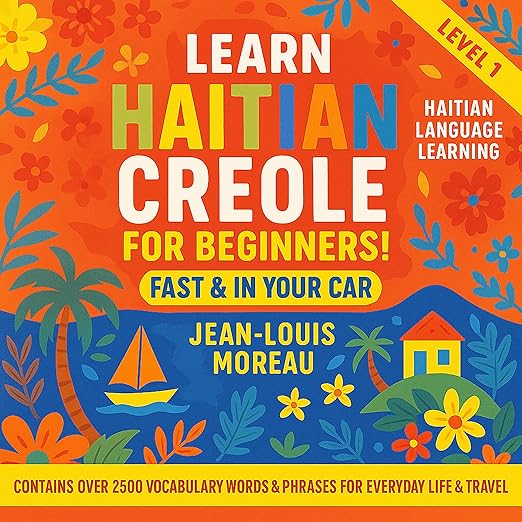
I tested this one during a long drive on a stretch of highway where I had nothing but time and a Spotify-free stretch of attention. Language-learning audio has a specific challenge: it has to be structured enough to be instructional but varied enough to survive eighty minutes of continuous listening without turning into white noise. Learn Haitian Creole for Beginners Fast and in Your Car by Jean-Louis Moreau, narrated by Imani Conley, handles this better than most phrasebook-style audiobooks in the genre.
The format is what the title promises: over 2,500 common Creole phrases and vocabulary words, organized into categories that map to real-world situations. Each phrase is given in Creole, pronounced slowly and then repeated, followed by the English translation. The category structure, travel, food, restaurant ordering, dating, professions, emotions, places in a city, covers the ground a motivated beginner needs before a trip or a meaningful social interaction.
Our Take on Learn Haitian Creole for Beginners
Haitian Creole is spoken by more than twelve million people worldwide, primarily in Haiti and in significant diaspora communities in Florida, New York, Boston, and Montreal. It’s a language that deserves more learning resources than it gets, and the existing options tend to skew toward either academic overcomplication or tourist-brochure superficiality. This audiobook lands usefully in between. It’s not going to teach you grammar rules or build structural language intuition, that’s not what it’s designed for, but for someone who wants to arrive in Port-au-Prince capable of ordering food, asking for directions, and having a basic conversation, the material here is practical and well-organized.
Imani Conley’s narration is the key variable for this kind of audio course. A language-learning narrator who rushes phrases or clips pronunciation renders the whole exercise pointless. Conley is deliberate without being mechanical, and the repetition structure, each phrase said slowly, then again, gives the ear time to internalize sounds before moving on. The result is a phrasebook that actually works as an audiobook, which is not as common as the genre might suggest.
Why Listen to Learn Haitian Creole for Beginners
The commute and car-travel format is genuinely smart for this type of content. Language acquisition benefits from repetition in varied attentional contexts, and the car, where you’re engaged but not visually occupied, is one of the more effective environments for passive vocabulary absorption. The structure of the audiobook aligns with this: categories are discrete enough that you can dip in and out of sections on different drives, returning to food vocabulary one day and travel phrases the next, without losing coherence.
For anyone traveling to Haiti specifically, the travel and everyday-life sections are the most immediately useful. The restaurant and food categories are detailed and practical. The business and professions sections have more limited utility for casual travelers but would be valuable for anyone working with Haitian Creole-speaking communities professionally. The dating section exists and is what it is, useful context for understanding social registers even if you’re not there for romance.
What to Watch For in Learn Haitian Creole for Beginners
This is a phrasebook in audio form, not a language course. There are no grammar explanations, no verb conjugation structures, no explanations of why Haitian Creole works the way it does in relation to its French and African language roots. If you finish this audiobook expecting to hold a spontaneous conversation on an unfamiliar topic, you will be disappointed. If you finish expecting to navigate the specific situations covered, ordering meals, discussing professions, describing feelings, finding places in a city, you will have genuinely useful tools.
The ten-hour runtime is also worth flagging. At that length, this is more of a reference resource you return to repeatedly than a narrative you listen through once. The reviewers who gave it five stars, and all available reviews are five stars, which is unusual, indicate that listeners who approached it with correct expectations found the content delivered on its promises.
Who Should Listen to Learn Haitian Creole for Beginners
Travelers planning a trip to Haiti or to Haitian Creole-speaking communities who want practical conversational readiness rather than formal linguistic study. Healthcare workers, educators, or social service professionals who work with Haitian diaspora populations and need immediate functional vocabulary. Anyone curious about the language itself as a way of engaging with Haitian culture, Haitian Creole has a fascinating history as a creole language that developed among enslaved people in colonial Saint-Domingue, and even a phrasebook-level engagement opens some of that history. Listeners expecting a full grammar course should look for a more structured learning resource.
Frequently Asked Questions
Is this audiobook useful without any prior knowledge of Haitian Creole or French?
Yes. No prior knowledge is assumed or required. The format is phrase-by-phrase with English translations provided for everything, so complete beginners are the target audience.
How does Imani Conley handle the pronunciation of Haitian Creole, which has sounds distinct from both English and French?
Conley narrates at a deliberately slow pace with multiple repetitions of each phrase, which gives listeners time to absorb unfamiliar phonemes. The approach prioritizes practical usability over speed.
Is ten hours of language content appropriate for a single listen-through, or is this better used as a reference?
Better as a returning reference. The categorical structure, organized by topic rather than narrative, means you can revisit specific sections (travel phrases, restaurant vocabulary) on different drives as your needs shift.
Does the audiobook address any cultural context for using Haitian Creole appropriately?
The content is primarily practical vocabulary with limited cultural framing. The phrase categories touch on social situations but don’t include significant context about Haitian culture or customs. For deeper cultural preparation, supplementary reading would help.