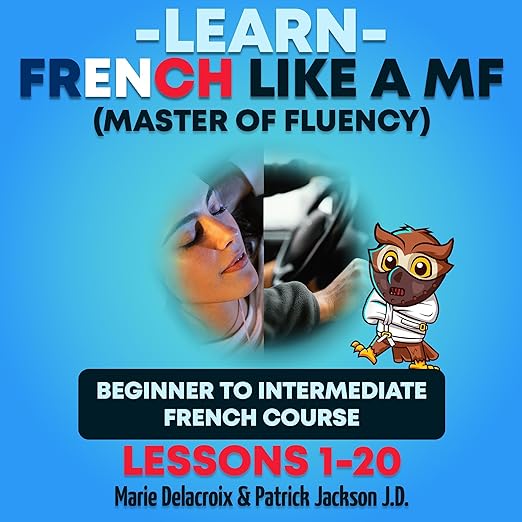
Marie Delacroix's audiobook course Learn French Like a MF (Master of Fluency): Beginner to Intermediate French Course (Lessons 1-20), narrated by native speaker Alexia Dubois, makes an immediate case against the conventional language-learning model: the idea that you absorb a language by memorizing vocabulary lists and drilling conjugation tables before you are allowed to actually speak. At 17 hours and 23 minutes, this is a fully audio-structured course built to be your primary French learning medium, not a supplement to a textbook, and it works from the premise that adults learn conversational French fastest when they hear it used the way Parisians, Lyonnais, and Quebecois actually speak.
Dubois Teaches the French Parisians Actually Speak
The course's core argument is that most French-learning resources train you to produce a register of the language that no native speaker actually uses. Delacroix builds against that by centering natural expressions, practical vocabulary, and real-world scenarios from the earliest lessons. The 20 progressive lessons take listeners from genuine beginner territory through intermediate fluency, and the pacing within each lesson gives enough repetition for pronunciation to register without becoming tedious. Dubois is an ideal narrator for this material: her accent is clear and non-regional, and her delivery at learner-friendly speeds never crosses into the exaggerated slowness that makes some language audiobooks feel condescending.
The scenarios covered are genuinely practical: ordering at cafes, navigating the Metro, chatting with locals, managing travel logistics. These are not the situations that intermediate French textbooks eventually arrive at after fifty pages on French history. They are the situations that matter within the first twenty-four hours of arriving in a French-speaking country, which tells you something about the course's priorities. The course teaches grammar through context rather than through explicit rule instruction, which is consistent with how adults in immersive environments actually acquire a language. That means some dedicated grammar-learners will find the approach feels less rigorous than they want, while others will find it more natural than any course they have tried before.
The sleep-learning supplement, included in the full 17-hour runtime, layers core vocabulary over gentle background music for optional reinforcement. This is not new instructional content; it is a consolidation pass through material the earlier lessons introduced. Some learners find sleep-adjacent audio reinforcement genuinely useful as a review tool, while others will treat it as optional. Either approach works, since the primary lesson content is complete without it.
Designed for the Ear Instead of the Page
The format is built for audio in a way that print-origin language courses are not. Unlike audiobook versions of print French textbooks, which frequently reference diagrams, charts, or exercises that do not translate to a listening environment, this course was designed around the ear as the primary organ of acquisition. Every lesson is fully transcribed in the accompanying PDF, available in your audio library, which provides written scaffolding for listeners who want to read alongside without the course depending on it. Dubois's narration carries the full instructional weight.
For commuters and travelers, the 17-hour format is particularly practical. The lesson structure means you can work through one or two sessions per commute and feel genuine forward momentum. The course does not claim you will be fluent in a week; it claims that by lesson twenty you will have a foundation that holds up in actual conversation. That is a more honest promise than most competing programs make, and the audio-first design ensures that the pronunciation dimension of French acquisition, which apps consistently underdeliver on, gets the attention it requires. Learners who have plateaued despite months of app use will recognize immediately that this approach engages a different mechanism.
Zero Reviews So Far, Ambitious Marketing Claims
The course carries no listener reviews at the time of this writing, so independent confirmation of specific outcomes is limited to the publisher's claims. The PDF transcript is a companion document in your audio library, which means listeners without easy access to a screen during their primary listening sessions should plan their workflow accordingly. The sleep-learning material adds time to the runtime but is optional content rather than core instruction, so the primary lesson content runs shorter than the 17-hour total figure suggests.
The marketing language around fluency sets ambitious expectations. Moving from beginner to intermediate in twenty lessons is a realistic goal for dedicated learners; the kind of fluency that lets you follow fast, idiomatic speech in an unfamiliar regional accent takes considerably more time and exposure. The course gets you to a foundation worth building on, which is exactly what a beginner-to-intermediate program should be positioned as. Listeners who expect complete conversational freedom by the end of lesson twenty will be disappointed; those who treat this as a strong foundation for continued learning will find the investment worthwhile.
Plateaued App Learners Finally Fix Their Pronunciation
Adults who have hit a plateau with app-based French learning and need something that actually addresses pronunciation and spoken French will get substantial value from this audiobook course. Commuters who want their transit time to do meaningful language work are ideally positioned for this format. Complete beginners who want audio as their primary medium, rather than a supplement to a textbook, will find this more suited to their needs than courses that assume a classroom baseline. Listeners who require a heavily grammar-forward approach with explicit rule explanations before practical application may want to supplement with a print grammar resource, since this course teaches structure through context rather than direct instruction.
Before You Press Play
- Performance: Alexia Dubois delivers native French pronunciation with clarity suited to learners, modulating speed in a way that gives ears time to register unfamiliar sounds without patronizing listeners who are building real fluency.
- What it covers: Conversational French acquisition, real-world scenario practice, grammar through context
- Feel: Energetic and direct, structured but never dry
- Our call: Adults who have stalled on French apps and want an audio-native course with real pronunciation modeling and transcript support will find this a substantial step forward.
Frequently Asked Questions
Is the accompanying PDF essential to getting value from this audiobook course, or can it work as audio only?
The course is designed for audio-primary learning, and Dubois's narration carries the instructional content without requiring the PDF. The transcript is a useful reinforcement tool for learners who want to check spelling or review vocabulary between sessions, but the audio stands on its own.
How does Alexia Dubois's narration handle making French pronunciation accessible without oversimplifying it for this audiobook?
Dubois modulates her speed in a way that separates individual sounds clearly without adopting the artificial enunciation that makes learner-focused recordings sound nothing like real conversation. Native expressions are delivered at natural rhythm and then slowed for repetition, which trains the ear for actual spoken French.