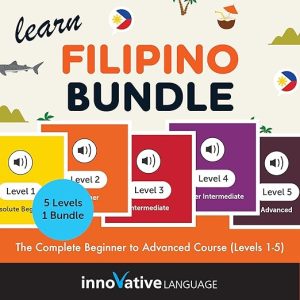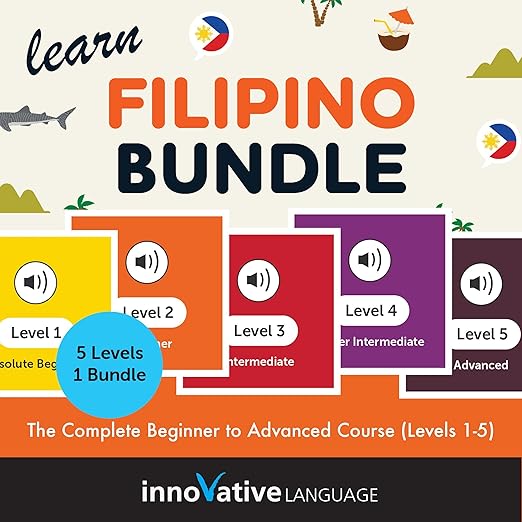
How much Filipino can a stack of five-minute conversations actually build? That is the question this audiobook bundle exists to answer, and the description is unusually blunt about its own premise: no single recording will get anybody to fluency, but ten of them together might. Innovative Language Learning released it in July 2025 under the FilipinoPod101 banner: ten separate courses stitched into a single purchase.
Method here is straightforward and unfashionable in the best way. Every lesson opens with an everyday conversation between native speakers, and then teachers take it apart word by word in plain English. No grammar drills, no vocabulary lists to memorize and, the copy insists, no synthetic voices anywhere in the recording. What gets built is recognition first and production second, which happens to be the order in which most people actually acquire a language. The claim about synthetic voices is worth pausing on, because it is the one competitive statement on this page a listener can verify within a minute of pressing play.
Five levels run from absolute beginner to advanced, and the description adds that the whole thing is aligned to the CEFR. That is a real standard with six named bands, and this page maps not one of them. Anyone who needs to reach a specific level for work, for study or for a visa application gets a marketing word instead of a coordinate, which is the one genuinely useful thing this listing could have supplied and chose not to.
What I keep returning to is that the bundling is the honest part of the pitch. Language products usually sell you level one and hope for the best, and this one concedes in its own opening lines that a single course cannot finish the job, then sells the entire ladder in one transaction. The trade is that you are buying a full sequence sight unseen, from a publisher whose earlier levels you have not tested, with no sample of any of them offered.
Five-Minute Lessons Survive Any Interruption
For audio-first learning, the five-minute unit is exactly the right call. It survives interruption, which nothing longer does, and it lets a learner finish something in the gap between two other tasks instead of abandoning a half-completed chapter. A lesson short enough to repeat three times in a row is a lesson that actually gets repeated, and repetition is the entire mechanism by which any of this works. The failure mode stays mild as well. Losing your place in a chapter costs you the chapter, while losing your place in a five-minute lesson costs almost nothing, which is why people come back to it.
The content promises are specific enough to be checkable: chatting about the weekend with Filipino friends, ordering food in a restaurant, asking for directions on a trip to the Philippines. Those happen to be the three situations that genuinely arise, and building a course around them rather than around verb tables is a decision that pays off inside the first week. Cultural nuance rides along inside the dialogues, which is the only place it was ever really learnable.
Reading along matters more here than in almost any other kind of title. Spelling cannot be heard, and a learner who has only ever heard a phrase cannot look it up, write it down or type it into a message. The read-along file is the difference between recognizing something and being able to use it, it ships with the recording, and anyone studying seriously should treat it as half the product rather than as a bonus.
Ten Audiobooks Claim to Fill Five Levels
Nothing on this page tells you whether it works. The bundle carries no rating and not one written response, which for a July 2025 release means a buyer is working from the description and nothing else. The narrator credit compounds the problem: that credit reads FilipinoPod101, which is a brand rather than a person, while the copy promises lessons made by native Filipino teachers and voice actors. Named performers are being advertised and then not named.
Numbers do not line up either. The title sells Levels 1 to 5. The description says the bundle contains ten FilipinoPod101 audiobooks and never explains how ten titles map onto five levels. Running time gets the same treatment, with the copy saying over twenty-four hours in two separate places while the entry records twenty-six hours and fifty-one minutes. At the advertised five minutes a lesson, that implies well over three hundred segments, and no index of them is published anywhere.
Two smaller things worth knowing. The language line reads English, which is defensible given that the explanations are in English, but anybody filtering a catalog by language will not find a Filipino course sitting where they expect it. And the description still carries its storefront ending intact, instructing you to download the bundle right now. Sales copy has been pasted into a product page without anyone reading it back afterward.
Self-Directed Learners With a Concrete Reason Fit Best
Self-directed learners with a concrete reason to learn Filipino are the obvious audience: family, a partner's household, a move to the Philippines, work that involves the country. The conversational focus assumes you want to talk to people rather than pass an examination, and the structure assumes you will show up repeatedly across months rather than binge a single weekend. Anybody in that position is getting an unusual quantity of teaching for the money. It suits anyone rebuilding a heritage language too, where the target is not a classroom but a conversation with a grandparent, and the everyday register on offer here is exactly right for that.
Casual dabblers should not start here. A ladder running from absolute beginner to advanced is a commitment measured in seasons, and abandoning it at level two leaves you with the same phrasebook competence a free app would have handed over in an afternoon. Anyone who needs grammar explained systematically should also look elsewhere, since the description rules out drills explicitly, and a learner who wants to know why a sentence works will find the conversational method quietly maddening.
Commit to the schedule and this is a generous amount of teaching for the money; treat it as something to sample and you have bought a ladder in order to stand at the bottom of it.
Quick Take
- Big ideas: Conversational Filipino from absolute beginner to advanced, five-minute lessons, native-speaker dialogues, CEFR alignment.
- Atmosphere: Patient, repetitive, quietly relentless.
- Worth it?: A serious quantity of teaching for one purchase, sold by a page that will not name a single voice on it.