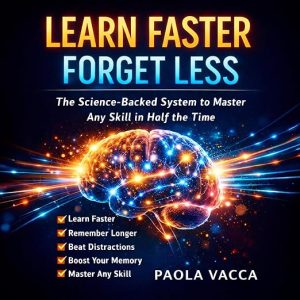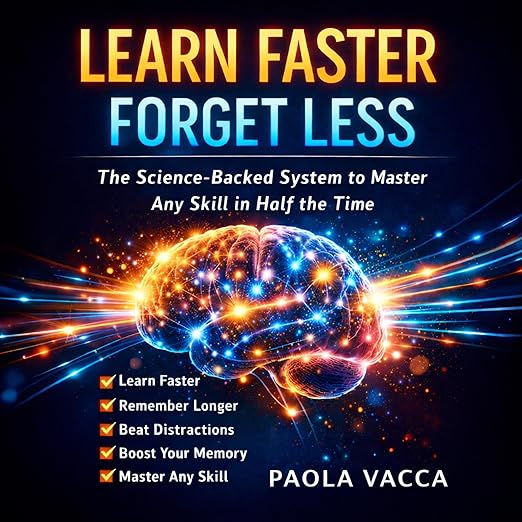
Paola Vacca's Learn Faster, Forget Less opens with a question that most people who have ever sat through an exam have asked themselves at some point: why does studying for hours fail to produce retention that actually lasts more than a few days? The audiobook's answer, delivered by Scott LeCote across one hour and twenty-four minutes, is that the problem is not intelligence or effort but method. The traditional study model, long passive sessions, repeated rereading of highlighted notes, sits in direct contradiction to how memory consolidation actually works at the neurological level. What Vacca proposes instead is a system built on neuroscience findings that have been in the research literature for decades but have not reliably made it into most educational settings where students actually spend their study hours.
The core techniques Vacca outlines are active recall, spaced repetition, and focused short sessions. These are concepts familiar to anyone who has read Barbara Oakley's work on learning or Cal Newport's writing on deep focus, but Vacca presents them with practical clarity and without jargon, and LeCote's narration gives each technique appropriate weight without padding the explanations beyond their natural length. At eighty-four minutes, this is a deliberately lean audiobook, and the runtime is itself an argument for the approach: you do not need an eight-hour production to convey high-value ideas when the goal is practical orientation rather than comprehensive theory. The brevity is a feature, not a limitation, and the format models the focused efficiency it recommends.
LeCote Reads the Ebbinghaus Curve With Precision
The book is most genuinely useful for listeners who know their learning habits are not working but have not yet systematically encountered the research-backed alternatives. Active recall, the practice of testing yourself on material rather than re-exposing yourself to it passively, is counterintuitive enough that many people continue studying by rereading long after they have encountered evidence that it produces weak long-term retention. Vacca makes the case for switching clearly and provides enough practical guidance on how to actually implement the switch to make it actionable rather than purely theoretical for the listener.
The spaced repetition material is the audiobook's strongest section. Vacca explains the forgetting curve, first documented by Hermann Ebbinghaus in the 1880s and confirmed repeatedly since by cognitive scientists, with the right balance of scientific grounding and practical application. LeCote reads this section with a precision that suits it well; the ideas require careful sequential delivery because the concepts build directly on each other, and losing a listener's full comprehension at any point means losing the downstream argument. Whether you are studying for professional examinations, building career skills, or working through a language curriculum, the principles in this section transfer without modification to any knowledge domain you choose to apply them to.
Pausing to Summarize Turns Listening Into Practice
The audiobook format suits this material better than it might initially seem. The techniques Vacca describes are fundamentally about how to process audio input into long-term memory, which means the listening context is itself an implicit demonstration of the book's own claims. A listener who implements active recall by deliberately pausing and mentally summarizing each section before moving to the next will internalize the material differently and more durably than one who simply plays it through as background audio. Vacca's structure makes that kind of active listening easy to adopt without the book needing to explicitly instruct you to do so at every step.
LeCote's pacing is the narration's most notable quality. He does not rush the material, which would undermine the audiobook's implicit argument that focused, unhurried attention is the foundation of effective learning, but he also does not artificially extend his delivery with padding or excessive repetition. The result is a listening experience that models the focused, attentive engagement it recommends rather than contradicting it through its own production choices.
Distraction Gets Less Time Than It Deserves
The section on eliminating distraction and mental fatigue is shorter than it probably deserves to be given how central the distraction problem is to why most study sessions fail before the question of method even becomes relevant. Vacca covers the key points but moves through them quickly. Listeners who find that section particularly relevant to their situation should treat it as an introduction rather than a complete treatment and seek supplementary material, whether that is Newport's writing on deep work or the behavioral science literature on environment design and habit formation more broadly.
Also pay careful attention to the chapter on building consistency without relying on motivation. Vacca's argument here, that systems and environmental design matter more than willpower or inspiration as the foundation of sustained learning practice, is well-supported by the behavioral science literature and is arguably the most practically important insight in the entire audiobook. It is also the one most likely to be underestimated by listeners because it is framed modestly rather than as the book's headline claim.
Eighty-Four Minutes for Students Ready to Act
Students at any level, professionals actively building new skills, and language learners will all find directly applicable material here. The audiobook is accessible enough for listeners with no prior background in neuroscience and substantive enough to provide genuine value even for those who have encountered some of this material in other forms. Listeners looking for deep theoretical engagement with memory science should look to longer, more academically oriented texts; this is a practical guide designed for people who want to change their study habits this week rather than complete a course in cognitive psychology first. At eighty-four minutes, it is a very reasonable commitment.
In Brief
- Read by: Scott LeCote narrates with a clean, encouraging energy that suits the instructional format well, pacing the material at a speed that feels like a knowledgeable colleague rather than a lecture.
- At its heart: Memory science, habit formation, the gap between studying and learning
- Vibe: Practical and encouraging, designed to make the listener feel capable rather than overwhelmed
- Short version: Learn Faster, Forget Less is a compact, well-organized overview of evidence-based learning techniques that delivers genuine value within its lean runtime.
Frequently Asked Questions
Is this audiobook useful for language learning specifically, or just general studying?
The techniques Vacca describes apply directly to language acquisition. Active recall and spaced repetition are the foundations of most effective language learning programs, and she discusses both in enough detail to adapt them to vocabulary and grammar study.
At only 84 minutes, does this audiobook cover enough ground to be worth the time?
The runtime matches the scope. Vacca focuses on the highest-leverage techniques rather than attempting comprehensive coverage, and the audiobook's brevity is itself an argument for prioritization over accumulation.
Does Scott LeCote's narration add anything distinctive to this audiobook?
His pacing is the main contribution. LeCote reads at a measured speed that suits focused listening, and his tone is encouraging without being sycophantic, which is the right register for instructional material of this kind.