Quick Take
- Narration: Rania Al Hanini is the obvious casting choice for a Levantine Arabic language course, and her pronunciation guidance is precise and aurally modeled throughout.
- Themes: Levantine dialect acquisition, cultural immersion, practical travel communication
- Mood: Encouraging and methodical, with a travel-companion energy
- Verdict: A well-structured audio introduction to conversational Levantine Arabic that works best for travelers and curious learners, though it covers starter ground rather than fluency.
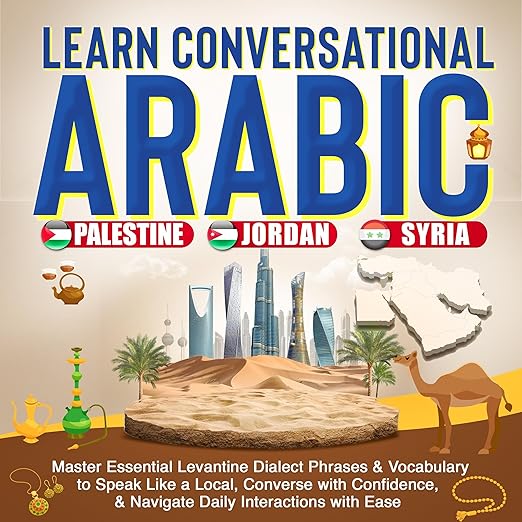
Language learning audiobooks occupy a peculiar niche. They are not the immersive, AI-driven apps that now dominate the language learning space, nor are they the structured grammar textbooks that serious linguists prefer. They are something in between: a guided introduction that works best when you treat it as orientation rather than comprehensive curriculum. Learn Conversational Arabic by Global Citizen Language Learning sits comfortably in that niche, and at three hours and forty-three minutes, it is honest about its scope.
The focus here is specifically on Levantine Arabic, the dialect family spoken across Lebanon, Syria, Jordan, and Palestine, rather than Modern Standard Arabic, which is the written and formal register. That is a significant and useful choice. If your goal is to communicate with people in the Levant, in a market in Amman or a cafe in Beirut, Levantine Arabic is what you need. Modern Standard Arabic is a formal register that native speakers use in news broadcasts and formal settings but not in daily conversation. Plenty of Arabic learning resources ignore this distinction and teach MSA to travelers who then arrive in Lebanon and find themselves speaking in a way that sounds formal to the point of awkwardness.
Our Take on Learn Conversational Arabic
The audiobook covers ten fundamental lessons built around practical scenarios: greetings, asking for directions, ordering food, navigating transportation, shopping. Rania Al Hanini narrates and models pronunciation throughout, which is the essential feature that makes this material work in audio format. You cannot learn pronunciation from text alone, and Al Hanini’s modeling of the sounds specific to Levantine Arabic, including the consonants that do not exist in English, is the reason to choose this format over a book.
The publisher is Blackstone Publications, which has a strong track record with language learning audio, and the production quality reflects that. The audio support for pronunciation practice is well integrated with the lesson structure rather than added as an afterthought. The ten lessons build logically from foundational vocabulary and greeting conventions into more complex transactional phrases, always anchored in the scenarios a traveler or professional is most likely to encounter.
Why Listen to Learn Conversational Arabic
At a perfect five-star rating across forty-two reviews, this is a product whose audience is finding it useful. That audience, based on the synopsis framing, is people who are captivated by Arabic but intimidated by the script, the pronunciation, and the dialect variations. By focusing on the Levantine dialect and keeping the lessons practical and scenario-based, the course has lowered the entry barrier substantially.
The absence of written script instruction is a feature rather than a gap for this particular audience. If your goal is conversational communication rather than reading Arabic, you do not need to learn the script to begin. This course treats Arabic as a spoken language first, which is how native speakers actually acquire it as children. For adult learners with limited time, that prioritization makes the early investment pay off faster.
What to Watch For in the Ten Lessons
The cultural insights embedded throughout the lessons are worth attention beyond their linguistic utility. Language learning and cultural learning are inseparable at the practical level, and this course uses its scenario-based structure to deliver context that will help a traveler navigate social situations rather than just linguistic ones. Understanding when to use formal versus informal registers, and what kinds of conversational openers are expected in Levantine social contexts, is as practically useful as the vocabulary itself.
Three hours and forty-three minutes covers starter ground. Listeners who complete this course will have a functional orientation to Levantine Arabic for travel purposes, not conversational fluency. The appropriate next step would be structured practice with a native speaker, an app like Pimsleur for deeper audio drilling, or a more comprehensive course for those with serious professional or academic goals.
Who Should Listen to Learn Conversational Arabic
Travelers planning a visit to Lebanon, Jordan, Syria, or Palestine who want to arrive with more than a phrase book will find this genuinely useful preparation. Professionals working in Levant-region business contexts who want basic social language to build rapport will also get real value from it. People seeking fluency or interested in Modern Standard Arabic for reading or formal contexts should look at more comprehensive programs. This is an entry point, and it is a good one, built for people who understand that the biggest barrier to Arabic learning for an English speaker is getting started at all.
Frequently Asked Questions
Does this course cover Modern Standard Arabic or a regional dialect?
It focuses specifically on Levantine Arabic, the dialect spoken in Lebanon, Jordan, Syria, and Palestine. This is the right choice for travel or daily communication in those regions. Modern Standard Arabic, used in formal and written contexts, is a different register not covered here.
Is Rania Al Hanini a native Levantine Arabic speaker, and does her pronunciation reflect actual usage?
Based on the audio content, her pronunciation reflects native-level familiarity with Levantine Arabic. The course specifically credits her role in providing authentic pronunciation modeling, which is the primary argument for audio over text-based learning for this material.
Will I be able to hold a basic conversation after completing this three-hour course?
You will have functional orientation for common travel scenarios: greetings, ordering food, asking directions, and basic transactional exchanges. Conversational fluency in the sense of spontaneous free discussion requires substantially more practice than any three-hour course can provide. Think of this as a foundation-layer listen.
Does the course teach the Arabic script, or is it entirely phonetic?
The course is entirely audio-based and does not teach the Arabic script. It is designed for practical spoken communication rather than reading or writing. The core learning methodology is phonetic and audio-first, which suits its target audience of travelers and casual learners.