Quick Take
- Read by: Doris Kearns Goodwin reads the introduction and afterword herself, though the listing does not specify who handles the main narration, worth previewing before an 18-hour commitment.
- At its heart: Presidential leadership under crisis, moral purpose, historical parallels to present-day politics
- Vibe: Analytical and comparative, closing on an unexpectedly elegiac note
- Short version: A well-researched comparative study that rewards listeners already curious about how these four presidencies actually functioned under pressure.
Leadership earns its scope: eighteen hours spent moving between Lincoln, Theodore Roosevelt, Franklin Roosevelt, and Lyndon Johnson is a real commitment, but Doris Kearns Goodwin uses the space well, and the audiobook holds together as one argument rather than four separate biographical sketches stitched together.
That argument is specific: leadership is not an innate trait but something forged, and often forged through failure, and Goodwin structures each section around the moment a reversal nearly ended each man's public life before it properly began. It is an ambitious framework for a single audiobook to sustain across four very different presidencies, and for the most part it does.
A HISTORY Channel Series Covering Less Ground
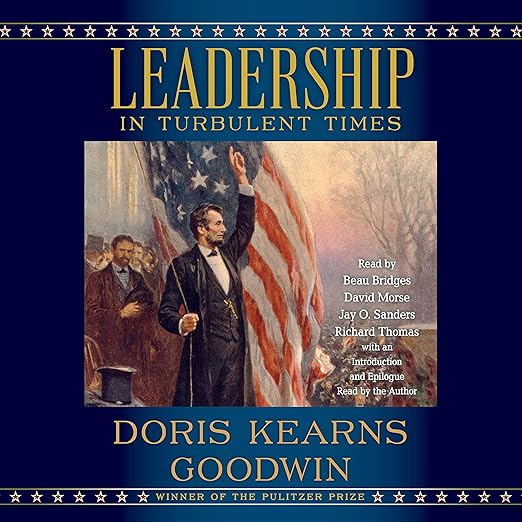
The book's full title, Leadership: In Turbulent Times, gets referenced directly by reviewer Kelley Ridings, and that subtitle matters more than it might first appear: Goodwin wrote this explicitly to speak to a fractured political moment, using historical distance to say something about present-day leadership without ever losing the specificity of Lincoln's cabinet politics, Theodore Roosevelt's conservation fights, FDR's Depression-era improvisation, or Johnson's civil rights maneuvering. It inspired a multipart HISTORY Channel series covering Lincoln and Roosevelt specifically, though the audiobook's four-president structure is more ambitious than that adaptation.
Goodwin's own history adds an unusual layer to the Johnson sections specifically: she worked as a young White House Fellow under Johnson early in her career, and that firsthand vantage point shows in how she handles his civil rights legislation, neither hagiographic nor reflexively critical, but grounded in direct knowledge of how that White House actually operated.
A Personal Bookend at Start and Close
Goodwin's reputation as a presidential historian, built across five decades of work, shows in how confidently she moves between these four very different men without flattening their differences into a single leadership formula. Reviewer RTM, who describes already having read extensively about all four presidents, still came away with new and specific details, which says something about the depth of research underneath the book's readable, story-driven structure.
One detail worth knowing going in: the author reads the introduction and afterword herself. That framing device, Goodwin speaking directly to the listener at the start and close of an eighteen-hour audiobook, gives the whole project a personal, essayistic bookend that a narrator-only edition would not have, even though the bulk of the text in between is handled separately.
The book also takes real care with each man's specific historical context rather than forcing artificial parallels between eras: Lincoln's cabinet-building during secession, Theodore Roosevelt's conservation and trust-busting fights, FDR's improvisation during the Depression's early days, and Johnson's civil rights maneuvering each get treated as genuinely distinct problems requiring genuinely distinct leadership approaches, rather than four variations on a single template.
The audiobook's eighteen hours also make it a natural fit for listeners already working through other Goodwin titles or comparable presidential histories, since her recurring interests, moral courage, coalition-building, the loneliness of executive decision-making, thread through this book in ways that will feel familiar to anyone who has read her earlier work on Lincoln or the Roosevelts.
A Deliberate Departure Into Comparative Territory
Goodwin's earlier books, including Team of Rivals on Lincoln's cabinet and No Ordinary Time on the Roosevelts during World War II, each focused on a single presidency, and Leadership represents a deliberate departure into comparative territory after decades of that single-subject depth. Longtime readers of her earlier work will notice how much she compresses here relative to those standalone books, trading some granular detail for the ability to draw explicit connections across eras.
The book's central question, whether crisis makes leaders or simply reveals them, gets tested differently across all four case studies, and Goodwin resists giving a single tidy answer, letting Lincoln's self-doubt, Theodore Roosevelt's restless energy, FDR's calculated optimism, and Johnson's ferocious legislative instinct each suggest a different piece of the puzzle rather than converging on one formula.
This audiobook's listing does not specify who narrates the main body of the text beyond Goodwin's own introduction and afterword, which is worth knowing before you commit to eighteen hours of listening. If a specific narrator voice matters to your enjoyment of long-form nonfiction, it is worth sampling a preview before buying rather than assuming based on the author's own participation in the bookend chapters.
No Narrator Named Beyond the Introduction and Afterword
The final chapter, which reviewer Amazon Customer describes as covering each president's death and how they are remembered, lands with real emotional weight after eighteen hours spent with these four men, but it also means the book's momentum shifts from analytical to elegiac right at the end. If you are expecting a tidy, upbeat close built around leadership lessons, be ready instead for something closer to a meditation on mortality and legacy.
Because the book moves chronologically through each man's rise before circling back to compare them, listeners should also expect some structural repetition as Goodwin re-establishes context across four separate historical periods; this is a deliberate choice that serves the comparative argument but does mean the pacing is less linear than a single biography would be.
Better Broken Into Sections by President
This is a strong match for listeners who already have some familiarity with American presidential history and want a comparative, cross-era study rather than a single cradle-to-grave biography. Kelley Ridings' review captures the audience well: people looking to history right now for some sense of how the country has made it through difficult moments before.
Given the eighteen-hour length and comparative structure, this also works well broken into sections organized around each president rather than consumed strictly start to finish, for listeners who want to focus on one figure at a time.
If you want a deep, single-subject biography rather than a four-way comparative study, or if narrator continuity across the full text matters more to you than Goodwin's own bookending presence, you may want to look elsewhere first. But as an accessible entry point into how these four presidencies actually worked under pressure, Leadership holds up as a substantial, well-researched listen.