- Voice: Mark Boyett keeps dense testimony and cross-referenced documents moving without letting the procedural detail flatten into monotone.
- Big ideas: Institutional cover-up, testimony versus official record, one attorney's decades-long case
- Atmosphere: Intense and argumentative, courtroom-adjacent rather than reflective
- Worth it?: A committed, testimony-heavy case for CIA involvement in the JFK assassination, best suited to listeners already engaged with the research rather than newcomers wanting balance.
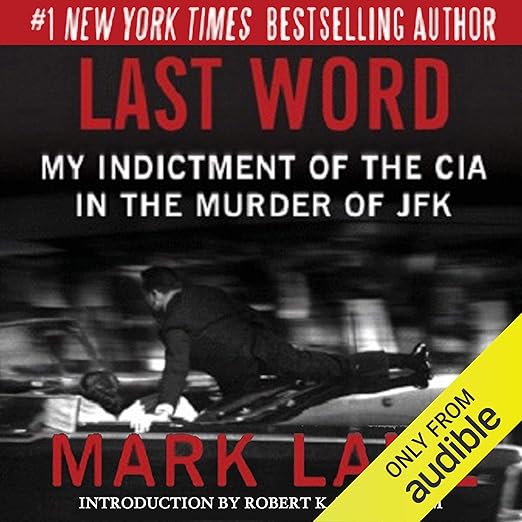
Dealey Plaza sits at the center of this audiobook the way it sits at the center of every book Mark Lane wrote about the Kennedy assassination, not as a backdrop but as the specific physical puzzle Lane spent decades trying to solve. Last Word is framed, in the book's own description, as his final and most complete argument: that the CIA orchestrated the murder of President Kennedy and controlled the movements of police and Secret Service personnel on the ground that day. Lane, a New York Times bestselling JFK historian, is described as the attorney behind the only US court case in which jurors concluded the CIA was involved in the assassination plot, and he builds his case here through new interviews, Oliver Stone, Dallas Police deputy sheriffs, Robert K. Tanenbaum, and Abraham Bolden, rather than simply restating decades-old material.
The strongest material here is procedural rather than speculative: sworn Warren Commission testimony from a police officer who drew his gun on a man claiming Secret Service credentials, credentials the Secret Service later denied issuing to anyone on foot in Dealey Plaza that day. Lane builds his argument brick by brick from documented contradictions like this one rather than leaning purely on inference, and reviewer Jeff Marzano specifically credits the book with adding 'fascinating and important details' beyond what he'd already read elsewhere in the JFK-conspiracy literature, including material that directly engages Vincent Bugliosi's massive 1,600-page rebuttal, Rewriting History.
Reviewer Dennis R. Wilkins offers the most useful frame for going in: three things the book does well, three things worth knowing before you commit, a balance worth holding onto here too, since the case Lane makes depends entirely on whether a listener already accepts his premise that the Warren Commission's lone-gunman conclusion is wrong. For listeners who do, Georges Melki's review captures the appeal directly, arguing Lane 'proves without any reasonable doubt' that the single-shooter account is untenable. For listeners approaching the material skeptically, the book reads less like proof and more like Lane's closing argument in a case he built his entire career around.
Lane's career itself is part of the book's argument, whether a listener accepts that or not: he worked as a young attorney before becoming one of the earliest and most persistent critics of the official assassination investigation, and Last Word arrives as the capstone of roughly five decades spent building the same case across multiple earlier books, including Rush to Judgment. That long personal history gives the book a different weight than a first-time author's theory would carry, whatever a listener ultimately concludes about the underlying claims; this is someone who spent an entire career, not a single research sprint, assembling this specific argument.
Testimony Read Aloud Mimics a Case Argued
At just under twelve hours, Last Word has room to walk through testimony and cross-reference documents in a way a shorter true-crime treatment couldn't, and audio narration suits this kind of material better than skimming a page of citations might, since a narrator reading testimony aloud, in sequence, mimics something closer to hearing a case argued in court, appropriate given Lane's own background as a trial attorney. Narrator Mark Boyett's job here is largely to stay out of the way of dense factual material without letting it go flat, keeping momentum through interview transcripts and procedural detail across eleven-plus hours.
The interviews Lane conducted specifically for this book, Oliver Stone among them, give it a different texture than a straight archival rehash. Stone's own JFK film looms over any conspiracy-adjacent JFK book published since, and hearing him discussed directly by Lane rather than referenced secondhand gives this entry a more current, engaged feel than older Lane titles covering the same ground. Abraham Bolden, the first Black Secret Service agent assigned to a presidential detail, adds a firsthand institutional perspective that a purely document-based account wouldn't have access to.
The book's structure, moving between sworn testimony, contemporary interviews, and Lane's own analytical framing, asks a narrator to shift register cleanly between quoting a document verbatim and stepping back into Lane's own argumentative voice, without blurring the line between the two for the listener. That distinction matters more in a book like this than in most true crime, since the persuasive power of Lane's case rests on a listener being able to tell exactly which claims come from primary source testimony and which come from Lane's own interpretation of it, a line the narration has to keep audibly clear across almost twelve hours.
Bugliosi Gets Referenced Mostly to Be Rebutted
This book takes a clear, committed position on one of the most contested claims in American history, and it does not present the CIA-involvement theory as one option among several; it argues it as settled fact. Listeners should go in aware they are hearing Lane's case for the prosecution, not a balanced survey weighing his argument against the Warren Commission's official findings or against critics like Bugliosi, whose own 1,600-page counterargument gets referenced here mostly to be rebutted rather than fairly represented.
Dennis R. Wilkins' review structure, three good observations, three bad ones, is worth taking as a genuine guide rather than a formality, since even a five-star reviewer sympathetic to Lane's overall project found real weaknesses worth naming specifically. The density of names, committees, and cross-referenced testimony across eleven-plus hours also asks more sustained attention than a casual listen accommodates; this rewards a listener taking notes or already familiar with the broad outline of Warren Commission history, more than someone coming to the JFK case entirely cold.
A Closing Argument Built to Preempt Counterarguments
This is for listeners already engaged with JFK assassination research who want Lane's culminating argument, built from new interviews rather than a repackaging of his earlier books, and for anyone specifically interested in institutional and procedural questions, chain of command, credential fraud, testimony gaps, rather than broader cultural mythology around the assassination. True-crime listeners drawn to legally-minded, testimony-heavy nonfiction will find Lane's attorney background shaping the argument's structure throughout.
Listeners drawn to attorney-authors generally, writers who bring courtroom logic and cross-examination instincts to nonfiction argument, will recognize Lane's method even if they disagree with his conclusions; the book reads structurally like a closing argument built to anticipate and preempt specific counterarguments, a rhetorical discipline distinct from how most journalist-authored conspiracy nonfiction gets built. Listeners who've followed Lane's earlier books, particularly Rush to Judgment, will find this functions as a genuine capstone rather than a repackaging, since the new interviews and more recent research give familiar readers real reason to return for one more pass through material they may think they already know.
Readers seeking a neutral historical overview, or one that fairly represents the case against Lane's own conclusions, should look elsewhere, since this audiobook is unapologetically an advocate's closing statement rather than a balanced inquiry. Anyone who finds the broader CIA-assassination theory implausible going in is unlikely to be moved by eleven-plus hours built on the premise that it's already proven.