Quick Take
- Narration: Jennifer Vuletic’s Australian accent grounds this colonial New South Wales story in a voice that feels native to the material, and her precision in the courtroom passages is among the performance’s best qualities.
- Themes: The law as a gendered instrument, women’s suffrage as a fight for procedural fairness, the unknowability of certain crimes
- Mood: Measured and quietly outraged, legal history with a feminist spine
- Verdict: A model of how to write true crime that takes the social history as seriously as the case, and refuses to resolve what cannot be honestly resolved.
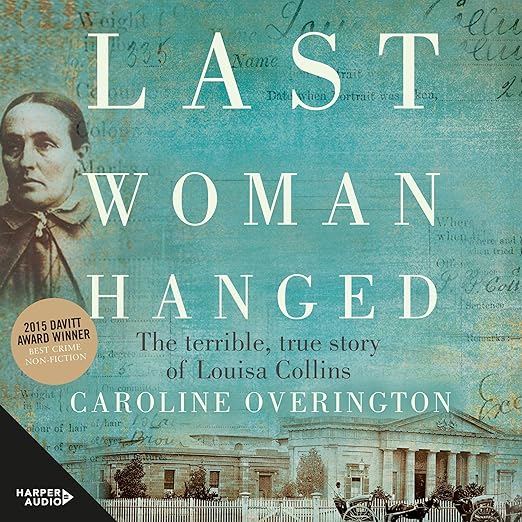
I spent an afternoon with Last Woman Hanged while doing something domestic and forgettable, and what struck me was how Caroline Overington uses the classic true crime structure, the case, the trial, the execution, and then keeps asking questions the genre normally considers closed. Was Louisa Collins guilty? Overington genuinely does not know, and she has the honesty to say so, on the page and through Jennifer Vuletic’s narration, across nine and a half hours. That refusal is what makes this book more than a crime narrative.
Louisa Collins was forty-one, a mother of ten, twice widowed, and hanged at Darlinghurst Gaol in January 1889. Both her husbands died of what the Crown asserted was arsenic poisoning. She was tried four times, an extraordinary and legally questionable sequence, before a conviction was obtained. The evidence was substantially circumstantial. Her ten-year-old daughter May was called to testify against her. If you needed a case that concentrated nearly every dimension of Victorian legal injustice toward women into a single file, this is it. Overington assembles the record with forensic care and presents it with the literary quality that her eleven previous books, fiction and nonfiction, have established.
The Four-Trial Structure and What It Tells You
The four-trial sequence is the book’s most legally striking element, and Overington devotes careful attention to it. The legal community at the time was itself uncomfortable with the process; multiple retrials of a defendant to overcome acquittals and hung juries has a coercive quality that even 1880s legal culture could recognize. Overington documents the objections that were raised, from within the judiciary and from commentators, without presenting them as decisive. The process ground on regardless. On the fourth trial, a conviction was finally obtained.
Vuletic handles the courtroom passages with precision. She is particularly effective with the testimony sections, where the adversarial structure of Victorian cross-examination, which was not designed to protect witnesses the way modern procedure attempts to be, comes through in the transcript reproductions. May Collins’s testimony is one of the more affecting passages in the book, a ten-year-old child being walked through questions about her mother’s household practices, with consequences the child could not have fully understood.
The Women Who Organized Around What the Law Would Not Give Them
Overington is explicit about her purpose: Last Woman Hanged is also a letter of thanks to the generation of women who organized to oppose Collins’s execution and who used the case to advance arguments for women’s legal equality. They could not vote, could not stand for parliament, could not sit on juries. A legal system comprised entirely of men was deciding whether a woman should hang. That structural critique, which the organized women of 1889 articulated clearly, was not powerful enough to save Louisa Collins. It was, eventually, powerful enough to change the law.
Overington traces this thread with the care it deserves. The women who petitioned and organized in 1889 were working within a suffrage movement that would achieve the vote in New South Wales in 1902, among the first in the world. Collins’s case was not the cause of that outcome, but it was one of the pressures that built toward it.
A Davitt Award Winner That Earns the Designation
The book won the 2015 Davitt Award for Best Crime Book in the nonfiction category, and reading it makes clear why. One reviewer described it as presenting all sides of the issue and providing a careful appraisal of Collins’s alleged crimes without landing a verdict. A review in the Sydney Morning Herald called it a useful challenge to any tendency to simple moral indignation, which is probably the most accurate critical summary. The evidence for Collins’s guilt is real but not conclusive. The evidence that the process was contaminated by gendered prejudice is overwhelming. Holding both of those simultaneously is the work the book demands, and Vuletic’s narration delivers it without leaning toward resolution.
Who Should Listen and Who Should Skip
Last Woman Hanged is essential for listeners interested in Australian colonial history, legal history, or the history of women’s suffrage. It works equally well as true crime for listeners who want more than genre satisfaction. Vuletic’s narration is among the better performances in this genre space, grounded by an Australian accent that is a genuine asset for colonial material.
Skip it if you need a verdict. Overington’s even-handedness is a strength but also a demand. She will not tell you whether Louisa Collins killed her husbands, because she honestly does not know. The 297 ratings and 3.9 average reflect a split that Overington herself anticipated: some readers come for true crime resolution and leave frustrated; others come for legal and social history and find the book exceeds their expectations. The Davitt Award nomination is the better guide to quality here. Vuletic’s performance across nine and a half hours is sustained and consistent, and she handles the shift between Overington’s analytical prose and the quoted testimony and newspaper extracts with a naturalness that keeps the textual variety from feeling jarring.
Frequently Asked Questions
Does Last Woman Hanged conclude that Louisa Collins was guilty or innocent?
Deliberately not. Overington presents the evidence on both sides and argues that certainty is not available at this historical distance. The book’s argument is that regardless of Collins’s guilt, the process that condemned her was fundamentally unjust.
Why was Louisa Collins tried four times?
The Crown was unable to obtain a conviction in the first three trials, which resulted in acquittals or hung juries. The decision to continue retrying her was legally controversial at the time and remains so. Overington documents the legal community’s discomfort with the process extensively.
What role did Collins’s daughter May play in the trials?
May Collins, who was ten years old, was called to testify about her mother’s household practices. Her testimony was among the prosecution’s key evidence. Overington covers the ethical dimensions of using a child’s testimony against her parent in a capital case with appropriate care.
Is Jennifer Vuletic’s Australian accent authentic to the colonial New South Wales setting?
Yes, and it is one of the narration’s genuine strengths. Vuletic’s accent and cadence ground the story in its colonial Australian context in a way that an American or British narrator would not achieve as naturally.