The Short Version
- Read by: Julia Whelan handles a large three-generation ensemble with real skill, even outside the literary restraint she's best known for.
- At its heart: family legacy, generational conflict, nostalgia
- Vibe: Warm and comedic
- Short version: A charming multigenerational family comedy best suited to listeners who enjoy a big cast over a tight focus.
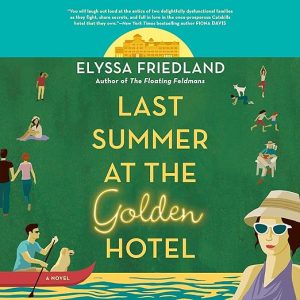
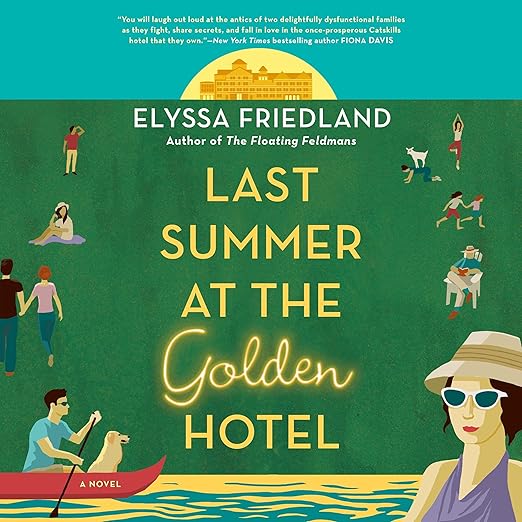
Two families who built a Catskills resort together over sixty years are forced back into the same rooms by a tempting sale offer, and this audiobook spends nine hours and twenty-six minutes watching six decades of buried grievances resurface at exactly the wrong moment. Elyssa Friedland's Last Summer at the Golden Hotel follows the Goldmans and the Weingolds, business partners and best friends whose glamorous resort has fallen into disrepair, as grandparents, parents, and millennial grandchildren all stake competing claims on what should happen next. The synopsis pitches it directly at fans of Dirty Dancing and The Marvelous Mrs. Maisel, and the comparison sets expectations accurately for the tone throughout. Sixty years of shared history between the two families means every argument in the present carries the weight of decades of unspoken resentment and genuine affection both.
Julia Whelan narrates a book that needs to move fluidly between comedy and real family wound-licking, and her catalog gives real reason for confidence here: she is established across both literary fiction, where reviewers have praised her precise emotional restraint, and contemporary commercial fiction, where she is one of the format's most prolific and recognized voices. A sprawling two-family ensemble spanning three generations is a genuine test of range rather than restraint alone, since grandparents, parents, and grandchildren all need distinct enough voices that a listener never loses track of whose scene it is, and that differentiation challenge sits slightly outside the register Whelan is most often praised for.
Courtney's review calls it a 'breath of fresh air' book picked up on a friend's recommendation from author Jane Rosen, and that word-of-mouth discovery path fits a book that leans on charm rather than marketing muscle to find its readers. Jamie's review, docking it slightly to an actual 4.25 stars, still calls the book 'uproariously funny' and filled with family drama and secrets, which is about as honest a mixed-positive reaction as this kind of ensemble comedy tends to get.
The synopsis credits Friedland as 'the acclaimed author of The Floating Feldmans.' That is a reputation cue rather than a plot connection, and it is the kind of author credential that signals a track record with exactly this flavor of family-ensemble comedy rather than a one-off experiment in the genre. Listeners unfamiliar with Friedland's other work can take the repeated best-of-summer accolades listed in the synopsis, from Good Morning America to Bustle to PopSugar, as a more immediate signal of how her books tend to land with a wide readership.
What Makes Last Summer at the Golden Hotel Worth Hearing
Ryan Hogan's review makes an unexpected case for the book's setting itself: previously unfamiliar with the Catskills as a real vacation history, Hogan became genuinely interested in that history after watching a comparable television show, then encountered this book through a book club and found real personal connection despite starting as an outsider to the culture. That is a meaningful signal for anyone hesitant to pick up a book this specifically rooted in one community's history: the emotional material, family loyalty, generational conflict, and holding onto a fading place, travels well beyond its specific setting.
The synopsis promises long-buried secrets, financial scandal, and a genuine question of whether the Golden can be saved at all, and Jamie's review confirms the execution matches that pitch, calling it 'FILLED with lots of family drama and secrets' and describing it as held together by the walls of a fading, once-grand resort. Business and pleasure clash deliberately throughout, per the synopsis's own framing, which keeps the comedy from floating free of real stakes: someone's actual inheritance and livelihood are on the table alongside the nostalgia.
The Golden's history as a genuine celebrity draw for more than sixty years gives the family's current predicament real weight: this is not a struggling business searching for its first success; it is a fading landmark whose owners remember exactly how glamorous it used to be, which sharpens both the comedy and the grief running underneath it. That kind of decline-of-a-golden-age setting has real resonance for any reader with a family business or vacation spot of their own that has seen better days.
Things to Know Before Starting Last Summer at the Golden Hotel
Only three ratings currently sit on this listing, a genuinely small sample for a book that collected a Good Morning America Buzz Pick nod, a Skimm can't-miss-beach-read tag, and best-of-summer honors from both Bustle and PopSugar in its actual release year. That gap likely reflects how this specific audiobook edition has been rated and reviewed rather than anything about the book's broader reception, but listeners who weight a large rating pool heavily should know the sample here is thin regardless of the accolades surrounding the print release.
This is a large ensemble cast spread across two families and three generations, and listeners who prefer a tightly focused single-protagonist story may find the constant point-of-view shifting among grandparents, parents, and grandchildren takes real effort to track in audio, where no page exists to flip back to and confirm who is speaking. The comedy is also gentler than broad slapstick; the genuine family dysfunction running underneath the laughs means listeners wanting pure lighthearted escapism without emotional weight should adjust expectations.
The financial scandal the synopsis promises alongside the family secrets suggests real money is genuinely at stake beyond hurt feelings, and listeners expecting a purely sentimental nostalgia piece should know Friedland works actual business stakes, a resort in disrepair, a tempting sale offer, real financial pressure, into the emotional plot rather than keeping the money question in the background.
Who Elyssa Friedland Is Writing For
Multigenerational family sagas are the draw here, especially for listeners who enjoyed Friedland's earlier novel The Floating Feldmans or who want something in the emotional neighborhood of Dirty Dancing's Catskills setting without the dance numbers. Anyone who likes watching a large cast slowly reveal how much resentment and love can coexist inside one family business is exactly who this book was written for.
Every accolade in the synopsis, the Good Morning America pick, the Skimm and Bustle best-of-summer tags, frames this as beach-read comfort fiction, and listeners hoping for something with more literary ambition than a warm ensemble comedy should temper expectations accordingly. The family drama has real weight, but Friedland is working in a register built for enjoyment over edge, and readers who want their multigenerational sagas darker or more formally ambitious will find this stays comfortably inside beach-read territory throughout.
A Few Questions About Last Summer at the Golden Hotel
How many narrators does the Last Summer at the Golden Hotel audiobook use for its large cast?
Just one. Julia Whelan narrates the entire ensemble solo, which means listeners rely on her voice work alone to distinguish grandparents, parents, and grandchildren across two families.
Is the Last Summer at the Golden Hotel audiobook appropriate for a beach vacation listen?
Very much so. Its own marketing history as a Good Morning America Buzz Pick and Skimm can't-miss beach read points directly at that kind of casual, warm-weather listening.