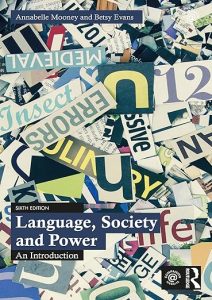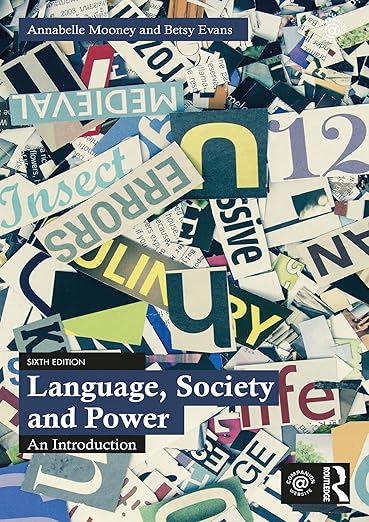
Language, Society and Power opens a question that this audiobook spends nearly twelve hours answering with real precision: how does the language we use reflect, reproduce, and sometimes challenge the social structures we inhabit? Annabelle Mooney's textbook, now in its sixth edition, has been a foundational text in linguistics and communication studies for years, and its translation into audio by Susan Osman represents an interesting test of what a well-crafted academic text can do in a listening format. The answer, it turns out, is considerable, particularly for students who absorb material more readily through hearing than through reading dense print.
The craft decision that makes this work for audio is the same one that has made the textbook durable in print across multiple editions: Mooney assumes no prior linguistic background among her readers. The conceptual architecture is built from the ground up, which means listeners approaching this without formal linguistics training are not disadvantaged. The book moves through its core questions, how language functions across age, ethnicity, class, and gender; how identity is constructed through speech; how media and political language shapes public understanding, with the careful scaffolding that allows each chapter to build on the previous one without demanding specialized vocabulary the reader has not yet encountered.
Sixth Edition Tackles Fake News and COVID Language
What elevates this beyond standard linguistics survey material is the sixth edition's expansion into territory that feels genuinely contemporary rather than archival. The revised chapters on politics and media now address environmentalism as a discourse zone, the politics of consumer choice, the role of social media in political activism, and the evolving language of surveillance. The coverage of fake news as a linguistic phenomenon, gender fluidity and representation debates, and COVID-19's documented effect on linguistic change gives the book a present-tense relevance that earlier editions could not fully anticipate.
The question of whether identity is constructed or expressed through language is one Mooney handles with appropriate nuance throughout. Rather than committing to a single theoretical position, she presents the major frameworks, performativity, social constructionism, indexicality, in a way that actively encourages listeners to develop their own analytical instincts rather than simply adopting hers. This is pedagogy that builds critical thinking rather than transmitting settled conclusions. The companion website exercises extend this analytical work, though that resource is obviously print-adjacent rather than audio-accessible.
The book's decision to address surveillance language and the linguistics of protest and activism makes it more politically engaged than earlier editions. This is not a neutral posture, Mooney has perspectives on power and language that surface through her examples and framings, but the analytical tools she provides work whether or not readers share those perspectives, which is the mark of genuinely useful critical pedagogy.
Dense Academic Prose Works as an Audiobook
For a university student using this as a course text, the audiobook format offers the genuine advantage of absorbing dense academic prose in a mode that can accompany other activities, though the analytical complexity of some chapters will demand attentive listening rather than background play. The material on political discourse and media language is particularly rich territory for active listening, since Mooney's examples draw from real public language that listeners can verify against their own experience of political speech and news framing.
The book covers ground that crosses disciplinary boundaries naturally and productively. Students of communication, media studies, sociology, cultural studies, and psychology will all find frameworks here that connect directly to the central questions of their own fields. The decision to assume no linguistic background means the book functions as an accessible bridge between linguistics proper and these adjacent disciplines, making it genuinely useful for introductory coursework across multiple departments without sacrificing intellectual rigor.
Almost Twelve Hours That Demand Active Attention
With only four ratings in the system at the time of this review, there is minimal listener data to draw on. What can be said is that the print edition has a long track record as a university staple, which provides a solid basis for assessing the underlying content quality. The main challenge for audio listeners is the textbook structure itself: chapters are organized analytically rather than narratively, and the absence of a storyline to carry the listener forward means attention must be actively maintained across the eleven hours and fifty minutes. This is not a fault of the writing; it is simply the honest nature of academic text in audio form.
The companion website, which includes exercises, further reading, a Twitter resource directory, and supplementary videos, is referenced throughout the audio but obviously requires a separate device to access. Listeners using this as a primary course text will want to run the book alongside those digital resources. Listeners exploring the material purely out of personal interest may find the audio sufficient as a standalone experience.
Serious Value for Students Beyond Linguistics Class
Students enrolled in introductory linguistics, communication studies, sociology, or cultural studies courses will find this an accessible and well-organized course text that holds up in audio form. Curious non-specialists with a genuine interest in how language shapes political and social reality will also find it engaging, particularly the chapters on media language, political discourse, and identity construction in everyday talk. Listeners who need a purely narrative or case-study-driven approach may find the textbook structure demanding across nearly twelve hours. For everyone else, this is a serious and rewarding introduction to one of the more consequential questions in the contemporary social sciences.
The Short Version
- Narrator: Susan Osman handles the textbook's academic prose with a measured cadence that keeps the material accessible for listening without losing the precision the subject demands.
- Subjects: language as social force, identity construction through speech, media and political discourse
- Tone: Rigorous but genuinely accessible, with widening implications across every domain of daily life
- Bottom line: The sixth edition of this linguistics textbook translates well to audio for students and curious non-specialists who want a serious framework for thinking about how language shapes power.
Common Questions
Is this audiobook suitable for someone with no formal linguistics background?
Yes, explicitly. Mooney designs the book for students approaching language and society for the first time, assuming no prior linguistic knowledge. The conceptual framework is built carefully from first principles, which makes the audiobook accessible to curious non-specialists as well as first-year university students without disadvantaging either group.
Does the audiobook include the exercises and companion website content mentioned in the text?
No. The audio contains the full text of the sixth edition, but the companion website exercises, further reading links, and video resources are only accessible through the print or digital edition. Listeners using this for a course will need to access those supplementary materials separately alongside the audio.