In Brief
- Narration: Michel Thomas narrates his own method live with a real student, which is the pedagogy itself, not just delivery.
- Themes: interactive language building, spoken-only instruction, sentence construction without rote memorization.
- Mood: Calm, patient, session-paced rather than lecture-paced.
- Verdict: A genuinely interactive French course best suited to learners who have already finished the Foundation level and want to build on it.
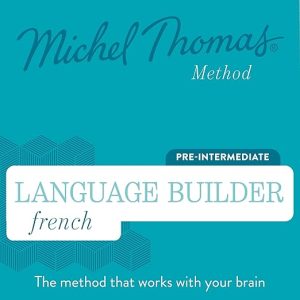
Michel Thomas spent fifty years decoding how languages actually work before he ever put a lesson plan on paper, and this audiobook is one of the results: a two-hour, one-to-one French seminar built entirely around spoken interaction rather than a textbook. The premise of Language Builder French, the second course in the five-part Michel Thomas Method sequence, is disarmingly simple. No writing, no memorizing, no homework, just a teacher prompting a student to construct sentences from building blocks until the construction becomes instinct.
The audiobook format is not incidental here; it is the entire mechanism. Thomas built his method on the idea that a learner absorbs structure by hearing it applied in real time and responding out loud, which is precisely what a printed grammar guide cannot replicate. The Times called the approach 'painless learning,' the Daily Telegraph said it 'works like a dream,' and Time Out claimed 'five minutes in and you already feel like you're winning,' three notices that all land on the same core claim: momentum arrives fast.
Withholding Conjugation Tables Until You've Earned Them
Language Builder French earns its reputation by staying disciplined about what it is not trying to do. This is not a vocabulary flashcard app dressed up as audio, and it is not a grammar lecture with French examples bolted on. It is a genuine two-way seminar, recorded, where a real student pauses to think through an answer before Thomas confirms or corrects it, and the listener is invited to do the same work in real time rather than passively absorb finished sentences.
Reviewer Joy S. describes listening 'while cooking etc,' reporting 'amazing progress from just repeating the phrases,' which is a genuinely useful data point about how forgiving the format is of a distracted or multitasking environment, a real advantage for an audio-only product over a workbook that demands a desk and a pen. Donald Crowter's review, titled 'A 2 disc supplement to introductory,' frames the course precisely as marketed: a builder that expands on the Foundation course using 'same pause think method,' not a standalone starting point.
The building-block philosophy is easiest to understand through what it deliberately withholds. A traditional classroom approach would hand a beginner a verb conjugation table and ask them to memorize it before ever forming a sentence. Thomas's method does the reverse: it gives a learner just enough raw vocabulary and structure to attempt a real sentence immediately, lets them work through constructing it out loud, and only then supplies the correction. The theory, borne out across five decades of Thomas's own teaching practice, is that a sentence built through genuine effort sticks in memory far more securely than one copied from a page, even when the first attempt is wrong.
Two Hours of Audio, Five to Six of Work
The single most important thing to understand before pressing play is that the listed runtime, 2 hours and 15 minutes, is not the actual time commitment. The course itself states plainly that learners should expect to spend 5 to 6 hours completing it, because the pause-and-respond design means a listener is meant to stop the recording, work out an answer, and only then continue. That is not padding or an inflated marketing estimate; it is the honest shape of an interactive method delivered through a medium that has no built-in pause prompts of its own.
Michel Thomas narrates the course himself, and that self-narration is not a nice-to-have; it is the pedagogy. The same principle that makes any strong personality-driven audio language method work applies here: the instructor's own pacing, patience, and manner of prompting a hesitant answer out of a real student is the actual lesson, not just the delivery vehicle for a script someone else could have read.
Thomas built this method's reputation over five decades of hands-on teaching before any of it was ever recorded for a mass audience, working with individual students face to face long before Language Builder French existed as a packaged product. That teaching-first pedigree is audible in how the course is paced: this is not a script written by a curriculum committee and read cold by a hired voice; it is a genuine record of Thomas's own developed classroom instincts, licensed here through Hodder and Stoughton and still selling on the strength of a method built decades before anyone thought to put it on disc.
Seventeen Ratings Praise Momentum Over Promised Fluency
Language Builder is explicitly the second entry in a five-part sequence, Foundation, Language Builder, Intermediate, Vocabulary Course, and Insider's, and the synopsis is direct about needing Foundation French first. A listener starting with zero French and no prior Foundation course exposure will find this course assumes vocabulary and sentence patterns it does not re-teach from scratch, so the honest recommendation is to start one course earlier if this is a first exposure to the language.
An accompanying PDF is included with purchase, and while the entirely oral design means the PDF is not required to follow the seminar itself, listeners who want a written reference for spelling or later review should download it rather than rely on audio memory alone. With only 17 ratings behind its 4.6 average, this is also a lower-visibility title than the flagship Foundation course, worth knowing before assuming the review base reflects wide market testing.
The press blurbs quoted directly in the synopsis are worth reading carefully rather than taken at face value, since a claim about momentum and confidence is not the same as a claim about achieved fluency. This course, like the method generally, is built to make a learner feel capable quickly, a real and valuable psychological effect for anyone discouraged by slower traditional classroom instruction, but early confidence is not the same promise as fluency after the full sequence, and Language Builder specifically is honest about being one building-block stage in a longer five-course arc rather than a complete solution on its own.
Cooks and Commuters Who Already Know Basics
Learners who have already completed the Foundation French course, or who otherwise have a working beginner vocabulary, are the clear intended audience, and Joy S.'s account of building real confidence in making herself understood suggests the method delivers on that specific promise. Commuters, cooks, and anyone who learns better by producing language out loud than by reading it silently will likely find the format's demands a genuine fit rather than a friction point.
Complete beginners with no prior French exposure need the Foundation course first, not this one, since Language Builder is built to widen and reinforce vocabulary rather than introduce it from zero. Listeners who prefer explicit grammar rules laid out and labeled, rather than absorbed through guided sentence-building, should also know this method deliberately avoids that approach by design.