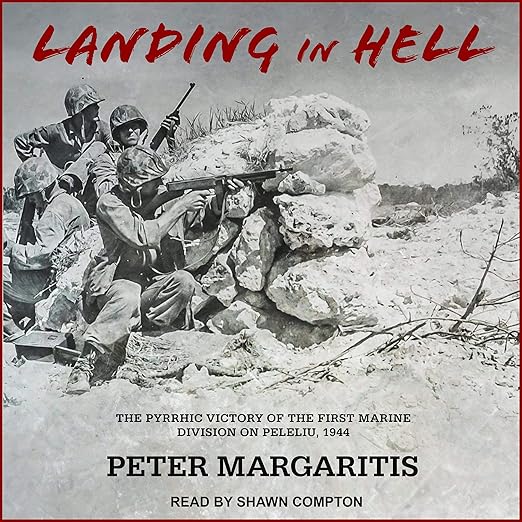
Quick Take
- Narration: Shawn Compton delivers the precise, measured register that military operational history requires, no dramatizing, sufficient pace, clear pronunciation of tactical terminology.
- Themes: Command failure, the price of strategic miscalculation, institutional accountability
- Mood: Analytical and sobering, with moments of genuine horror at the human cost
- Verdict: The most rigorous analysis of the Peleliu campaign available in audio, Margaritis corrects earlier accounts while being honest about what remains contested.
I was about three hours into Landing in Hell when I found myself reaching for a legal pad, which doesn’t happen often with audiobooks. Peter Margaritis builds his case against the conventional Peleliu narrative the way a prosecutor would, methodically, with specific evidence, willing to say exactly where the older accounts went wrong and why. By the time you understand what he’s arguing about General Rupertus and the command decisions that turned a potentially manageable operation into the most costly per-capita engagement in Marine Corps history, you’re taking notes because you don’t want to lose the thread.
The Battle of Peleliu, September to November 1944, a tiny Pacific island at the southern end of the Palau chain, has been written about before. Eugene Sledge’s With the Old Breed is the most celebrated account, a first-person memoir of the 1st Marine Division’s experience there that stands among the best WWII memoirs ever written. But Sledge was writing from within the experience, not analyzing the decisions that produced it. Margaritis is doing something different: he is working backward from the casualty figures to ask who decided what, when, and whether those decisions were defensible. His answers are not comfortable.
Where the Earlier Accounts Went Wrong
The book’s stated ambition is to correct several earlier accounts of the Peleliu campaign, and Margaritis delivers on this most clearly in his treatment of General William Rupertus. Rupertus’s famous prediction that Peleliu would fall in four days, a week at most, has been treated variously as overconfidence, intelligence failure, and institutional pressure from MacArthur’s timeline for the Philippines invasion. Margaritis pulls apart the decision-making chain with enough specificity to show exactly where each failure occurred and who bears responsibility for which element of it.
A reviewer who describes himself as a deep student of the battle, specifically noting Margaritis’s treatment of Rupertus as the most illuminating he’s encountered, captures what the book does best. The question of why Rupertus kept the infantry attacks coming in the sledgehammer pattern that maximized Marine casualties against Japanese defensive positions specifically engineered to absorb frontal assault is the moral center of the analysis. Margaritis doesn’t exonerate Rupertus, but he contextualizes him within a command environment that was itself flawed, which is a more honest accounting than simple condemnation.
The Presidential Summit and What It Determined
One of the book’s most valuable contributions is its coverage of the summit between Roosevelt, MacArthur, and Nimitz that determined the Peleliu operation’s place in Pacific strategy. This context is often compressed or absent in accounts focused on the ground battle, and Margaritis makes a genuine argument that understanding the operation’s strategic rationale, and its contested necessity, is essential to evaluating the command decisions that followed.
The book includes detail on the new weapons deployed at Peleliu, the specifically new Japanese defensive strategy (the shift from banzai charges to deep cave fortifications designed to maximize attacker casualties), and the ways in which American intelligence failed to anticipate this tactical evolution. These elements give the analysis operational depth that goes beyond individual command critique. The new Japanese defensive doctrine, replacing the banzai charge with a labyrinth of interconnected cave fortifications designed to absorb assaults and inflict maximum casualties on attackers, was not merely a tactical shift. It was a strategic calculation that the island’s terrain and the Japanese command’s knowledge of it made uniquely lethal. The Umurbrogol Pocket, the network of ridges and caves at Peleliu’s center, became a killing ground that the 1st Marine Regiment’s frontal attacks could not reduce without the kind of losses that took the division out of action for half a year. The battle emerges as a convergence of multiple failures rather than one commander’s culpable error, which is both more accurate and more troubling.
The Debate About Necessity
A reviewer who disagrees with Margaritis’s conclusion about the invasion’s necessity, arguing that it was not required to protect the Philippines invasion, illustrates something important about this book: it presents a defensible argument and acknowledges where that argument remains contested. Some historians and veterans have maintained that Peleliu served no strategic purpose sufficient to justify its cost. Margaritis argues the strategic case for the operation while documenting the operational failures that made it catastrophic. Listeners will find the evidence to form their own view, which is the mark of rigorous rather than advocacy-driven military history.
Shawn Compton’s narration handles this material with appropriate authority. Military history requires a narrator who can deliver tactical information clearly and maintain analytical precision across hours of operational detail without losing momentum. Compton does this competently throughout the ten-hour runtime.
For Operational History Readers and Those Who Came for the Ground Fight
Listen to this if you have read Sledge or encountered the Peleliu story through Ken Burns’s The War and want the command-level analytical framework to sit behind that ground-level experience. The two approaches complement each other directly: Sledge gives you what it felt like; Margaritis gives you why it happened.
Skip this if you’re looking for personal testimony, vivid combat narrative, or the kind of ground-level intimacy that the best WWII memoirs provide. Landing in Hell is operational and analytical history. It explains the Battle for Peleliu; it doesn’t recreate it. For listeners who want both, reading Sledge first and then Margaritis is a logical sequence.
Frequently Asked Questions
Is this a good starting point for learning about the Battle of Peleliu, or is prior knowledge needed?
Margaritis provides sufficient historical context for readers coming to Peleliu fresh, the strategic situation in the Pacific, MacArthur’s Philippines timeline, the specific geography and layout of the island. That said, readers who have already encountered the battle through Eugene Sledge’s With the Old Breed or Ken Burns’s The War will find the analytical layer significantly more resonant.
Does the book engage with the Sledge memoir, or is it a standalone analysis?
The book operates independently of Sledge, focusing on command decisions and strategic context rather than ground-level experience. But it directly addresses the historiography of Peleliu and corrects what Margaritis views as errors in earlier accounts, Sledge’s perspective is part of that record, though the book’s primary targets are strategic and operational histories.
How does Margaritis treat General Rupertus, is this primarily a condemnation of his leadership?
Margaritis is more precise than that. He documents specific command failures attributed to Rupertus while contextualizing them within broader intelligence failures, strategic pressure from MacArthur’s timeline, and the Japanese tactical evolution that no American commander had fully anticipated. One reviewer, identifying himself as someone who has read more Rupertus material than anyone he knows, calls this the most illuminating treatment he has encountered.
Does the book address the argument that the Peleliu operation was strategically unnecessary?
Yes, directly. Margaritis makes the case that the operation served a genuine strategic purpose in protecting the Philippines invasion, while at least one reviewer with military background disagrees with that conclusion. The book presents sufficient evidence for listeners to evaluate the strategic debate themselves, which is part of what makes it more rigorous than hagiographic military history.