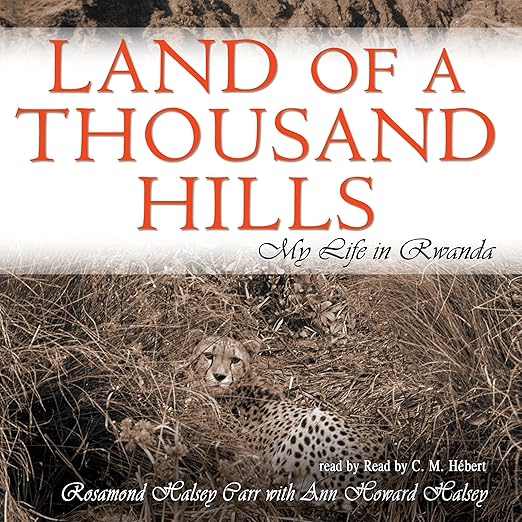
Quick Take
- Narration: C. M. Hébert delivers a measured, respectful performance that suits the memoir’s retrospective tone, though some listeners may find it slightly cool for such emotionally charged material.
- Themes: Colonial Africa and its aftermath, personal resilience, witness to genocide
- Mood: Reflective and deeply humane, building toward something devastating
- Verdict: One of the most quietly extraordinary Africa memoirs in audio, essential for anyone drawn to first-hand accounts of Rwanda’s twentieth century.
I came to this one during a stretch of evenings when I had been reading widely around the 1994 Rwandan genocide, trying to understand through multiple lenses what historians call one of the fastest mass killings in recorded history. I had absorbed the journalism, the policy analyses, the survivor testimonies. What I hadn’t yet found was someone who had simply been there, across all of it, for decades. Rosamond Halsey Carr had. She arrived in Central Africa in the 1940s as a New York fashion illustrator, the least likely figure for such a life, and she never truly left. Land of a Thousand Hills is what she made of those fifty years.
The audiobook runs just over ten hours, and I found myself rationing it, not wanting it to end. C. M. Hébert reads with steady composure, which initially I worried might flatten Carr’s prose. But Hébert’s restraint turns out to be the right choice. This is a book that earns its emotional weight through accumulation, not crescendo, and a narrator who pushed harder would have undercut that effect.
A Life Built in the Wrong Order
What strikes you early is the sheer improbability of Carr’s trajectory. A Manhattan woman in her thirties, married to a hunter-explorer, lands in the Belgian Congo. Divorce leaves her stranded, practically speaking, in neighboring Rwanda. Rather than retreat, she takes on the management of a flower plantation in the Mugongo hills. The book’s first half covers this period with unhurried attention to the rhythms of colonial life: the beauty of the landscape, the complicated relationships between European settlers and Rwandan workers, the particular texture of a life built on someone else’s land.
Carr is honest about the paradoxes of her position without performing guilt in the way contemporary memoir often demands. She loved Rwanda fiercely and understood, perhaps late, that the structures she benefited from were extractive and unjust. The book does not resolve that tension so much as sit inside it, which feels more truthful than resolution would.
Dian Fossey as She Actually Was
One of the book’s unexpected pleasures is its portrait of Dian Fossey, who was Carr’s neighbor and friend in the hills near the Virunga volcanoes. One reviewer called Fossey “a very complex person,” and the book earns that description. Carr knew Fossey before the fame, watched the obsession with the mountain gorillas intensify into something that pushed people away, and was present in the aftermath of Fossey’s murder. The portrait is neither hagiographic nor sensationalist. It is the account of someone who actually knew her, and it corrects the flatness of both the documentary record and the Hollywood version.
This section alone would justify the listen for anyone who has spent time with Gorillas in the Mist and wondered about the human being behind the conservation legend.
The Genocide in the Voice of a Woman Who Was There
The book’s final section, covering the 1994 genocide, is where the restrained narration earns its full meaning. Carr was eighty-two. She had already seen colonialism, independence, coups, and the grinding ethnic violence of the preceding decades. What she witnessed in April and the months following falls into a different register entirely. The synopsis’s phrase “unparalleled first-hand account” is not marketing language. Carr was present in a way almost no Western observer was, known and trusted by both communities, and her account of those months carries an authority that more distanced journalism cannot replicate.
Hébert’s steadiness through this material is exactly right. The horror needs no amplification. What it needs is exactly what Carr provided: a witness who had spent fifty years earning the right to say what she saw.
The book ends with Carr, at eighty-two, establishing an orphanage for children who survived the genocide. A reviewer noted that this felt inspirational, and I understand what they mean, though the word undersells it. After everything Carr witnessed, the decision to stay and build something was not optimism. It was a more complicated act of faith than that word suggests.
Who Should Listen, Who Should Skip
This audiobook is for listeners who want Africa memoirs grounded in specific, credible experience rather than safari adventure or humanitarian voyeurism. It pairs naturally with Philip Gourevitch’s We Wish to Inform You That Tomorrow We Will Be Killed with Our Families for those building a fuller picture of Rwanda’s twentieth century. If you come specifically for the 1994 events, note that the genocide section, while powerful, is one part of a much longer life story, and the earlier decades are equally worth your time. Skip this if you need narrative propulsion or dramatic pacing; Carr’s memoir moves at the pace of memory, not plot.
Frequently Asked Questions
Does the audiobook cover the 1994 genocide directly, and how graphic is that section?
Yes, Carr provides a first-hand account of the genocide and its immediate aftermath. It is emotionally devastating but not gratuitously graphic. She writes from the perspective of someone who knew the victims and perpetrators personally, which gives the account a weight that clinical reportage cannot match.
How much of the book deals with Dian Fossey?
Fossey appears throughout several chapters as Carr’s neighbor and friend in the Virunga hills. The portrait is candid and more complex than most accounts, covering the friendship, the increasing isolation, and Fossey’s death. It is not the book’s primary focus, but it is one of its most memorable threads.
Is this audiobook suitable as an introduction to Rwandan history, or does it assume prior knowledge?
It works well as an introduction precisely because Carr embeds historical events in lived experience. You will absorb the context of Belgian colonialism, independence, Hutu-Tutsi tensions, and the genocide through a personal narrative rather than a textbook framework. Listeners with prior knowledge will find additional layers, but it is entirely accessible without background.
Is C. M. Hébert’s narration a good match for Carr’s prose style?
Hébert reads with composure and clarity that suits Carr’s measured, retrospective voice. Listeners expecting an emotionally expressive performance may initially find the approach cool, but the restraint ultimately serves the material. Carr’s prose earns its impact through understatement, and Hébert understands that.