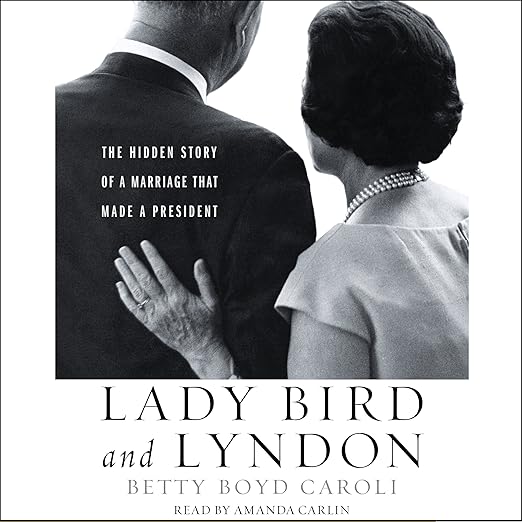
Betty Boyd Caroli spent seven years in the archives of the LBJ Library before writing Lady Bird and Lyndon, and the audiobook carries the density of that research without becoming inert under its weight. Caroli's central argument is deceptively simple: marriage is the most underreported story in political life. Her deeper argument is that in the case of Lady Bird and Lyndon Johnson, understanding the marriage is essential to understanding the presidency - because Lady Bird was not the passive, flower-preserving background figure that the conventional narrative has made her, but a strategist, a fundraiser, a campaigner in hostile territory, and the person who kept a deeply troubled man functional enough to govern.
The conventional story Caroli sets out to revise goes like this: Lyndon Johnson married Lady Bird Taylor for her money, humiliated her throughout their marriage by conducting affairs openly, and left her a legacy defined by environmental aesthetics while he defined history. What Caroli finds in the never-before-released letters between them, and in dozens of interviews conducted for the project, is a marriage far more reciprocal and far more consequential than that version allows. Lady Bird was not a victim of Lyndon's behavior. She was a negotiator who understood exactly who she had married and made strategic choices accordingly.
Iron Fist in a White Glove
Caroli frames the relationship from its beginning with unusual psychological specificity. Lady Bird grew up the daughter of a domineering father and a cultured but fragile mother - a formation that, Caroli argues, prepared her for the particular challenges of being partnered with a man like Lyndon Johnson. When a "tall, pushy Texan" showed up and they married within weeks, the speed that looks impulsive in hindsight was, in Caroli's reading, the result of a tacit and clear-eyed negotiation: she would accompany an extraordinary political talent; he would take her out of a world she needed to leave. That original compact shaped everything that followed.
The political material is where the book is most revisionary. Caroli documents Lady Bird's role in specific high-stakes moments - swooping in to secure a critical donor, keeping the team united during Lyndon's paralytic dark moods, barnstorming through hostile territory during the 1964 campaign when Lyndon was unwilling or unable to do it himself. These are not anecdotes about a supportive spouse. They are accounts of political intervention at the level of strategy. Caroli's phrase, "an iron fist in a white glove," borrowed from Vanity Fair's review, is not flattering in the conventional sense - it suggests both capacity and concealment, which is precisely her point.
Carlin's Quiet Authority Waits for Earned Emotion
Amanda Carlin's narration suits the material in the way that the best narrator-to-content pairings do: without drawing attention to itself. She reads with a quiet authority that matches Caroli's prose - measured, clear, never pushing toward emotion that the text hasn't yet earned. The sixteen-hour runtime covers an enormous amount of archival ground, and Carlin keeps the pacing steady without sacrificing the texture of individual scenes. The letters between Lady Bird and Lyndon, in particular, receive a reading that respects their private quality - they feel like correspondence rather than quotation.
Caroli is a historian who has spent her career on First Ladies, and her expertise surfaces throughout in the comparative perspective she brings. Lady Bird is not evaluated in isolation but in the context of other political partnerships, other marriages that made or undermined presidencies. This gives the book a depth that purely biographical treatments sometimes lack: you understand not just who Lady Bird was but where she stands in the broader history of the role she occupied.
Seven Years of Archival Work, Now Visible
The book does not resolve the question of Lyndon Johnson's moral character in the way some readers might want. Caroli is neither an apologist nor a prosecutor. Lyndon emerges as what the historical record suggests he was: a man of extraordinary political gifts and significant personal failings, whose behavior toward Lady Bird was often difficult to square with any simple narrative of love or exploitation. Readers who come to the book with strong prior feelings about LBJ - either reverence for the Great Society legislation or condemnation of Vietnam and the personal conduct - will find those prior judgments complicated without being definitively overturned.
The never-before-released letters add genuine archival value to the project. Caroli does not use them merely as color. She reads them as primary documents that reveal the actual dynamics of the relationship in ways that public record and memoir do not. The letters are where the book makes its strongest claims, and where the evidence for the revisionist portrait is most directly present.
Seven years of archival work is visible not just in the letters themselves but in the texture of the book's secondary detail - the specific donor's name, the precise moment in the campaign, the internal team dynamic during a specific crisis. Caroli doesn't let this detail accumulate into catalog-style documentation. It moves; it builds; it characterizes. By the time she reaches the final years of the presidency and the weight of Vietnam on both Lyndon and Lady Bird, you understand the marriage well enough to feel what each of them was bearing, which is exactly what seven years of research for a sixteen-hour audiobook ought to produce.
Complicated Over Comfortable, With Carlin Steady Throughout
This audiobook rewards listeners interested in American political history, specifically the mid-twentieth century and the Johnson years, but also anyone interested in the architecture of political marriages and the way institutions like the presidency have historically relied on labor that went unacknowledged. Caroli's revisionist portrait of Lady Bird is not hagiographic - it's historically specific and clear-eyed about what Lady Bird chose and what she surrendered. Skip if you want a straightforward chronological biography with clean moral resolution. This book is more interested in the complicated than the comfortable, and Carlin's steady narration keeps that complexity in view across the full sixteen-hour runtime.
Questions Listeners Ask
Does this audiobook require prior knowledge of Lyndon Johnson's presidency to follow and appreciate?
Some familiarity with the broad outlines of LBJ's career is helpful - the Great Society legislation, Vietnam, the 1964 election - but Caroli provides enough context that listeners without deep background can follow the political narrative. The book is more about the marriage than the policy record.
What makes this audiobook different from other biographies of Lady Bird Johnson?
Caroli had access to never-before-released letters between Lady Bird and Lyndon, and she spent seven years in the LBJ Library archives. The revisionist argument - that Lady Bird was a key political strategist rather than a passive First Lady - is grounded in that primary source evidence rather than existing secondary literature.